
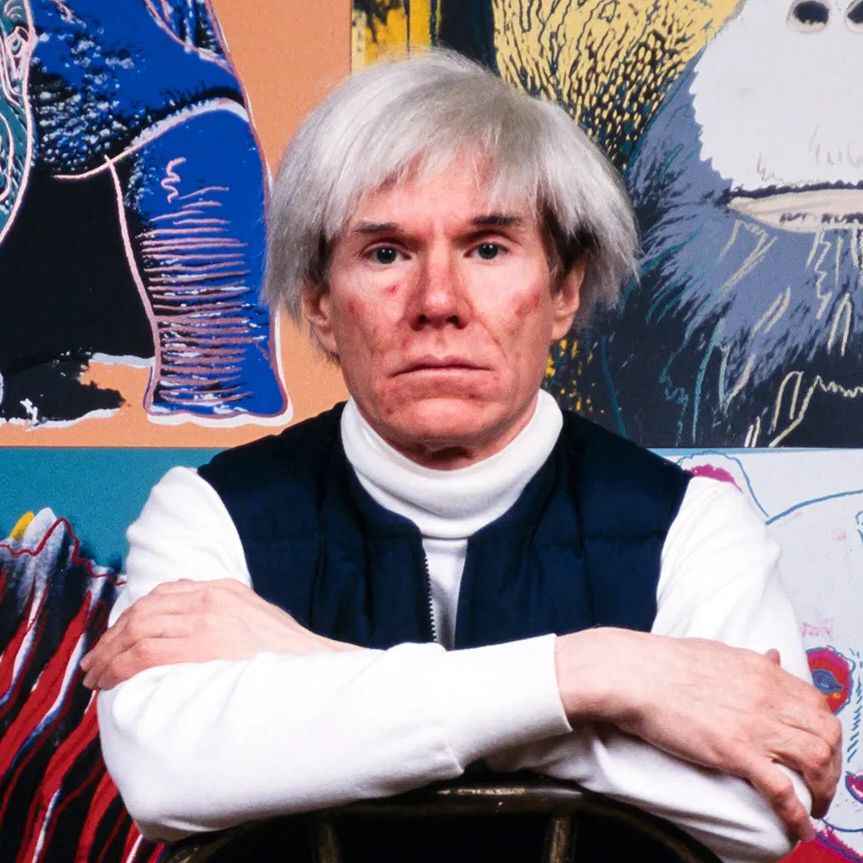


Renowned for his fascination with celebrity culture, consumerism, and image replication, Andy Warhol stands as one of the most influential figures in twentieth-century art. Drawing heavily from everyday life and mass media, he created some of the most recognisable images of the era. His iconic 32 Campbell’s Soup Cans, the Brillo Box sculptures, and his vivid portraits of Marilyn Monroe and Elizabeth Taylor reshaped the boundaries of fine art and popular culture. Rejecting traditional modes of painting and sculpture, Warhol embraced silk-screen printmaking to achieve the sharp lines and vibrant colours that became his signature. Beyond his own prolific output, he played a pivotal mentoring role for artists such as Keith Haring and Jean-Michel Basquiat, shaping the trajectory of contemporary art for generations. His legacy continues to echo globally through artists like Richard Prince, Takashi Murakami, and Jeff Koons. Exhibitions at major institutions including the Whitney Museum of American Art, the Museum of Modern Art, Tate Modern, and the Centre Pompidou affirm his enduring cultural impact, while his works have repeatedly achieved prices over 100 million dollars at auction.
About Andy Warhol
Andy Warhol was born in Pittsburgh in 1928 to a family of Slovak immigrants. After studying design at Carnegie Institute of Technology, he moved to New York in the late 1940s and first established himself as a leading commercial illustrator. His early success in advertising sharpened his interest in the language of branding, repetition, and surface, themes that would come to define his later fine-art practice.
By the early 1960s Warhol had transitioned fully into painting and printmaking, drawing imagery from consumer goods, tabloid newspapers, and Hollywood icons. His studio, the Factory, became a nexus of experimentation, celebrity encounters, and subcultural energy. Warhol’s deliberate blending of commercial aesthetics with fine art established him as a central figure of the Pop Art movement, challenging the distinction between high and low culture while redefining the purpose and process of artmaking.
Iconic Series and Artworks
Warhol’s body of work is anchored by several landmark series that transformed the visual landscape of contemporary art. His 32 Campbell’s Soup Cans captured American consumer culture with disarming simplicity, while his Brillo Box sculptures questioned authorship, authenticity, and the nature of art itself. His portraits of Marilyn Monroe remain some of the most enduring images of the century, merging glamour with repetition to explore fame and mortality.
Other significant series include the Disaster paintings, in which Warhol used repeated news images to examine violence, death, and media saturation, as well as his Electric Chair and Car Crash works, which juxtaposed pop colours with unsettling subject matter. Across all media, Warhol maintained a fascination with seriality, surface, and the ways images circulate through culture.
Artistic Techniques and Themes
Warhol embraced silk-screen printmaking as a deliberate challenge to traditional notions of artistic originality. The technique allowed him to reproduce images mechanically while introducing slight variations that created visual tension. His use of bold colour fields, flat surfaces, and repeated motifs echoed both commercial graphic design and the logic of mass production.
Themes central to his work include celebrity obsession, consumer identity, mass media, and the erosion of authenticity in an image-driven society. Warhol’s artistic persona also became part of his practice, blurring the line between artist and brand. His interest in collaboration, performance, and film extended his influence beyond painting, shaping the broader cultural understanding of what an artist could be.
Art Market and Investment
Andy Warhol remains one of the most valuable and recognisable names in the global art market. His works routinely set auction records, with top pieces exceeding 100 million dollars. Collectors prize Warhol for the stability of his market, the broad appeal of his imagery, and the historic significance of his contribution to twentieth-century art.
Both unique works and editioned prints maintain strong demand, offering entry points for a wide range of collectors. Institutional exhibitions continue to reinforce his importance, supporting long-term market confidence. Warhol’s presence in major global museums further solidifies his status as a foundational figure for modern and contemporary art collections.
Authenticity and Provenance
Authenticating Warhol’s work is essential, given the breadth of his output and the prevalence of unauthorised reproductions. Many works were historically reviewed by the Andy Warhol Art Authentication Board, and detailed documentation from reputable galleries, auction houses, or the artist’s estate remains crucial. At FairArt we check the work has come from a reputable source and for editioned prints, verifying signatures, stamps, edition numbers, and publication records is particularly important.
Clear provenance strengthens both authenticity and long-term value, especially for works that have passed through significant exhibitions or collections. Collectors should ensure that all paperwork accompanies the artwork and trace ownership through trusted sources. For guidance on authenticity or provenance for Warhol works, [support@fairart.io](mailto: support@fairart.io) can provide assistance.