
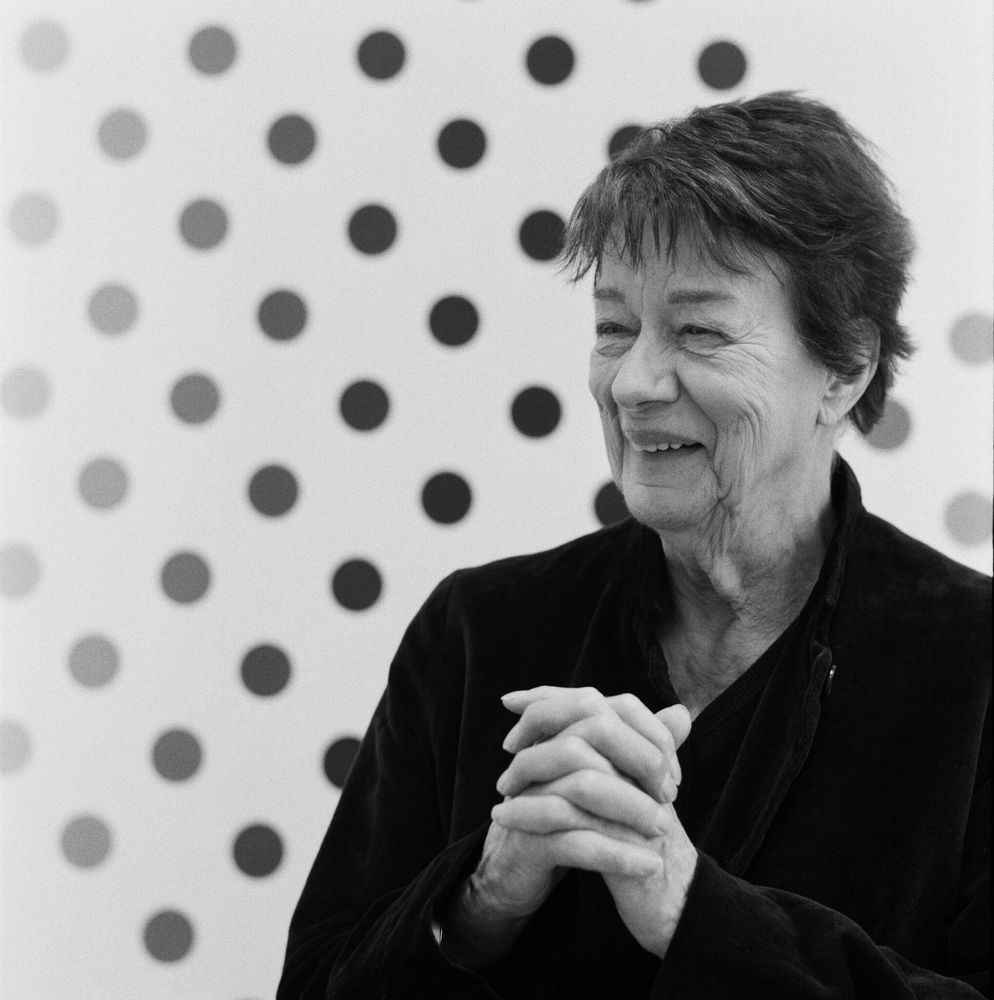


Bridget Riley’s intricate geometric abstractions helped define the Op Art movement of the 1960s, a moment in which perception itself became the subject of artistic inquiry. Through rhythmic arrangements of lines, curves, and vibrant colour sequences, Riley engineered optical effects that create the sensation of vibration, expansion, or movement across the surface of the canvas. While her early black-and-white works introduced these perceptual phenomena with striking clarity, she is best known today for her jubilant colour compositions, where precise chromatic relationships generate shifting visual experiences. Riley studied at Goldsmiths’ College and the Royal College of Art and briefly worked in advertising before committing fully to painting. Over the decades she has exhibited internationally in London, New York, Los Angeles, Paris, Shanghai, Tokyo, and Hong Kong. Her work forms part of major institutional collections including Arts Council England, the Centre Pompidou, the Metropolitan Museum of Art, Tate, and the Stedelijk Museum, and her paintings and prints continue to achieve millions on the secondary market.
About Bridget Riley
Born in 1931 in London and raised partly in Cornwall during the Second World War, Riley developed a deep sensitivity to light, landscape, and visual sensation from a young age. After studying at Goldsmiths’ College and then the Royal College of Art, she spent several years working in commercial advertising, honing her eye for clarity and precision. By the late 1950s and early 1960s she began producing the works that would define her early career: black-and-white optical paintings that invited perceptual instability, generating waves, pulsations, and illusions of depth.
Riley’s breakthrough came with her inclusion in the 1965 exhibition The Responsive Eye at the Museum of Modern Art in New York, which positioned her as a leading figure in Op Art. Since then she has continued to expand her visual vocabulary, moving into colour-based abstraction that explores rhythm, repetition, and the psychology of seeing. Her career spans more than six decades and is celebrated for its intellectual rigour, formal beauty, and ongoing exploration of perception.
Iconic Series and Artworks
Riley’s earliest and most iconic works include her black-and-white paintings such as Movement in Squares and Blaze, which demonstrate her mastery of precise, minimal means to create complex perceptual effects. The visual tension in these compositions, often involving subtle shifts in spacing or curvature, generates the sensation of motion across a static surface.
From the late 1960s onward Riley developed her celebrated colour series, including the Stripe paintings and later the Curve and Wave works. These compositions employ carefully calibrated chromatic sequences to guide the viewer’s eye across the canvas in shifting rhythms. Works from these periods demonstrate Riley’s commitment to exploring the relationship between colour, form, and optical sensation.
Her murals and site-specific installations further extend her interest in environment and perception. Across all periods, Riley’s work maintains exceptional coherence while continually evolving in complexity and ambition.
Artistic Techniques and Themes
Riley’s practice is rooted in meticulous preparation, analytical observation, and a deep engagement with art history - from Seurat’s pointillism to Matisse’s colour harmonies. She begins with extensive studies and works through numerous variations before arriving at a composition that achieves the desired perceptual effect. Despite their precision, her paintings are executed by hand, preserving subtle human variations that contribute to the work’s vitality.
Themes central to Riley’s work include optical experience, visual rhythm, spatial ambiguity, and the dynamic relationship between viewer and artwork. She is less concerned with symbolism or narrative than with the direct, physiological experience of seeing. Her compositions invite viewers into active participation, as the eye moves across the surface and generates shifting illusions in real time.
Art Market and Investment
Bridget Riley’s market remains exceptionally strong, supported by her status as one of the most significant living British artists and a pioneer of post-war abstraction. Her paintings, especially early black-and-white works and major colour canvases, have achieved multimillion-dollar results at auction. Works on paper and prints are also highly sought after, offering entry points to collecting her work at a broader range of price levels.
Riley’s continued exhibition presence and institutional recognition strengthen her market stability. Collectors value her work for its historical importance, visual sophistication, and the enduring relevance of her perceptual investigations. As interest in post-war abstraction continues to grow, Riley’s position within this context remains firmly established.
Authenticity and Provenance
Authenticity is essential when acquiring Bridget Riley’s work due to her longstanding career and the wide range of media she has produced. Many works are accompanied by documentation from established galleries, trusted dealers, or major auction houses. For editioned prints, clear verification of signatures, dates, and edition numbers is crucial.
Provenance should trace back to reputable sources and ideally include exhibition history or publication references, which strengthen both authenticity and long-term value. Collectors are advised to acquire works through recognised dealers or platforms and to maintain complete records of ownership and documentation. For assistance with verifying authenticity or provenance for a Bridget Riley artwork, [support@fairart.io](mailto: support@fairart.io) can provide guidance.