
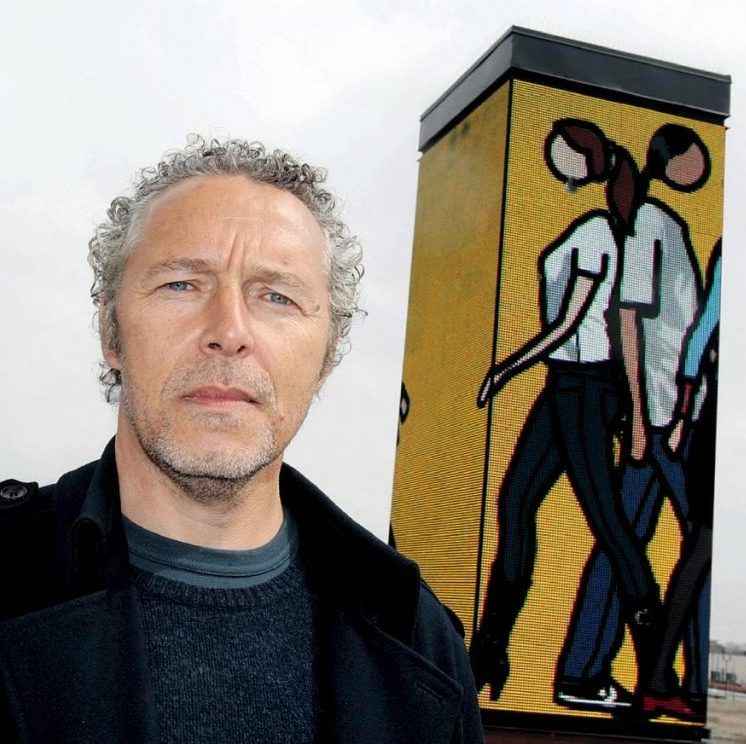


Julian Opie, born in London in 1958, is one of Britain’s most distinctive contemporary artists, celebrated for his bold, pared-back visual language that reduces the human figure and everyday scenes to their most essential lines and forms. After graduating from Goldsmiths School of Art in 1983, where he studied under Michael Craig-Martin, Opie quickly developed a style that merges minimalism, pop sensibilities, and digital aesthetics. His work spans painting, sculpture, LED installations, and large-scale public commissions, making him a defining figure in the evolution of contemporary figurative and graphic art. Opie has exhibited widely across the globe, with major solo exhibitions at institutions such as the Hayward Gallery in London, Kunstverein in Cologne, and K21 in Düsseldorf, as well as presentations at the Delhi Triennial, the Venice Biennale, and Documenta. His public artworks appear in cities worldwide, from Tokyo and New York to Seoul, Prague, and Hong Kong. Today, his works are held in prominent museum collections including Tate, the British Museum, the Victoria & Albert Museum, MoMA, and the National Portrait Gallery, demonstrating the international reach and enduring appeal of his practice.
About Julian Opie
Julian Opie emerged in the 1980s as part of a generation redefining how audiences engage with representation. His early works incorporated sculptural forms, industrial materials, and painted surfaces, gradually leading to the highly recognisable style he is known for today: black outlines, simplified shapes, and flat planes of colour that distil figures and landscapes into universally readable icons.
Opie’s practice is rooted in the observation of everyday life - walkers on city streets, drivers on motorways, swimmers, couples, and passersby. His interest lies in capturing motion, identity, and the rhythms of contemporary life through a visual language that feels immediate yet thoughtfully refined. From his London studio, he continues to develop works that straddle sculpture, technology, and drawing, maintaining a position as a leading figure in contemporary British art.


