


FairArt Guarantee
All artworks are covered. Get the item you ordered or your money back.
Before any work ships, our specialists verify its signature, numbering, edition details, provenance and any certificates. If anything doesn’t match, the sale is cancelled and you’re refunded in full under the FairArt Guarantee.
Whoever you buy from, you get the same checks, the same protection and the same team looking after you until the work is with you.
Every work is packed to our standards and sent by tracked express courier, fully insured in transit. You’ll see the exact shipping cost before you buy or make an offer.
Dispatch times vary depending on the nature of the work and how it needs to be packed. Once it’s on its way, you can follow every step with tracking updates by email and SMS, plus time-stamped proof of delivery.
Every work arrives as new, in the condition it was in when the artist or gallery first released it.
If anything isn’t as described when it arrives, let us know within 3 working days. We’ll arrange the return at the seller’s cost and refund you in full.
Have a question?
Have a question?
Additional Information
There are 2 ways to buy on FairArt - Buy Now or Make Offer.
There are 2 ways to Buy on FairArt
Learn more on our Buyer Page
2. Make Offer
Or, you can instead name your price by placing an offer.
If you hold the Highest Offer when the seller decides to Sell Now (currently: £175), your order will be confirmed automatically.
You can update or delete your offer anytime, free of charge, until it’s accepted.
There are 2 ways to sell on FairArt - Sell Now or List.
There are 2 ways to Sell on FairArt
Learn more on our Seller Page
2. List
Or, you can instead List the work at a price of your choice.
If you hold the Lowest Listing (currently: £425) when a buyer decides to Buy Now, the sale will automatically be assigned to you.
You can update or delete your listing anytime, free of charge.
Artwork Specifications
2022
Print - Acrylic and oil bar on clay disc
1,000
Arusha Gallery
Specifications
2022
Print - Acrylic and oil bar on clay disc
1,000
Arusha Gallery
About The Artist

British, b. 1990
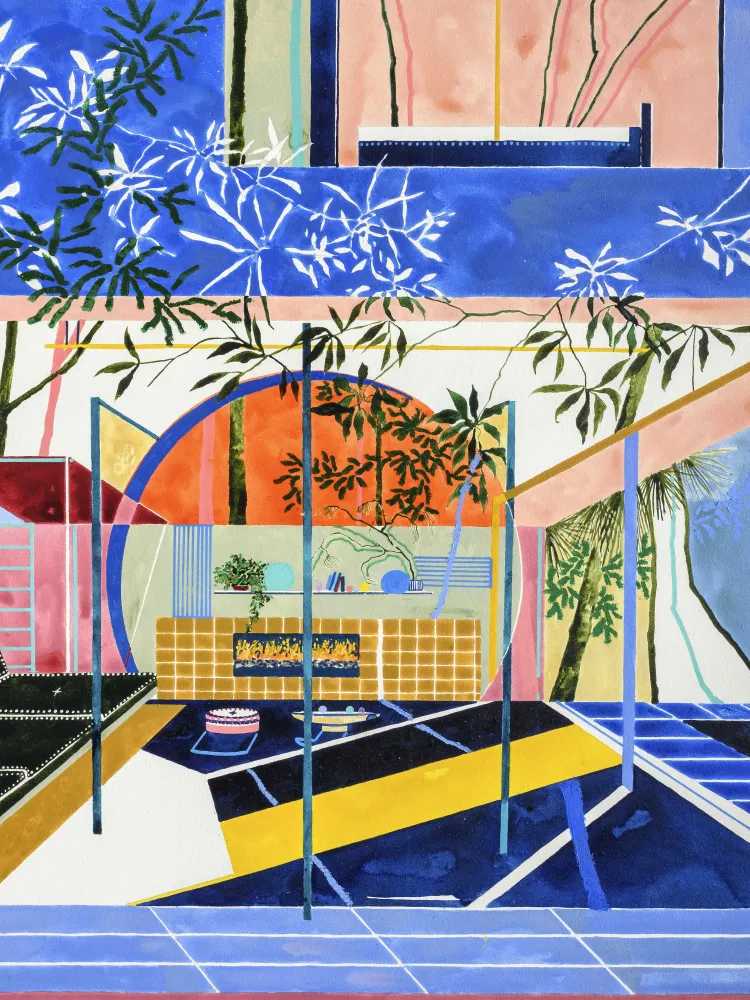
Charlotte's work is inspired by interiors, travels, and architectural composition, in seamless communion with elements from the natural world. Trees push through flat concrete, while perspectives unfold in sheets of glass. These images of modernist leisure leave one with the feeling of having entered a space only recently vacated, dramatising stillness without surrendering movement. These are environments that suggest, technically as well as artistically, indistinct human activity and motion.
"The interiors that I paint are entirely imagined – I am very interested in architecture; a certain angle or spatial construction within a room. I do not necessarily have a constructed interior in my head, I start with one element that has inspired me and let the painting unfold.
There is a sense of anticipation yet stillness, almost like a moment frozen in time, remembering the split second of a place or object. It is this fragility and vulnerability I want to convey, almost waiting for something to happen or even emerge."
If, as Kevin Lynch argues in his essay The Image of the City (1960), architecture is ‘construction in space’ and therefore a ‘temporal art’, then Keates’s paintings, replete with geometric and trapezoidal imagery, are the artist fracticalising the no-less concrete practice of the architect. Keates's work is interdisciplinary, meta-textual – serene, airy landscapes that shock the viewer with ‘more than the eye can see, more than the ear can hear’, evermore settings, corners and aspects ‘waiting to be explored’.
Charlottes works can be found in collections across the globe including the UK, Europe, US, Bahamas, Taiwan and Hong Kong.