

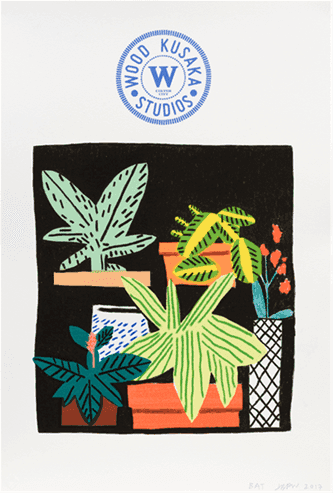
Notepad Doodle (State 1)

How & Work
Protected by the
FairArt Guarantee
All artworks are covered. Get the item you ordered or your money back.
Before any work ships, our specialists verify its signature, numbering, edition details, provenance and any certificates. If anything doesn’t match, the sale is cancelled and you’re refunded in full under the FairArt Guarantee.
Whoever you buy from, you get the same checks, the same protection and the same team looking after you until the work is with you.
Every work is packed to our standards and sent by tracked express courier, fully insured in transit. You’ll see the exact shipping cost before you buy or make an offer.
Dispatch times vary depending on the nature of the work and how it needs to be packed. Once it’s on its way, you can follow every step with tracking updates by email and SMS, plus time-stamped proof of delivery.
Every work arrives as new, in the condition it was in when the artist or gallery first released it.
If anything isn’t as described when it arrives, let us know within 3 working days. We’ll arrange the return at the seller’s cost and refund you in full.
Have a question?
Have a question?
Additional Information
There are 2 ways to buy on FairArt - Buy Now or Make Offer.
There are 2 ways to Buy on FairArt
Learn more on our Buyer Page
1. Buy Now
If the work is listed for sale, you can buy it instantly at the ‘Buy Now’ price.
2. Make Offer
There are currently no listings for this work. You can make an offer to alert potential sellers and encourage them into listing.
Our data shows that sellers are 85% more likely to list a work once an offer has been placed.
You can update or delete your offer anytime, free of charge, until it’s accepted.
There are 2 ways to sell on FairArt - Sell Now or List.
There are 2 ways to Sell on FairArt
Learn more on our Seller Page
1. Sell Now
If an interested collector has placed an offer on this work, you can sell it instantly at the ‘Sell Now’ price.
2. List
You can List this work for sale at a price of your choice.
If you hold the Lowest Listing when a buyer decides to Buy Now, the sale will automatically be assigned to you.
You can update or delete your listing anytime, free of charge.
Artwork Specifications
06-06-2017
Print - 14 colour lithograph on buff Arches
20
$4,000
£
€
$
Hamilton Press Gallery
Specifications
06-06-2017
Print - 14 colour lithograph on buff Arches
20
$4,000
£
€
$
Hamilton Press Gallery
About The Artist

American, b. 1977
In his boldly colored, graphic works—including paintings, drawings, and prints—Jonas Wood combines art historical references with images of the objects, interiors, and people that comprise the fabric of his life. Translating the three-dimensional world around him into flat color and line, he confounds expectations of scale and vantage point.
Born in Boston, Wood grew up surrounded by the art collection of his grandfather, featuring the work of artists such as Francis Bacon, Alexander Calder, Jim Dine, Robert Motherwell, Larry Rivers, and Andy Warhol. He received a BA from Hobart and William Smith Colleges, Geneva, New York, in 1999, majoring in psychology and minoring in studio art, then attended the University of Washington, Seattle, where he received an MFA in painting and drawing in 2002. During his student years, he explored making collage-like works based on montaged photographs that he took of himself, his friends, and their surroundings. These early photo-based paintings possess a darker and more volatile energy that is not as immediately evident in the work Wood is known for today.
Shortly after art school, Wood moved to Los Angeles, where he worked for the painter Laura Owens for a few years. Wood currently shares a studio with artist Shio Kusaka, his wife since 2002, and the pair often work in tandem, motifs migrating from Kusaka’s ceramic vessels to Wood’s paintings and back again. Common subjects include plants, portraits, and sports imagery, all of which come together in Wood’s lush interiors and intricate still lifes. He and Kusaka also incorporate imagery from their expansive art collection—including works by Alighiero Boetti, Michael Frimkess and Magdalena Suarez Frimkess, Mark Grotjahn, and Ed Ruscha—as well as from their children’s storybooks and drawings.
You could call [my work] a visual diary or even a personal history. I’m not going to paint something that doesn’t have anything to do with me. Of all of the possible things I could paint, the thing that interests me is something that I can get close enough to in order to paint it honestly. —Jonas Wood