
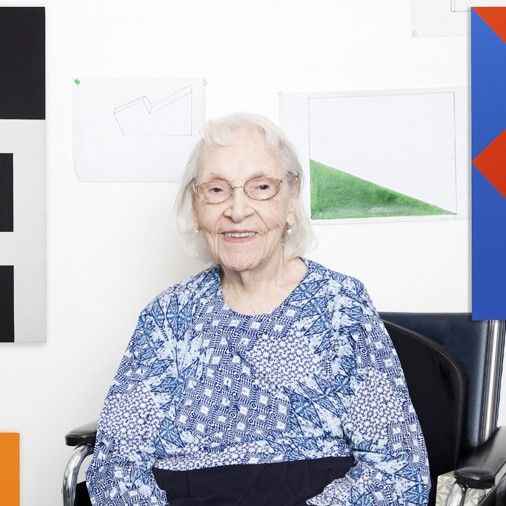
Carmen Herrere
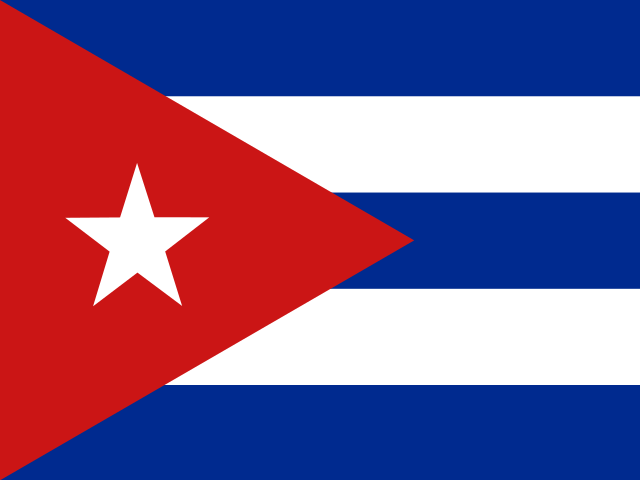 Cuban
Cuban|

Carmen Herrera’s vivid, hard-edged geometric compositions bridge key currents in North American and European art—such as Minimalism and Op art—with modernist movements in South America, including Venezuela’s Los Disidentes, Brazilian Concretism, and Argentina’s Grupo Madí. Trained in architecture at the Universidad de La Habana in the late 1930s, Herrera developed a rigorous sense of structure and spatial clarity that would define her practice.After moving between Cuba and France, she settled in New York in the 1950s, where she refined a visual language rooted in precise line, dynamic balance, and bold color relationships. Like contemporaries such as Barnett Newman and Kenneth Noland, Herrera pursued a reductive aesthetic; however, her work remained largely overlooked in the United States for decades.Recognition came later in life. Beginning around 2009, Herrera’s work garnered significant critical attention, leading to numerous solo exhibitions. In 2016, the Whitney Museum of American Art organized a major retrospective, cementing her place within the canon of postwar abstraction. Her work has since been exhibited internationally at institutions including the Mori Art Museum, Museo Reina Sofía, Fondation Cartier pour l’art contemporain, the Underground Museum, and the Museum of Fine Arts, Houston.In addition to her paintings, Herrera is celebrated for her large-scale aluminum sculptures, known as Estructuras (“structures”), which extend her exploration of form, space, and color into three dimensions.