

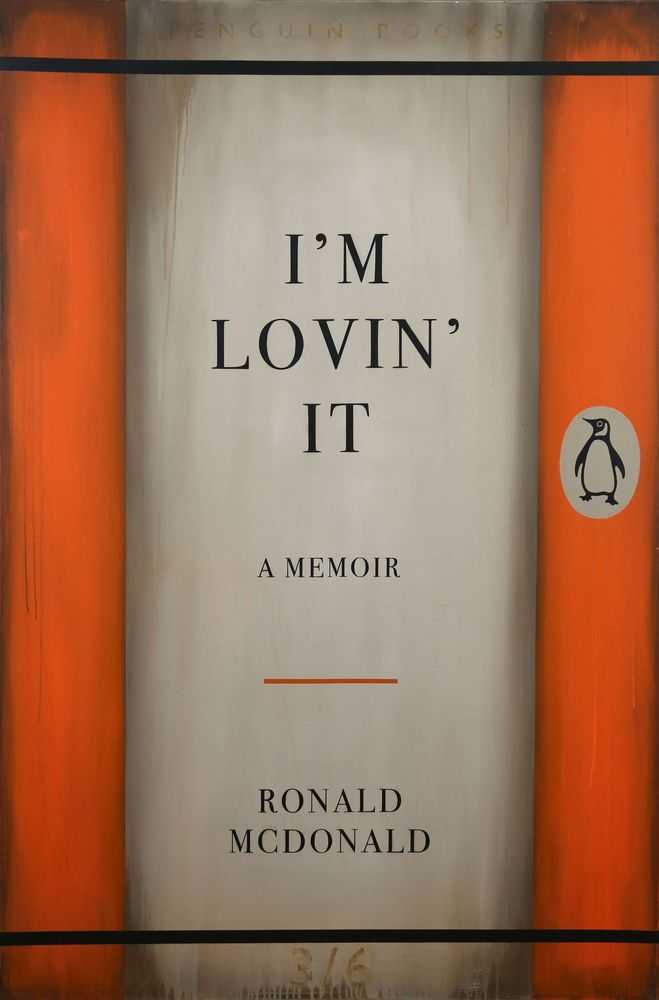
I'm Lovin It, by Ronald McDonald (Original)

How & Work
Protected by the
FairArt Guarantee
All artworks are covered. Get the item you ordered or your money back.
Before any work ships, our specialists verify its signature, numbering, edition details, provenance and any certificates. If anything doesn’t match, the sale is cancelled and you’re refunded in full under the FairArt Guarantee.
Whoever you buy from, you get the same checks, the same protection and the same team looking after you until the work is with you.
Every work is packed to our standards and sent by tracked express courier, fully insured in transit. You’ll see the exact shipping cost before you buy or make an offer.
Dispatch times vary depending on the nature of the work and how it needs to be packed. Once it’s on its way, you can follow every step with tracking updates by email and SMS, plus time-stamped proof of delivery.
Every work arrives as new, in the condition it was in when the artist or gallery first released it.
If anything isn’t as described when it arrives, let us know within 3 working days. We’ll arrange the return at the seller’s cost and refund you in full.
Have a question?
Have a question?
Additional Information
There are 2 ways to buy on FairArt - Buy Now or Make Offer.
There are 2 ways to Buy on FairArt
Learn more on our Buyer Page
1. Buy Now
If the work is listed for sale, you can buy it instantly at the ‘Buy Now’ price.
2. Make Offer
There are currently no listings for this work. You can make an offer to alert potential sellers and encourage them into listing.
Our data shows that sellers are 85% more likely to list a work once an offer has been placed.
You can update or delete your offer anytime, free of charge, until it’s accepted.
There are 2 ways to sell on FairArt - Sell Now or List.
There are 2 ways to Sell on FairArt
Learn more on our Seller Page
1. Sell Now
If an interested collector has placed an offer on this work, you can sell it instantly at the ‘Sell Now’ price.
2. List
You can List this work for sale at a price of your choice.
If you hold the Lowest Listing when a buyer decides to Buy Now, the sale will automatically be assigned to you.
You can update or delete your listing anytime, free of charge.
Artwork Specifications
2022
Original - Acrylic on canvas painting
Unique original
Specifications
2022
Original - Acrylic on canvas painting
Unique original
About The Artist
British, b. 1965
His early works began to appear in the early 2000’s on walls around central Paris- stencilled quotations taken from seminal works of the French literary canon- and rather than the widespread acclaim and adulation he had hoped for earned him near-universal condemnation and opprobrium, putting him firmly in the sights of the Gendarmerie Nationale.
Upon his return to Britain some years later, he recognised that stencilling lofty French literary quotes on walls was probably an unwise career path upon which to embark. Heavily influenced by the Stencil Movement that had its roots in 1960’s Parisian political protest art, Epi adapted his style, eschewing wall for canvas, appropriating and recapitulating tropes mined from the lexicon of contemporary art with his own inimitable (if at times questionable) flair, and developing a ‘technique’ that would incorporate graffiti, Surrealism, Minimalism, Pop, and mid-century poster art.
At the heart of his work lies a deeply-held disdain for the art establishment- whose staggering ignorance, unbridled pretentiousness and mindless capriciousness he has long found abhorrent- and a desire to poke fun at the very métier in which he chooses to make his living.
His Penguin Books series draws heavily on the work of Harland Miller; his stencilled works are reminiscent of Banksy’s early style, works that he was surrounded by growing up in Bristol in the ‘90s; his fondness for painted typefaces is born of his lifelong passion for the propagandist posters produced at the revolutionary guerrilla printing factory, the ‘Atelier Populaire’, established during the Paris student riots of May 1968.
It is through the recontextualisation of these familiar visual ideas- now indelibly marked upon the cultural landscape- that he hopes to shine a light on the absurdity of modern aesthetic sensibilities and a contemporary art market gone woefully awry.
Epi endeavours to bring his work into the reach of a broader base of art buyers eschewing the traditionally close-knit, incestuous clique of blue-chip collectors- until such a day that his work starts going for serious money, when he will tell his loyal clients to fuck off and start selling his works to a small coterie of ultra-rich philistines.
Epi now lives somewhere near Bath. He hopes that one day, long after his death, he will finally get the recognition he doesn’t deserve.