


Pink Pussyhat Bear

How & Work
Protected by the
FairArt Guarantee
All artworks are covered. Get the item you ordered or your money back.
Before any work ships, our specialists verify its signature, numbering, edition details, provenance and any certificates. If anything doesn’t match, the sale is cancelled and you’re refunded in full under the FairArt Guarantee.
Whoever you buy from, you get the same checks, the same protection and the same team looking after you until the work is with you.
Every work is packed to our standards and sent by tracked express courier, fully insured in transit. You’ll see the exact shipping cost before you buy or make an offer.
Dispatch times vary depending on the nature of the work and how it needs to be packed. Once it’s on its way, you can follow every step with tracking updates by email and SMS, plus time-stamped proof of delivery.
Every work arrives as new, in the condition it was in when the artist or gallery first released it.
If anything isn’t as described when it arrives, let us know within 3 working days. We’ll arrange the return at the seller’s cost and refund you in full.
Have a question?
Have a question?
Additional Information
There are 2 ways to buy on FairArt - Buy Now or Make Offer.
There are 2 ways to Buy on FairArt
Learn more on our Buyer Page
1. Buy Now
If the work is listed for sale, you can buy it instantly at the ‘Buy Now’ price.
2. Make Offer
There are currently no listings for this work. You can make an offer to alert potential sellers and encourage them into listing.
Our data shows that sellers are 85% more likely to list a work once an offer has been placed.
You can update or delete your offer anytime, free of charge, until it’s accepted.
There are 2 ways to sell on FairArt - Sell Now or List.
There are 2 ways to Sell on FairArt
Learn more on our Seller Page
1. Sell Now
If an interested collector has placed an offer on this work, you can sell it instantly at the ‘Sell Now’ price.
2. List
You can List this work for sale at a price of your choice.
If you hold the Lowest Listing when a buyer decides to Buy Now, the sale will automatically be assigned to you.
You can update or delete your listing anytime, free of charge.
Artwork Specifications
2022
Sculpture - Spray paint on cut maple plywood
50
Specifications
2022
Sculpture - Spray paint on cut maple plywood
50
About The Artist
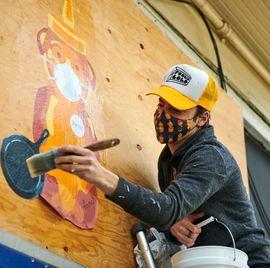
American, b. 1987
The artist known as fnnch (pronounced “finch”) has become one of San Francisco’s most recognizable figures in contemporary street art. Working primarily with stencils and spray paint, fnnch creates imagery that blends the accessibility of pop culture with the immediacy of public space. From his iconic honey bear series to tongue-in-cheek homages to consumer brands, his work has spread from Bay Area sidewalks and mailboxes to museums, nonprofit campaigns, and private collections.
Raised in Kirkwood, Missouri, fnnch began drawing seriously as a teenager, working briefly as an illustrator for a video game company before moving west in 2005 to attend Stanford University. There he earned degrees in economics and mathematics, but it was art—specifically, the possibility of placing images directly into people’s everyday environments—that would shape his career. By 2011 he had settled in San Francisco, adopting the pseudonym “fnnch” (a reference to a childhood nickname) to shield his identity as he painted in public spaces without permission. His first street pieces appeared in Duboce Park, sparking a practice that soon grew into a full-time pursuit.
While fnnch has experimented widely, his honey bear motif has become his signature. Borrowed from the familiar plastic honey bottles sold in grocery stores, the bear is reimagined in countless variations: wearing sunglasses, dressed as Run-DMC, painted in rainbow pride stripes, or carrying pandemic-era symbols like masks and soap. For fnnch, the bear embodies positivity and nostalgia—an object tied to childhood desire and sweetness. The ubiquity of the image has made it a cultural shorthand in San Francisco, at once celebrated for its cheerfulness and critiqued for saturating the city’s visual landscape.
His career has included both playful experiments and pointed commentary. The 9 Cans of LaCroix series, unveiled in 2017, nodded to Andy Warhol’s soup cans while poking fun at the sparkling water craze. In 2018, he covered San Francisco with 450 honey bear stickers in a campaign advocating lighter penalties for wheat-pasting and street art postings. During the COVID-19 pandemic, his boarded-up storefront murals and fundraising editions generated more than $300,000 in charitable contributions, supporting local organizations from the Roxie Theater to the Sisters of Perpetual Indulgence. His collaborations have also extended to civic projects, such as vaccination awareness campaigns with the city’s Department of Public Health.
fnnch openly acknowledges his debt to artists like Banksy, Andy Warhol, Jeremy Novy, Frank Stella, and Ellsworth Kelly. Yet his philosophy departs from overtly political street art. He argues that galleries reach too small an audience compared with the millions who live in or visit a city, and he prefers to create imagery that feels inclusive rather than divisive. “I wanted to paint something positive, nostalgic, even if it’s technically illegal,” he has said, describing the cognitive dissonance of liking something that isn’t meant to last.
The rise of NFTs in 2020 also drew his attention. He sold digital works depicting tech founders as honey bears for over $60,000, donating a portion to COVID relief, while cautioning that the NFT boom reminded him of the dot-com bubble.
Loved by many, criticized by some, fnnch has nonetheless left a strong imprint on San Francisco’s cultural identity. His honey bears—whether charming, kitschy, or provocative—demonstrate how a simple, reproducible form can become a mirror for the city’s debates around community, accessibility, and change.