


Mickey Mouse Now & Future Sofubi Figure

How & Work
Protected by the
FairArt Guarantee
All artworks are covered. Get the item you ordered or your money back.
Before any work ships, our specialists verify its signature, numbering, edition details, provenance and any certificates. If anything doesn’t match, the sale is cancelled and you’re refunded in full under the FairArt Guarantee.
Whoever you buy from, you get the same checks, the same protection and the same team looking after you until the work is with you.
Every work is packed to our standards and sent by tracked express courier, fully insured in transit. You’ll see the exact shipping cost before you buy or make an offer.
Dispatch times vary depending on the nature of the work and how it needs to be packed. Once it’s on its way, you can follow every step with tracking updates by email and SMS, plus time-stamped proof of delivery.
Every work arrives as new, in the condition it was in when the artist or gallery first released it.
If anything isn’t as described when it arrives, let us know within 3 working days. We’ll arrange the return at the seller’s cost and refund you in full.
Have a question?
Have a question?
Additional Information
There are 2 ways to buy on FairArt - Buy Now or Make Offer.
There are 2 ways to Buy on FairArt
Learn more on our Buyer Page
1. Buy Now
If the work is listed for sale, you can buy it instantly at the ‘Buy Now’ price.
2. Make Offer
There are currently no listings for this work. You can make an offer to alert potential sellers and encourage them into listing.
Our data shows that sellers are 85% more likely to list a work once an offer has been placed.
You can update or delete your offer anytime, free of charge, until it’s accepted.
There are 2 ways to sell on FairArt - Sell Now or List.
There are 2 ways to Sell on FairArt
Learn more on our Seller Page
1. Sell Now
If an interested collector has placed an offer on this work, you can sell it instantly at the ‘Sell Now’ price.
2. List
You can List this work for sale at a price of your choice.
If you hold the Lowest Listing when a buyer decides to Buy Now, the sale will automatically be assigned to you.
You can update or delete your listing anytime, free of charge.
Artwork Specifications
19-11-2021
Sculpture - Mixed Media
Limited edition
Nanzuka
Specifications
19-11-2021
Sculpture - Mixed Media
Limited edition
Nanzuka
About The Artist
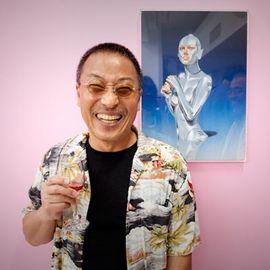
Japanese, b. 1947
Sorayama is known for his fine art, illustration, and industrial design. Of the distinction between the first two, Soryama commented in an interview: "Unlike art, illustration is not a matter of emotion or hatreds, but an experience that comes naturally through logical thinking."
Sorayama's first art book Sexy Robot, was published by Genko-sha in 1983. For the work, he used ideas from pin-up art, which in the book then appear as chrome-plated gynoids in suggestive poses. His next book, Pin-up (Graphic-sha, 1984), continued in the same vein. A number of his other works similarly revolve around figures in suggestive poses, including highly realistic depictions in latex and leather. His pin-up work appeared monthly for years in the pages of Penthouse magazine, and Playboy TV later aired made a television special on Soryama's art. Sorayama said of his pin-up work: "That’s my mania. I’ve been drawing them since high school. Back then, there was this thing for the Playboy and Penthouse playmates. Now, it’s the girl-next-door, idol type, but in our day, these pin-ups were like goddesses. I guess I could describe it as my own goddess cult." In 1985 Sorayama published the video Illustration Video, his first work apart from the books of illustrations. This features work he did for the films Brain Dead (1992), Timecop (1994), and Space Trucker (1995); design of trading cards, limited-edition prints, CD-ROMs, and the cover art for Aerosmith's 2001 album Just Push Play; art exhibitions; and the initial design for what would eventually become Sony's dog-like robotic "pet", the AIBO. He published an additional four books in the 1980s, and three new volumes plus a retrospective collection in the 1990s. Production models of Sony AIBO went to market on May 11, 1999.
In the 2000s, Sorayama's first-generation AIBO design (the robotics of which were developed by Sony's Toshitada Doi) received the Grand Prize of Best Design award, the highest design award conferred by Japan. AIBO has since been included in the permanent collections of the Museum of Modern Art (MOMA) and the Smithsonian Institution. MOMA published a book, Objects of Design by Paola Antonelli, which included AIBO along with other noteworthy designs where form and function combine in harmony. AIBO was the first "artificially intelligent" mass-market consumer robot for entertainment applications. It has been the subject of special studies at Carnegie Mellon University and other academic institutions. Also in this decade, Sorayama produced nine more books and the Nike "White Dunk Project" included Sorayama's art among the 25 most inspiring Japanese artists.