

The Opener

How & Work
Protected by the
FairArt Guarantee
All artworks are covered. Get the item you ordered or your money back.
Before any work ships, our specialists verify its signature, numbering, edition details, provenance and any certificates. If anything doesn’t match, the sale is cancelled and you’re refunded in full under the FairArt Guarantee.
Whoever you buy from, you get the same checks, the same protection and the same team looking after you until the work is with you.
Every work is packed to our standards and sent by tracked express courier, fully insured in transit. You’ll see the exact shipping cost before you buy or make an offer.
Dispatch times vary depending on the nature of the work and how it needs to be packed. Once it’s on its way, you can follow every step with tracking updates by email and SMS, plus time-stamped proof of delivery.
Every work arrives as new, in the condition it was in when the artist or gallery first released it.
If anything isn’t as described when it arrives, let us know within 3 working days. We’ll arrange the return at the seller’s cost and refund you in full.
Have a question?
Have a question?
Additional Information
There are 2 ways to buy on FairArt - Buy Now or Make Offer.
There are 2 ways to Buy on FairArt
Learn more on our Buyer Page
1. Buy Now
If the work is listed for sale, you can buy it instantly at the ‘Buy Now’ price.
2. Make Offer
There are currently no listings for this work. You can make an offer to alert potential sellers and encourage them into listing.
Our data shows that sellers are 85% more likely to list a work once an offer has been placed.
You can update or delete your offer anytime, free of charge, until it’s accepted.
There are 2 ways to sell on FairArt - Sell Now or List.
There are 2 ways to Sell on FairArt
Learn more on our Seller Page
1. Sell Now
If an interested collector has placed an offer on this work, you can sell it instantly at the ‘Sell Now’ price.
2. List
You can List this work for sale at a price of your choice.
If you hold the Lowest Listing when a buyer decides to Buy Now, the sale will automatically be assigned to you.
You can update or delete your listing anytime, free of charge.
Artwork Specifications
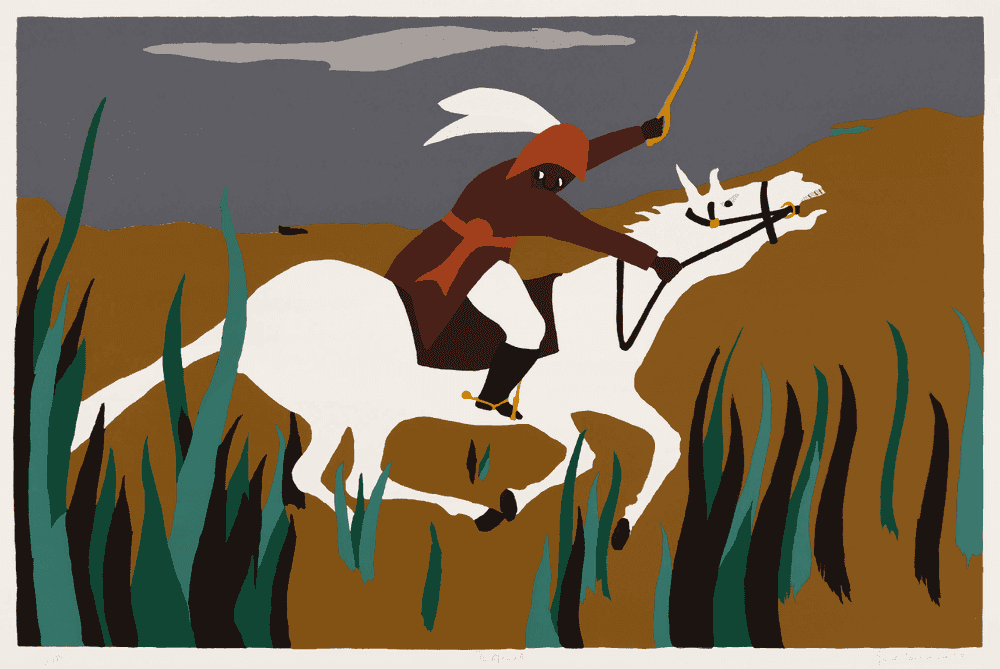
1997
Print - Silk screen on paper
125
Specifications
1997
Print - Silk screen on paper
125
About The Artist
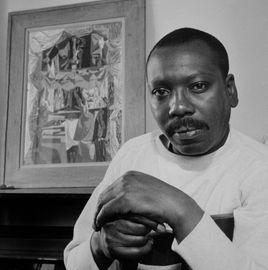
American, b. 1917
Jacob Lawrence, a visionary artist integral to the Harlem Renaissance, redefined the narrative of Blacks in America, envisioning it not as a standalone experience but as an inseparable part of the broader American heritage. Born in New Jersey and later raised in the vibrant enclave of Harlem, Lawrence's artistic journey intricately intertwined with the cultural richness and intellectual fervor of the Harlem Renaissance during the 1920s and 1930s.
As a product of the Great Migration, a transformative period when millions of African Americans moved from the rural South to urban centers in the North, Lawrence considered himself a "child of the Great Migration." This mass relocation, spanning from 1915 to the 1950s, shaped not only his personal life but also became the thematic bedrock of his artistic expression.
Harlem, a crucible of creativity in the midst of the Harlem Renaissance, served as Lawrence's muse. The kaleidoscope of colors, patterns, and energy on the streets inspired him profoundly. His artistic journey began in the early 1930s when he enrolled in art classes, and by the age of 23, he had completed five narrative series depicting pivotal moments and figures in Black history, from Toussaint L'Ouverture to Harriet Tubman.
In the backdrop of World War II and the ongoing Great Migration, Lawrence embarked on a monumental project between 1940 and 1941—the Migration Series. Imbued with a deep sense of purpose, he immersed himself in research, listening to the stories of migrants, and spent months sketching and painting 60 individual panels that collectively told the poignant story of the Great Migration.
Lawrence's unique approach involved a swift and focused technique, using quick-drying tempera paint on hardboard panels. The result was a series of striking, minimalist images that distilled the vast migration into intimate vignettes, often centered on human figures. Each panel conveyed a wealth of information through geometric shapes and a limited color palette, reflecting Lawrence's belief in the power of simplicity.
Breaking racial barriers in 1941, Lawrence achieved a historic milestone by becoming the first African American artist to have his work acquired by The Museum of Modern Art, despite the prevailing segregation. Through his vivid and accessible visual storytelling, Lawrence not only celebrated the richness and complexities of African American history but also educated both his community and the broader world. His legacy endures as a testament to the transformative power of art in shaping narratives and fostering understanding across cultural boundaries.