
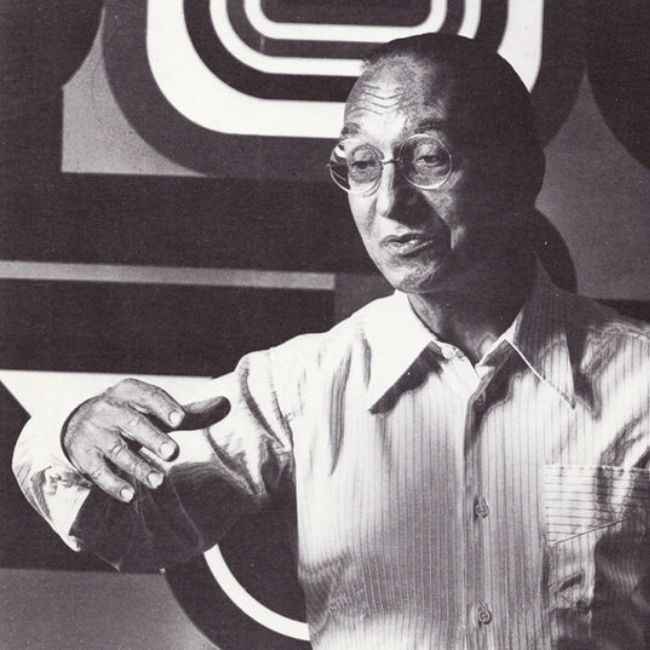

Jean Dewasne (1921–1999) was a pioneering French artist and a leading figure of postwar geometric abstraction. Closely associated with the movement of Abstraction-Création and later Op Art, Dewasne developed a bold visual language defined by hard-edged forms, vibrant color, and a commitment to pure abstraction.Rejecting illusionism and narrative, Dewasne sought to create a universal, rational art rooted in clarity and structure. His compositions—often referred to as “Antisculptures”—are characterized by sharply delineated planes of color arranged in dynamic, architectonic relationships. Through the use of industrial materials such as lacquer and enamel, he achieved a luminous, highly polished surface that reinforced the precision and autonomy of his forms.A key contributor to the postwar Parisian avant-garde, Dewasne also played an important role in integrating art and architecture. His large-scale public commissions, including immersive mural environments, reflect his belief in art as an integral part of everyday life. Notably, his collaboration with Edgar Pillet on architectural projects exemplified his ambition to dissolve the boundaries between painting, space, and design.Dewasne’s work has been exhibited internationally and is held in major museum collections. Today, he is recognized as a central figure in the evolution of European abstraction, whose rigorous formalism and visionary approach continue to resonate within contemporary art discourse.