
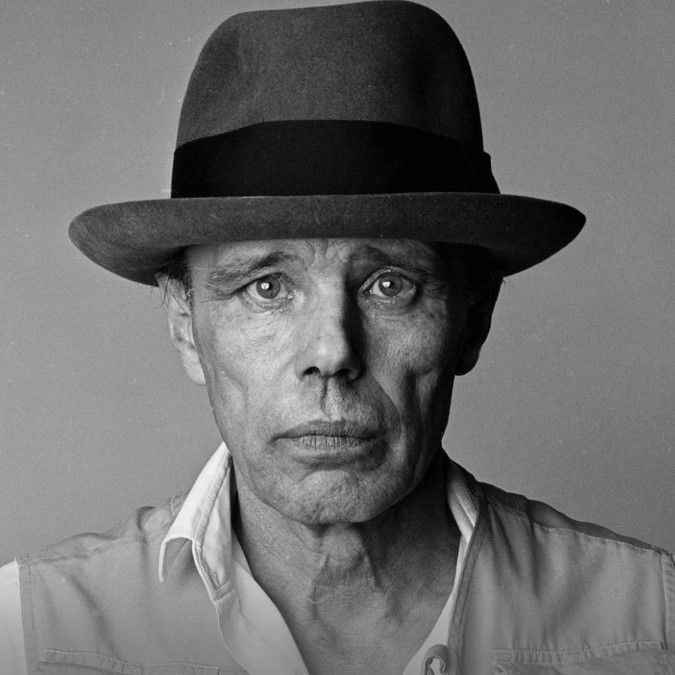
Joseph Beuys
 German
|

Joseph Beuys regarded art as a catalyst for radical social change, positioning it as a force capable of reshaping society itself. In the postwar era, he significantly expanded the boundaries of avant-garde sculpture through a multidisciplinary practice that challenged conventional definitions of art. Closely linked to the Fluxus movement, Beuys advanced the concept of “social sculpture,” envisioning society as a collective artwork shaped by human creativity and participation.Working across assemblage, installation, performance, printmaking, and drawing, Beuys infused his projects with philosophical and humanist concerns. His actions often blurred the line between art and life—whether planting thousands of trees as ecological intervention or spending three days in a gallery with a wild coyote. Teaching was central to his practice as well. As a charismatic and influential professor at the Kunstakademie Düsseldorf, he mentored a generation of artists, including Anatol Herzfeld, Blinky Palermo, and Sigmar Polke.Beuys participated multiple times in major international exhibitions such as the Venice Biennale and Documenta, and his work has been featured in prominent institutions including Moderna Museet, Tate Modern, Kunsthalle Bern, Guggenheim Museum, and Museum of Modern Art. Today, his works command seven-figure prices at auction, underscoring his enduring influence on contemporary art.