
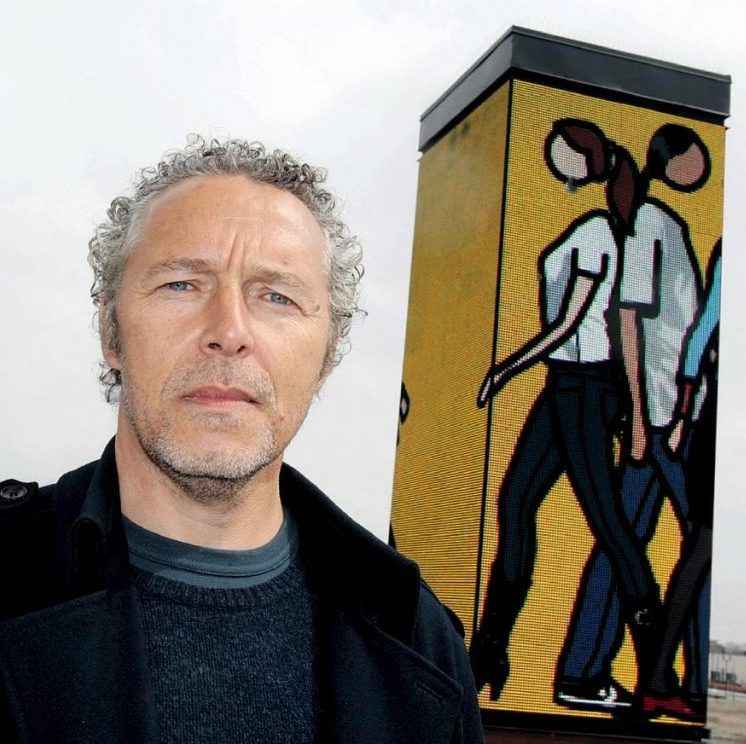


Julian Opie, born in London in 1958, is one of Britain’s most distinctive contemporary artists, celebrated for his bold, pared-back visual language that reduces the human figure and everyday scenes to their most essential lines and forms. After graduating from Goldsmiths School of Art in 1983, where he studied under Michael Craig-Martin, Opie quickly developed a style that merges minimalism, pop sensibilities, and digital aesthetics. His work spans painting, sculpture, LED installations, and large-scale public commissions, making him a defining figure in the evolution of contemporary figurative and graphic art. Opie has exhibited widely across the globe, with major solo exhibitions at institutions such as the Hayward Gallery in London, Kunstverein in Cologne, and K21 in Düsseldorf, as well as presentations at the Delhi Triennial, the Venice Biennale, and Documenta. His public artworks appear in cities worldwide, from Tokyo and New York to Seoul, Prague, and Hong Kong. Today, his works are held in prominent museum collections including Tate, the British Museum, the Victoria & Albert Museum, MoMA, and the National Portrait Gallery, demonstrating the international reach and enduring appeal of his practice.
About Julian Opie
Julian Opie emerged in the 1980s as part of a generation redefining how audiences engage with representation. His early works incorporated sculptural forms, industrial materials, and painted surfaces, gradually leading to the highly recognisable style he is known for today: black outlines, simplified shapes, and flat planes of colour that distil figures and landscapes into universally readable icons.
Opie’s practice is rooted in the observation of everyday life - walkers on city streets, drivers on motorways, swimmers, couples, and passersby. His interest lies in capturing motion, identity, and the rhythms of contemporary life through a visual language that feels immediate yet thoughtfully refined. From his London studio, he continues to develop works that straddle sculpture, technology, and drawing, maintaining a position as a leading figure in contemporary British art.
Related categories
Iconic Series and Artworks
Opie’s Walking series, featuring animated LED or painted figures striding in continuous loops, has become one of his most recognisable bodies of work. These works appear in museums, corporate spaces, and public plazas worldwide, turning everyday movement into a universal symbol of modern life. His portraits - rendered in bold, graphic lines - strip away detail while maintaining a surprising sense of personality, a balance that has become central to his style.
Other iconic works include his Swimming and Running figures, his scenic motorways and landscapes, and his sculptural silhouettes. Public artworks such as his installations at Seoul Square, the Dentsu Building in Tokyo, and Regent’s Place in London demonstrate how his images scale seamlessly into large-format architectural and urban spaces. Across all media, Opie consistently explores how minimal marks can create maximum recognisability.
Artistic Techniques and Themes
Opie’s technique is grounded in reduction: paring down the world to clean lines, controlled colour palettes, and simplified shapes. He employs a wide range of technologies and materials, including vinyl, LED panels, painted aluminium, lenticular printing, and digital animation. This integration of traditional artistic skills with industrial processes reflects his longstanding interest in how images are produced, circulated, and consumed in contemporary culture.
Themes within his work include movement, identity, perception, and the intersection between art and everyday life. By representing people and environments with minimal detail, Opie invites viewers to project themselves into the imagery, creating a universal visual vocabulary. His approach dissolves the boundary between fine art and signage, portraiture and iconography, establishing a space where contemporary life is distilled into its clearest forms.
Art Market and Investment
Julian Opie’s market is well-established and international, supported by decades of critical recognition, museum exhibitions, and high-profile public commissions. His works - ranging from limited-edition prints to large-scale sculptures - appeal to both seasoned collectors and newcomers due to their clarity, recognisability, and versatility across formats and spaces. LED works and sculptures often command higher prices, while prints and smaller pieces offer entry points for a wide collector base.
With representation by 12 galleries worldwide and continued institutional programming, Opie’s market remains strong. His ability to merge accessibility with conceptual precision positions his works as attractive options for collectors seeking highly recognisable contemporary art with proven longevity.
Authenticity and Provenance
Given Opie’s prolific output across different media including prints, paintings, sculptures, digital works, and LED pieces, verifying authenticity is essential. FairArt checks that works are purchased through reputable galleries, official dealers, or established auction houses typically include certificates of authenticity, edition details, and signatures or identifying marks appropriate to the medium.
Provenance should document the artwork’s ownership history and, where applicable, exhibition or publication records, which help reinforce its value and legitimacy. For collectors acquiring works on the secondary market, ensuring accurate documentation is key. Those seeking assistance in verifying authenticity or establishing provenance for a Julian Opie piece can contact support@fairart.io for guidance.