

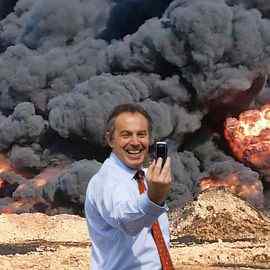


Kennardphillipps is the collaborative practice of British artists Peter Kennard and Cat Phillipps. Established in 2002 in response to the build-up to the Iraq War, the duo has become internationally recognized for politically charged photomontages, installations, prints, videos, and public interventions that confront themes of war, state power, environmental destruction, media manipulation, and social injustice. Working across galleries, public spaces, newspapers, digital platforms, and protest movements, they regard their practice not simply as commentary, but as an active form of political engagement—what they describe as "the visual arm of protest."Employing archival press photography, digital collage, drawing, painting, and large-scale installation, kennardphillipps transforms familiar images into striking visual metaphors that challenge dominant political narratives. Their work is distinguished by its direct visual language, combining documentary imagery with symbolic intervention to produce works that are immediately accessible while remaining conceptually rigorous. Rather than limiting their practice to the gallery, the artists encourage the public use and circulation of their imagery through demonstrations, campaigns, workshops, and freely downloadable activist materials.Among their most iconic works is Photo Op (2005/2007), the photomontage depicting former British Prime Minister Tony Blair taking a selfie before an inferno in Iraq. Widely regarded as one of the defining political artworks of the twenty-first century, the image has become an enduring symbol of opposition to the Iraq War and the relationship between political power, media spectacle, and armed conflict.kennardphillipps has exhibited extensively throughout Europe and internationally, with presentations at institutions including the Imperial War Museums, British Museum, National Portrait Gallery, Whitechapel Gallery, Fitzwilliam Museum, Museum of Contemporary Art in Kraków (MOCAK), and the Jorn Museum. Their work is held in numerous public and private collections and continues to serve as a powerful example of how contemporary art can function as both cultural critique and catalyst for political dialogue.