

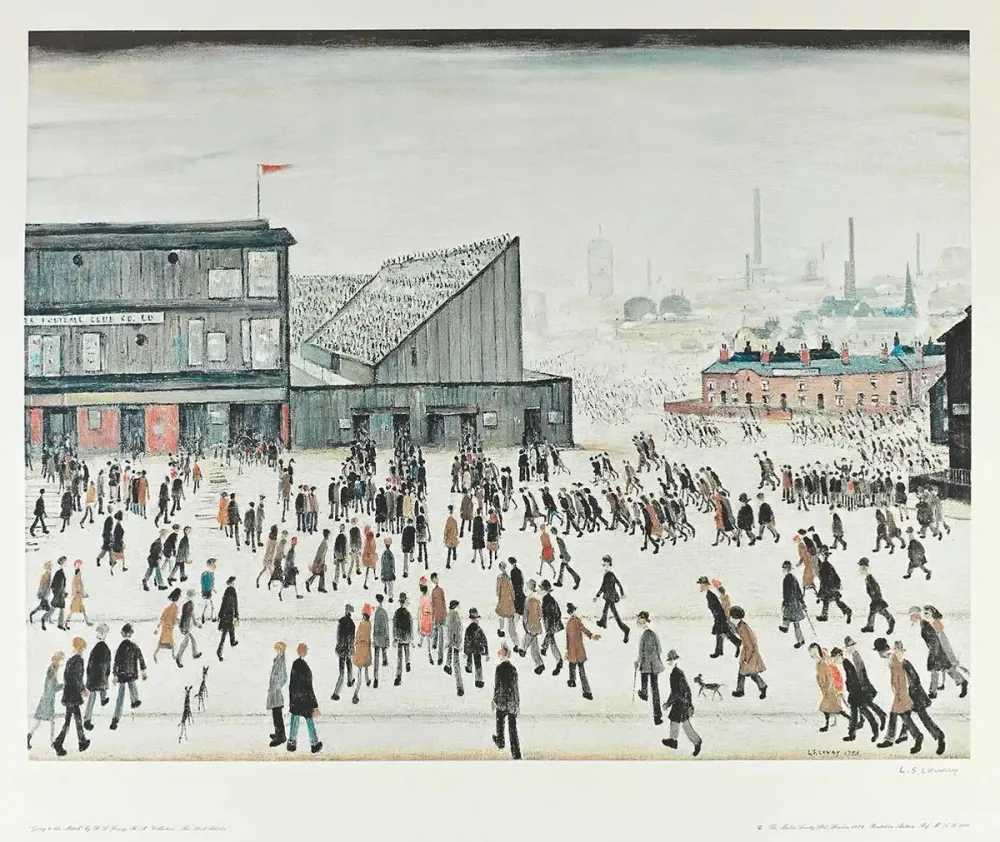
Going To The Match

How & Work
Protected by the
FairArt Guarantee
All artworks are covered. Get the item you ordered or your money back.
Before any work ships, our specialists verify its signature, numbering, edition details, provenance and any certificates. If anything doesn’t match, the sale is cancelled and you’re refunded in full under the FairArt Guarantee.
Whoever you buy from, you get the same checks, the same protection and the same team looking after you until the work is with you.
Every work is packed to our standards and sent by tracked express courier, fully insured in transit. You’ll see the exact shipping cost before you buy or make an offer.
Dispatch times vary depending on the nature of the work and how it needs to be packed. Once it’s on its way, you can follow every step with tracking updates by email and SMS, plus time-stamped proof of delivery.
Every work arrives as new, in the condition it was in when the artist or gallery first released it.
If anything isn’t as described when it arrives, let us know within 3 working days. We’ll arrange the return at the seller’s cost and refund you in full.
Have a question?
Have a question?
Additional Information
There are 2 ways to buy on FairArt - Buy Now or Make Offer.
There are 2 ways to Buy on FairArt
Learn more on our Buyer Page
1. Buy Now
If the work is listed for sale, you can buy it instantly at the ‘Buy Now’ price.
2. Make Offer
There are currently no listings for this work. You can make an offer to alert potential sellers and encourage them into listing.
Our data shows that sellers are 85% more likely to list a work once an offer has been placed.
You can update or delete your offer anytime, free of charge, until it’s accepted.
There are 2 ways to sell on FairArt - Sell Now or List.
There are 2 ways to Sell on FairArt
Learn more on our Seller Page
1. Sell Now
If an interested collector has placed an offer on this work, you can sell it instantly at the ‘Sell Now’ price.
2. List
You can List this work for sale at a price of your choice.
If you hold the Lowest Listing when a buyer decides to Buy Now, the sale will automatically be assigned to you.
You can update or delete your listing anytime, free of charge.
Artwork Specifications
1972
Print - Lithograph
300
Specifications
1972
Print - Lithograph
300
About The Artist
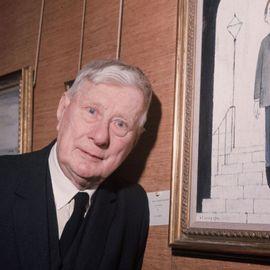
British, b. 1887
Laurence Stephen Lowry, the celebrated Modernist painter, is renowned for his distinctive naïve style, capturing the essence of cityscapes and industrial scenes in northern England. His canvases are teeming with stylized figures affectionately dubbed "matchstick men," amidst a backdrop dominated by factories, mills, and chimneys billowing smoke. For instance, his masterpiece "Huddersfield" (1973) presents a panorama of uniform figures set against a somber urban landscape, observed from a distant, elevated viewpoint.
Lowry's artistic palette is notably restrained, employing shades of ivory black, flake white, Prussian blue, ochre, and vermilion to evoke the stark realities of his subjects. His artistic journey began with evening classes at Salford Technical College and the Manchester School of Art, where he was mentored by the esteemed French Impressionist, Pierre Adolphe Valette. Later, Lowry shared his expertise as a visiting tutor at the esteemed Slade School of Fine Art.
In 1939, Lowry marked his debut with a solo exhibition at London's prestigious Lefevre Gallery, followed by notable showcases at the Royal Academy and the Paris Salon during his lifetime. Despite his passing, Lowry's legacy endured, culminating in a significant posthumous retrospective at Tate Britain in 2013, reaffirming his status as an icon of Modernist art.