

FairArt Guarantee
All artworks are covered. Get the item you ordered or your money back.
Before any work ships, our specialists verify its signature, numbering, edition details, provenance and any certificates. If anything doesn’t match, the sale is cancelled and you’re refunded in full under the FairArt Guarantee.
Whoever you buy from, you get the same checks, the same protection and the same team looking after you until the work is with you.
Every work is packed to our standards and sent by tracked express courier, fully insured in transit. You’ll see the exact shipping cost before you buy or make an offer.
Dispatch times vary depending on the nature of the work and how it needs to be packed. Once it’s on its way, you can follow every step with tracking updates by email and SMS, plus time-stamped proof of delivery.
Every work arrives as new, in the condition it was in when the artist or gallery first released it.
If anything isn’t as described when it arrives, let us know within 3 working days. We’ll arrange the return at the seller’s cost and refund you in full.
Have a question?
Have a question?
Additional Information
There are 2 ways to buy on FairArt - Buy Now or Make Offer.
There are 2 ways to Buy on FairArt
Learn more on our Buyer Page
2. Make Offer
Or, you can instead name your price by placing an offer.
If you hold the Highest Offer when the seller decides to Sell Now, your order will be confirmed automatically.
You can update or delete your offer anytime, free of charge, until it’s accepted.
There are 2 ways to sell on FairArt - Sell Now or List.
There are 2 ways to Sell on FairArt
Learn more on our Seller Page
1. Sell Now
If an interested collector has placed an offer on this work, you can sell it instantly at the ‘Sell Now’ price.
2. List
You can List this work for sale at a price of your choice.
If you hold the Lowest Listing (currently: £4,000) when a buyer decides to Buy Now, the sale will automatically be assigned to you.
You can update or delete your listing anytime, free of charge.
Artwork Specifications
15-07-2024
Print - 3 UV pigment prints on a 6-colour silkscreen printed background 410gsm Somerset Tub-sized Radiant white 100% cotton paper. One print is finished with hand-applied 24 carat gold leaf and ink details
125
Avant Arte
Specifications
15-07-2024
Print - 3 UV pigment prints on a 6-colour silkscreen printed background 410gsm Somerset Tub-sized Radiant white 100% cotton paper. One print is finished with hand-applied 24 carat gold leaf and ink details
125
Avant Arte
About The Artist
Spanish, b. 1977
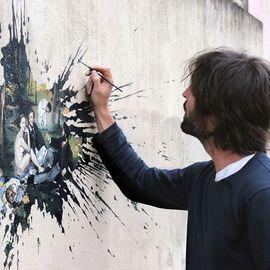
On one hand, Pejac is very particular when it comes to choosing the right place, right context, and right medium or tools, for a certain message. This is why he chose alleys of Istanbul for trompe l’oeil windows interventions; bustling streets of Bushwick, New York for a fossil trompe l’oeil; London’s light poles for gravity-defying shoes; Tokyo for a miraculous appearance of shark fin on the sidewalk; Amman for the poignant materialization of people’s memories on the weathered walls of the Jabad Al-Weibdeh refugee camp; or Moscow for My Only Flag, depicting a child raising a flag made of branches.
Respecting his roots, both figuratively and literally, he made a sobering statement about the importance of nature by painting a melting map of Earth draining into the sewer in his native city of Santander, initiating his leap into the international sphere along the way. A similar thing happened with the illusory tribute to healthcare workers, the universally momentous artwork Social Distancing at the Marqués de Valdecilla University Hospital, which he explained by saying, "Some people donated masks, others have given gowns and also offered tests. What I do best is paint." Alongside many other locations through Spain and around Europe, both on land and on the water, these places witnessed first-hand the seductive appeal and strong impact of the artist’s cleverly conceptualized and discreetly realized ideas.
Simultaneously, in his studio practice, Pejac is using his fine art education to experiment with a variety of techniques, continuously searching for the one that does the best job conveying the desired atmosphere of his vision and concepts. Working with everything from oils and watercolor, over charcoal and pencil, to scarping, burning, stencilling, and spraypainting, but no stranger to sculpture or installation, the artist sees his practice “more like a marathon than a sprint, while valuing the importance of the route”. In such effort, he is often reaching for the most rudimentary tools and materials to create a magic trick of sorts, an illusion through which his work becomes merely a seed which, once planted in the viewer’s mind, will hopefully sprout into a beautiful realization.