
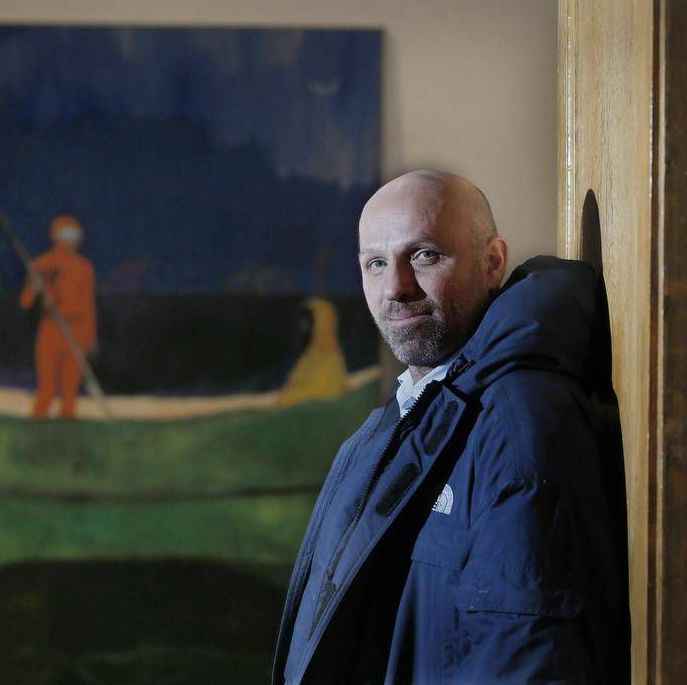



Peter Doig creates serene yet dreamlike paintings where kaleidoscopic landscapes unfold around enigmatic, partially obscured figures. His work often draws from memories of his childhood in Canada, filtering these recollections through a soft, blurred visual language that echoes the instability of memory itself. From quiet lakes to dense forests, his settings feel suspended between reality and imagination, with motifs such as canoes becoming recurring symbols of solitude, transition, and reflection. Doig’s work has been celebrated in solo exhibitions at Tate Britain, the Musée d’Art Moderne de Paris, and the Dallas Museum of Art. On the secondary market his paintings have sold for more than $10 million, and they are held in major institutions including the British Museum, the Art Institute of Chicago, the Museum of Modern Art, and the Metropolitan Museum of Art.
About Peter Doig
Born in Scotland in 1959, Peter Doig spent much of his childhood in Trinidad and Canada before later returning to Trinidad as an adult. These landscapes, climates, and cultural shifts became foundational to his visual imagination. Doig studied at Wimbledon School of Art, St Martin’s School of Art, and Chelsea School of Art, where he developed a painterly language rooted in atmosphere, ambiguity, and emotional resonance.
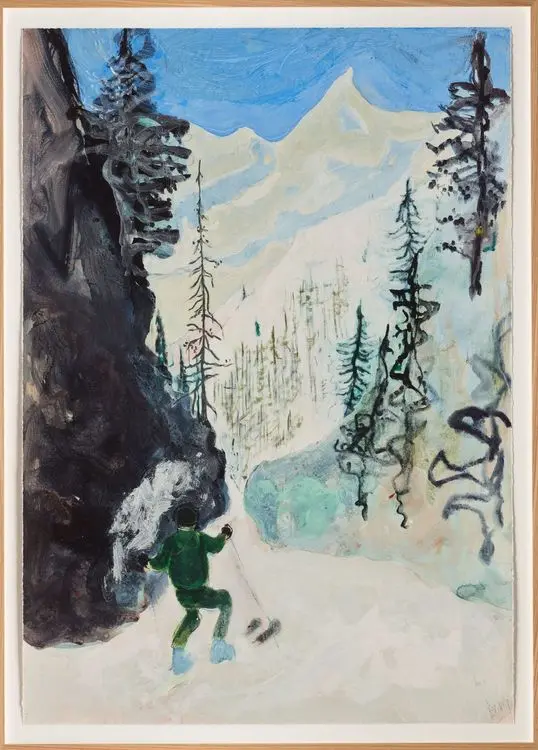
His rise in the 1990s coincided with a renewed interest in figurative painting, yet Doig’s approach remained distinct for its subtlety and its resistance to straightforward narrative. Whether depicting winter forests, lone skiers, or a canoe floating across a mirrored lake, his works feel like fragments of memory held just beyond full understanding. This sense of suspended time has become central to his reputation as one of the most influential contemporary painters working today.
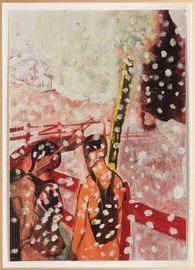
Iconic Series and Artworks
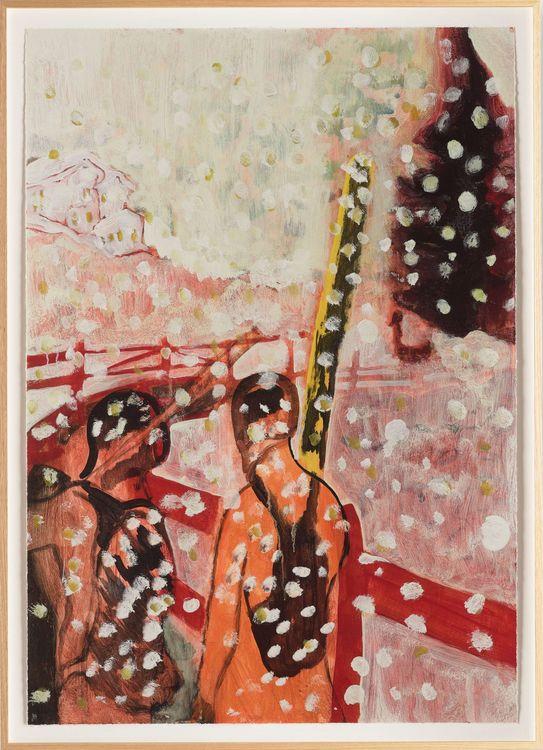
Doig is best known for works that transform remembered or imagined scenes into poetic, introspective images. His canoe paintings form one of his most recognisable series, with the lone vessel drifting across luminous waters becoming a symbol of contemplation and passage. Influential works such as White Canoe and Canoe Lake demonstrate his ability to evoke narrative potential without explicitly revealing it, drawing viewers into a space of reflection.
Other notable paintings include his atmospheric forest scenes, inspired partly by Canadian landscapes and by film stills that he reinterprets through layers of colour and texture. His ongoing engagement with Trinidad, where he has lived and worked extensively, introduced new motifs such as nighttime gatherings, tropical vegetation, and liminal coastal spaces. These paintings maintain his signature balance of realism and unreality, anchored by figures who appear both present and distant.
Artistic Techniques and Themes
Doig’s technique is defined by layered surfaces, diffused light, and a deliberate use of painterly texture. He often works from photographs, postcards, film stills, or memory, but transforms these sources through colour shifts, atmospheric washes, and subtle distortions. The result is a style that feels both observational and dreamlike, as though the scenes have been filtered through years of recollection.
Themes of memory, displacement, solitude, and the passage of time recur throughout his practice. Doig’s figures frequently appear at a remove, partially obscured by foliage, shadows, or distance, heightening the sense of emotional ambiguity. His landscapes serve not merely as settings but as psychological spaces, inviting viewers into introspective and often nostalgic states of mind. Through these techniques, Doig has cultivated a body of work that feels both deeply personal and universally resonant.
Art Market and Investment
Peter Doig’s art market is among the strongest of any living painter, with major works achieving multimillion-dollar results at international auctions. His paintings are prized for their rarity, quality, and emotional depth, and his distinctive visual language maintains a consistent appeal for collectors. High-profile institutional exhibitions and widespread critical acclaim continue to reinforce his market position.
Demand spans across paintings, works on paper, prints, and editioned pieces, although his large-scale canvases remain the most sought after. Collectors value the stability of his market, the global recognition of his work, and the significance of his place within contemporary figurative painting. As institutions continue to acquire major works, the long-term outlook for Doig’s market remains strong.
Authenticity and Provenance
Given the high value of Peter Doig’s work, ensuring authenticity is essential. Many pieces are accompanied by documentation from reputable galleries, auction houses, or the artist’s studio, and provenance should clearly trace the history of ownership and exhibition. Because Doig often works across multiple formats, including works on paper and editioned prints, verifying edition details and signatures is an important step for collectors.
Provenance not only safeguards authenticity but also contributes to the long-term value of the artwork. Clear documentation, confirmation from established dealers, and alignment with known catalogues or exhibition histories all contribute to collector confidence. For assistance in verifying authenticity or provenance for a Peter Doig artwork, you can contact [support@fairart.io](mailto: support@fairart.io).