


Self-Portrait

How & Work
Protected by the
FairArt Guarantee
All artworks are covered. Get the item you ordered or your money back.
Before any work ships, our specialists verify its signature, numbering, edition details, provenance and any certificates. If anything doesn’t match, the sale is cancelled and you’re refunded in full under the FairArt Guarantee.
Whoever you buy from, you get the same checks, the same protection and the same team looking after you until the work is with you.
Every work is packed to our standards and sent by tracked express courier, fully insured in transit. You’ll see the exact shipping cost before you buy or make an offer.
Dispatch times vary depending on the nature of the work and how it needs to be packed. Once it’s on its way, you can follow every step with tracking updates by email and SMS, plus time-stamped proof of delivery.
Every work arrives as new, in the condition it was in when the artist or gallery first released it.
If anything isn’t as described when it arrives, let us know within 3 working days. We’ll arrange the return at the seller’s cost and refund you in full.
Have a question?
Have a question?
Additional Information
There are 2 ways to buy on FairArt - Buy Now or Make Offer.
There are 2 ways to Buy on FairArt
Learn more on our Buyer Page
1. Buy Now
If the work is listed for sale, you can buy it instantly at the ‘Buy Now’ price.
2. Make Offer
There are currently no listings for this work. You can make an offer to alert potential sellers and encourage them into listing.
Our data shows that sellers are 85% more likely to list a work once an offer has been placed.
You can update or delete your offer anytime, free of charge, until it’s accepted.
There are 2 ways to sell on FairArt - Sell Now or List.
There are 2 ways to Sell on FairArt
Learn more on our Seller Page
1. Sell Now
If an interested collector has placed an offer on this work, you can sell it instantly at the ‘Sell Now’ price.
2. List
You can List this work for sale at a price of your choice.
If you hold the Lowest Listing when a buyer decides to Buy Now, the sale will automatically be assigned to you.
You can update or delete your listing anytime, free of charge.
Artwork Specifications
1967
Print - Screenprint
75
Specifications
1967
Print - Screenprint
75
About The Artist
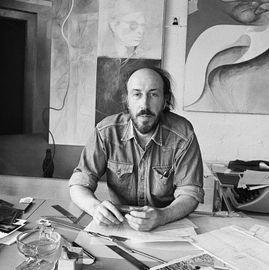
British, b. 1922
Richard Hamilton (1922 - 2011) stood as one of the most influential artists of the twentieth century. Born in London, he embarked on his artistic journey by attending evening classes at St Martin's School of Art. At the age of 16, he enrolled in the painting course at the Royal Academy Schools in 1938. However, his studies were interrupted by the outbreak of World War II, during which he worked as a draughtsman at EMI. Following the war, he returned to the Royal Academy but was eventually expelled for not making the most of his instruction. Undeterred, he pursued further education at the Slade School of Art from 1948 to 1951, where he began his lifelong endeavor of illustrating James Joyce's Ulysses.
In 1956, Hamilton played a pivotal role in the seminal exhibition "This is Tomorrow" at the Whitechapel Gallery. His contribution was a collage titled "Just what is it that makes today's homes so different, so appealing?" It featured a muscular figure holding a paddle with the word 'POP' emblazoned on it, thereby giving birth to the entire Pop Art movement. During this time, he corresponded with architects Peter and Alison Smithson, detailing the key components of Pop Art.
Hamilton skillfully captured the social transformations unfolding around him, whether reflecting on the rise of consumer culture or examining the impact of political events. These themes found expression in his images of protests, portraits, interiors, and landscapes. He often incorporated digital technology and media to explore multiple interpretations and manifestations of the same image, constantly challenging and breaking previously established boundaries, particularly through his paintings and prints.
Throughout his career, Hamilton taught at esteemed institutions such as the London Central School of Arts and Crafts, the Royal College of Art, and Kings College at the University of Durham (later the University of Newcastle upon Tyne). However, he retired from teaching in 1966. He also represented Britain at the 1993 Venice Biennale.
Hamilton's artistic achievements spanned the globe, with international exhibitions showcasing his work. In 2013, a significant retrospective exhibition was held at the Tate Modern in London, followed by a display at the Museo Nacional Centro de Arte Reina Sofía in Madrid. Today, his artwork is held in the collections of nearly every major museum worldwide.
Richard Hamilton passed away in 2011 at the age of 89 in Oxfordshire, England, leaving behind a profound and enduring artistic legacy.