
FairArt Logo

November 27th

Protected by the

This work isn’t listed right now - make an offer to notify potential sellers and encourage them into listing. .
Make offer

FairArt Guarantee

All artworks are covered. Get the item you ordered or your money back.

Authentication

Before any work ships, our specialists verify its signature, numbering, edition details, provenance and any certificates. If anything doesn’t match, the sale is cancelled and you’re refunded in full under the FairArt Guarantee.

Whoever you buy from, you get the same checks, the same protection and the same team looking after you until the work is with you.

Global Shipping

Every work is packed to our standards and sent by tracked express courier, fully insured in transit. You’ll see the exact shipping cost before you buy or make an offer.

Dispatch times vary depending on the nature of the work and how it needs to be packed. Once it’s on its way, you can follow every step with tracking updates by email and SMS, plus time-stamped proof of delivery.

Condition

Every work arrives as new, in the condition it was in when the artist or gallery first released it.

If anything isn’t as described when it arrives, let us know within 3 working days. We’ll arrange the return at the seller’s cost and refund you in full.

Have a question?

Additional Information

BuyingHow Buying Works

There are 2 ways to buy on FairArt - Buy Now or Make Offer.

There are 2 ways to Buy on FairArt

Learn more on our Buyer Page

1. Buy Now
This work isn’t listed right now. As a result, the Buy Now option is not available.

If the work is listed for sale, you can buy it instantly at the ‘Buy Now’ price.

2. Make Offer

There are currently no listings for this work. You can make an offer to alert potential sellers and encourage them into listing.

Our data shows that sellers are 85% more likely to list a work once an offer has been placed.

You can update or delete your offer anytime, free of charge, until it’s accepted.

Make Offer
SellingHow Selling Works

There are 2 ways to sell on FairArt - Sell Now or List.

There are 2 ways to Sell on FairArt

Learn more on our Seller Page

1. Sell Now
There are no live offers for this work, so the Sell Now option is not available.

If an interested collector has placed an offer on this work, you can sell it instantly at the ‘Sell Now’ price.

2. List

You can List this work for sale at a price of your choice.

If you hold the Lowest Listing when a buyer decides to Buy Now, the sale will automatically be assigned to you.

You can update or delete your listing anytime, free of charge.

List Now

Artwork Specifications

Date

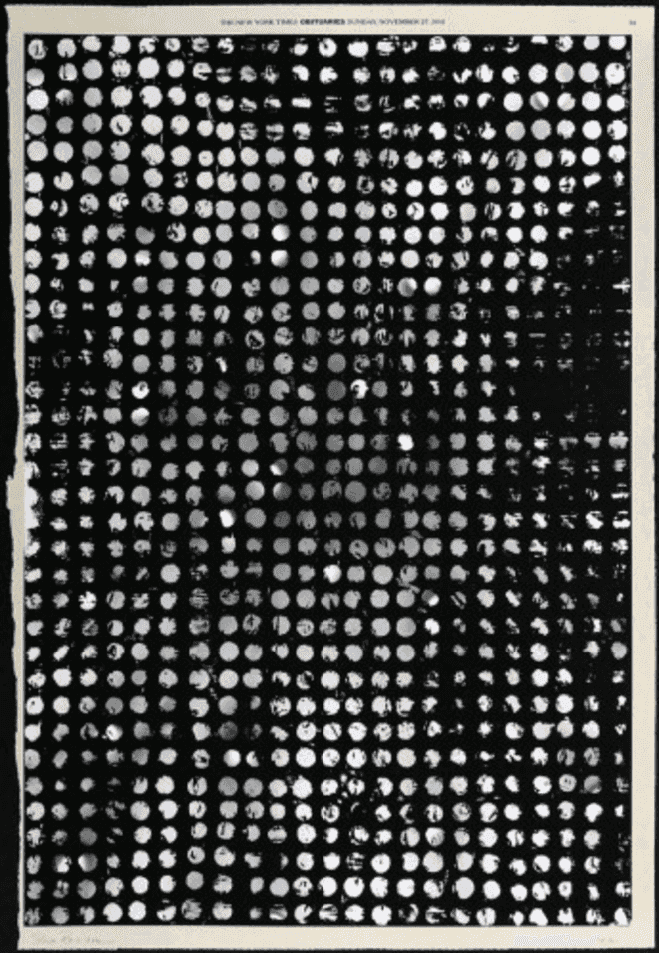
2016

Size
Material

Print - Lithograph

Edition size

20

Features
Signed

About The Artist

Ross Bleckner
Ross Bleckner

American, b. 1949

Ross Bleckner, born in 1949 in New York, was raised in the affluent community of Hewlett Harbor on Long Island. His early encounter with art came in 1965, when he visited The Responsive Eye, a seminal Op Art exhibition at the Museum of Modern Art. The experience proved formative, sparking his desire to become an artist. He pursued this path at New York University, where he studied under Sol LeWitt and Chuck Close, earning his BA in 1971. He then completed his MFA at the California Institute of the Arts in Valencia in 1973, where he met fellow artist David Salle.Returning to New York, Bleckner moved into a loft building in Tribeca in 1974. He later sold the building in 2004, but during the 1970s and early ’80s, it housed both the artist Julian Schnabel and the legendary Mudd Club, a cultural hotspot for musicians and artists. Bleckner’s first solo exhibition took place in 1975 at Cunningham Ward Gallery, and in 1979 he began a long relationship with Mary Boone Gallery, which became a central platform for the emerging art stars of the 1980s. In 1981, he met Swiss dealer Thomas Ammann, who became a key supporter and collector of his work.Bleckner’s Stripe paintings of the early 1980s—visually resonant with Bridget Riley’s Op Art—met with mixed critical reception. He followed them with his Weather series in 1983, marking a shift toward more atmospheric and emotionally charged imagery. His work gained significant recognition in 1984 when a single large painting was exhibited at Nature Morte in New York’s East Village. Around this period, he began creating elegiac compositions featuring chandeliers, candelabras, and ornate motifs suspended against dark backgrounds—symbolic memorials responding to the AIDS epidemic. His emotionally powerful pieces, such as 8,122+ as of January 1986 (1986), reflected the mounting death toll, while others used pointillist marks to evoke AIDS-related lesions or commemorated individual victims.In the late 1980s and early 1990s, Bleckner developed several new series. His Constellation paintings (1987–93) evoke celestial arrangements, while the Architecture of the Sky series (1988–93) references domed interiors, suggesting cosmic or spiritual spaces. During this time, he also began his Cell paintings, microscopic explorations of diseased cellular structures, inspired in part by his father's battle with cancer. These cellular forms—ranging from DNA strands to malignancies—would become a sustained visual theme in his work. In later years, he also produced a series of haunting bird paintings (1995–2003) and expanded his technical repertoire with new surfaces and airbrush techniques. In 1993, he acquired Truman Capote’s former residence in Sagaponack, Long Island.Bleckner's institutional recognition began with his first solo museum show at the San Francisco Museum of Modern Art in 1988. He has since been featured in numerous major exhibitions, including a midcareer retrospective at the Solomon R. Guggenheim Museum in 1995. His work has appeared in multiple Whitney Biennials (1975, 1987, 1989), the Biennale of Sydney (1988), and the Carnegie International (1988), among other prominent group exhibitions focusing on abstraction and contemporary themes. He continues to live and work in New York.

Your Recent Searches