Banksy|Barcode
All Barcode Works By Banksy (2)
Significance & Analysis
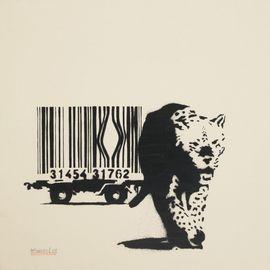
'Barcode' compresses an argument about captivity and consumption into a single, instantly legible image. The barcode is the mark that turns a thing into stock; here it doubles as a cage, and the animal has already found the gap. The print is usually read as a comment on how readily nature is priced, packaged and put on show, from zoos to the wildlife trade. Its restraint is part of its force. There is no colour beyond the black ink and the cream of the paper, and no background: only the leopard, the bent lines and a wide border of empty sheet, so the joke lands at a glance.
From canvas and street to print
The image predates the edition. Banksy painted it on canvas as 'Barcode Leopard' in 2002, and one version was shown that year at the 'Urban Discipline' exhibition in Hamburg; it later sold for £158,500 with fees at Bonhams in London in June 2016. He also stencilled the leopard on the side of a house on Pembroke Road in Bristol, his home city. The screenprint followed in 2004, one of a run of releases that year that included 'Girl With Balloon' and 'Napalm'.
Market peak and since
'Barcode' is one of Banksy's most sought-after prints, and its signed edition peaked in 2020 to 2022. The highest result of the last five years came at Forum Auctions in London in March 2022, when a signed impression made £104,250 with fees; another made £94,000 with fees at Bonhams in London in November 2021. The record for the signed edition is £140,700 with fees, set at Forum in December 2020. Unsigned impressions reached £30,240 at Phillips in London in January 2023. Both editions have sold for considerably less since: signed impressions for about £38,000 to £54,000, unsigned mostly between £8,000 and £18,000.
What Inscriptions and Stamps Appear on Barcode Prints?
How Big Is a Barcode Print?
Banksy Series