Banksy|Tesco Soup Cans
All Tesco Soup Cans Works By Banksy (25)
Significance & Analysis
'Soup Can' is Banksy's answer to Andy Warhol, and it works by changing a single label. Warhol's 'Campbell's Soup Cans' of 1962 gave each of 32 canvases a different flavour inside the same famous packaging. Banksy keeps the upright tin, the flat colour and the deadpan centring, and swaps the American brand for Tesco Value Cream of Tomato. The print is often read as Warhol in reverse: one cheap soup, dressed in packaging that keeps changing.
Colour as the subject
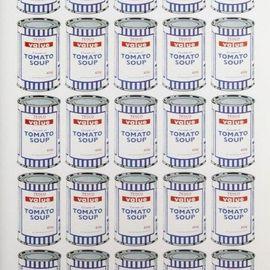
The colourways carry that reversal into the edition itself. After the main red, white and blue version, Pictures on Walls issued the same can in a long run of alternative palettes, each titled after its three or four colours: 'Banana, Cherry, Dark Blue', 'Sage, Green, Lime, Cherry', 'White, Emerald, Tan'. Each is a small edition of its own, so the series behaves less like a print run than a shelf of near-identical products. 'Four Soup Cans' followed in 2006 and moves the image closer to Warhol's grids, setting the tin four times on one sheet. The poster takes the repetition furthest. Its 25 identical tins, arranged five by five, leave nothing to choose between. Because it was produced in far larger numbers with the signature printed in the plate, it is the most accessible way into the series.
Auction results
The colourways lead the market. In September 2025 two of them, 'Banana, Lime, Purple' and 'Violet, Blue, Tan', each made £60,960 with fees at Christie's, the highest results for the series in the last five years. Prices peaked in 2020 and 2021, when 'Banana, Cherry, Dark Blue' made £94,500 at Sotheby's London in March 2021. The record for the series belongs to the signed main edition: an impression sold for ¥20,125,000 with fees at SBI Art Auction in Tokyo in July 2021. Unsigned impressions of the main colourway have since settled at about £15,000 to £20,000, the level they reached at Christie's, Sotheby's, Bonhams and Tate Ward in 2023 and 2024.
How Many Tesco Soup Cans Prints Were Made?
Why Did Banksy Choose a Tesco Value Can?
How Can You Tell the Soup Can Editions Apart?
Banksy Series