

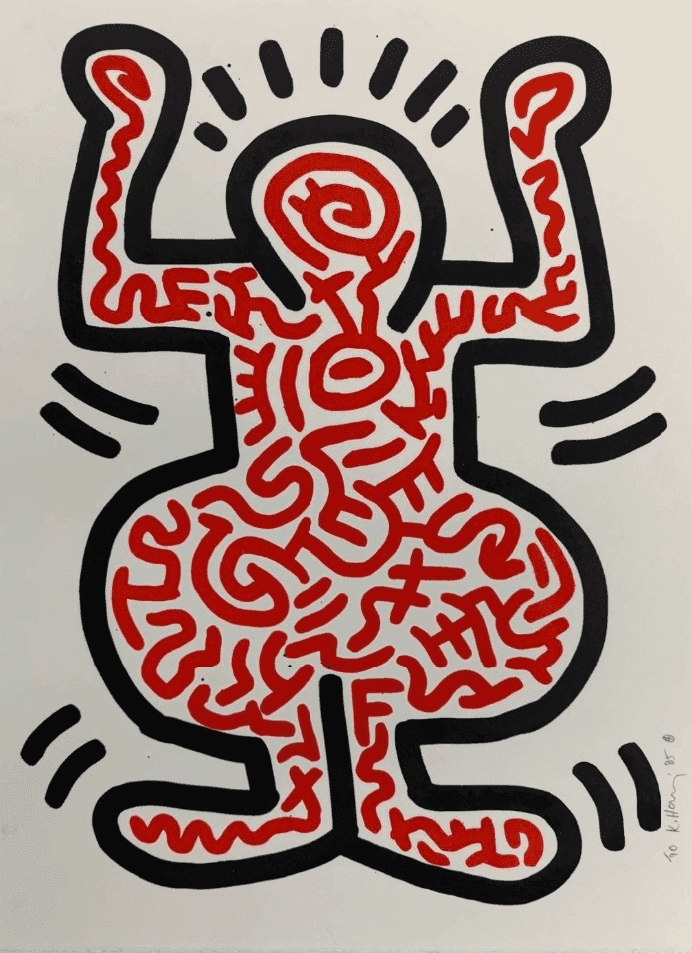
Ludo I

How & Work
Protected by the
FairArt Guarantee
All artworks are covered. Get the item you ordered or your money back.
Before any work ships, our specialists verify its signature, numbering, edition details, provenance and any certificates. If anything doesn’t match, the sale is cancelled and you’re refunded in full under the FairArt Guarantee.
Whoever you buy from, you get the same checks, the same protection and the same team looking after you until the work is with you.
Every work is packed to our standards and sent by tracked express courier, fully insured in transit. You’ll see the exact shipping cost before you buy or make an offer.
Dispatch times vary depending on the nature of the work and how it needs to be packed. Once it’s on its way, you can follow every step with tracking updates by email and SMS, plus time-stamped proof of delivery.
Every work arrives as new, in the condition it was in when the artist or gallery first released it.
If anything isn’t as described when it arrives, let us know within 3 working days. We’ll arrange the return at the seller’s cost and refund you in full.
Have a question?
Have a question?
Additional Information
There are 2 ways to buy on FairArt - Buy Now or Make Offer.
There are 2 ways to Buy on FairArt
Learn more on our Buyer Page
1. Buy Now
If the work is listed for sale, you can buy it instantly at the ‘Buy Now’ price.
2. Make Offer
There are currently no listings for this work. You can make an offer to alert potential sellers and encourage them into listing.
Our data shows that sellers are 85% more likely to list a work once an offer has been placed.
You can update or delete your offer anytime, free of charge, until it’s accepted.
There are 2 ways to sell on FairArt - Sell Now or List.
There are 2 ways to Sell on FairArt
Learn more on our Seller Page
1. Sell Now
If an interested collector has placed an offer on this work, you can sell it instantly at the ‘Sell Now’ price.
2. List
You can List this work for sale at a price of your choice.
If you hold the Lowest Listing when a buyer decides to Buy Now, the sale will automatically be assigned to you.
You can update or delete your listing anytime, free of charge.
Artwork Specifications
1985
Print - Lithograph
90
Specifications
1985
Print - Lithograph
90
About The Artist
American, b. 1958
In the charged atmosphere of New York’s East Village in the 1980s, Keith Haring emerged as one of the most compelling visual voices of his generation. Rising alongside Jean-Michel Basquiat, Kenny Scharf, and Jenny Holzer, he bridged the gap between graffiti, street culture, and the contemporary art world with an immediacy that felt both democratic and revolutionary. Beginning with chalk drawings on blank subway advertising panels, Haring transformed public spaces into vibrant visual networks, using the city as his canvas long before his studio practice propelled him to international acclaim. His work was fast, lucid, rhythmic, and unafraid to confront the anxieties of the era, making Haring not only an artist of his time but an interpreter of its urgency.
Keith Haring was born in 1958 in Reading, Pennsylvania, and raised in nearby Kutztown, where early influences included cartoonists and graphic storytellers. When he arrived in New York in 1978 to study at the School of Visual Arts, he became immersed in a creative underground defined by clubs, experimental performance, and the explosion of graffiti across the city’s boroughs. Haring quickly aligned himself with this energy, developing a language of bold lines, simplified figures, and radiant symbols that conveyed movement and emotion with startling clarity.
His ascent was rapid. The raw vitality of his subway drawings gained a cult following almost instantly, attracting the attention of passersby, fellow artists, and eventually leading institutions. By the mid-1980s, Haring had become a central figure in the global conversation around contemporary art, using his rising platform to speak openly about social justice, inequality, and compassion. His diagnosis with AIDS in 1987 fundamentally shaped the final years of his life and intensified the urgency of his practice, culminating in some of his most direct and impactful works before his death in 1990.