


FairArt Guarantee
All artworks are covered. Get the item you ordered or your money back.
Before any work ships, our specialists verify its signature, numbering, edition details, provenance and any certificates. If anything doesn’t match, the sale is cancelled and you’re refunded in full under the FairArt Guarantee.
Whoever you buy from, you get the same checks, the same protection and the same team looking after you until the work is with you.
Every work is packed to our standards and sent by tracked express courier, fully insured in transit. You’ll see the exact shipping cost before you buy or make an offer.
Dispatch times vary depending on the nature of the work and how it needs to be packed. Once it’s on its way, you can follow every step with tracking updates by email and SMS, plus time-stamped proof of delivery.
Every work arrives as new, in the condition it was in when the artist or gallery first released it.
If anything isn’t as described when it arrives, let us know within 3 working days. We’ll arrange the return at the seller’s cost and refund you in full.
Have a question?
Have a question?
About this artwork
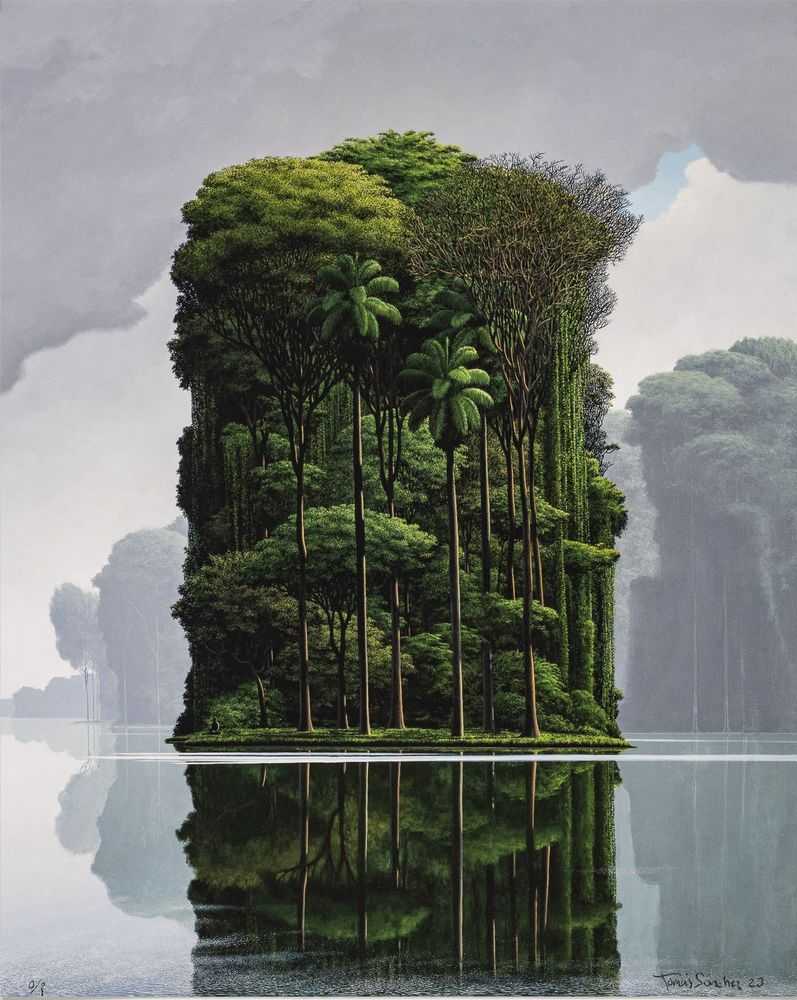
'Inner Love' is a UV pigment print by Tomas Sanchez on 410gsm Somerset TS Radiant White paper, sealed with a matte silkscreen varnish. The edition reproduces a larger painting of the same name, and Avant Arte says the printmakers paid particular attention to fidelity and colouration.
The publisher describes a cross-legged figure on a mirage-like island, mirrored in the water around it, in a scene inspired by the forests and rivers near Sanchez's studio in Costa Rica. For Sanchez, it says, the work gives space for a moment of self-reflection. He has said he believes it is a painting that "can transmit to others the same peace that it transmits to me".
Avant Arte released it on 18 January 2024 and kept it open to order for 24 hours, in an edition of 630. Each print measures 60 x 48 cm (23.6 x 18.9 in) and is signed, dated and numbered by the artist.
There are 2 ways to Buy on FairArt
Learn more on our Buyer Page
2. Make Offer
Or, you can instead name your price by placing an offer.
If you hold the Highest Offer when the seller decides to Sell Now (currently: £300), your order will be confirmed automatically.
You can update or delete your offer anytime, free of charge, until it’s accepted.
There are 2 ways to Sell on FairArt
Learn more on our Seller Page
2. List
Or, you can instead List the work at a price of your choice.
If you hold the Lowest Listing (currently: £3,950) when a buyer decides to Buy Now, the sale will automatically be assigned to you.
You can update or delete your listing anytime, free of charge.
Artwork Specifications
18-01-2024
Print - UV pigment print on 410gsm Somerset TS Radiant White paper with a matte silkscreen varnish seal
630
£393
£
€
$
Avant Arte
Specifications
18-01-2024
Print - UV pigment print on 410gsm Somerset TS Radiant White paper with a matte silkscreen varnish seal
630
£393
£
€
$
Avant Arte
About The Artist

Cuban, b. 1948
Sánchez’s symbolic landscapes have made him one of the most important living Cuban artists. Part of Volumen Uno in the 80s, a movement that resisted the heavily censored Cuban art of the time, he has since received international recognition, with auction prices in excess of $600,000 USD. Inspired by the Romantics, Sánchez paints the wilderness of his homeland, as well as vast panoramic views of garbage dumps. The works are incredibly detailed with a lush tropical palette, encompassing the physical wonder of the natural world, it’s immense spiritual power, and humankind's tendency to destroy it. Small human figures set against waterfalls, lagoons and palm trees engage with humankind's insignificance, search for inner peace, and broader environmental issues. Steeped in allegory, Sánchez’s art reinterprets traditional modes of painting to create an uncanny paradise that is at once hopeful and threatening.
While Sánchez is best known for his hyperreal landscapes, he has also experimented in print, sculpture, photography, drawing, and with different styles of painting. His earlier works under the title Expressionism explore a looser painted gesture steeped, as ever, in symbolism. El Circo/The Circus (1974), is an oil on canvas depicting a circus tent with a raucous crowd watching Jesus being carried on the cross. There is a red bullfighting cloth on the stage, but a chicken instead of a bull; the two men pulling the cross and gearing the crowd wear red colonialist hats. Various angels and the Virgin Mary are among the audience members, all of whom watch with both eagerness and dread. The work plays with tropes of religious iconography as a sardonic metaphor for the performativity of religion, colonialism, politics and populism, whether ancient or contemporary.
“I believe it’s through nature that we find freedom.” – Tomás Sánchez