Werner Bronkhorst|Forbidden Grass
All Forbidden Grass Works By Werner Bronkhorst (10)
Significance & Analysis
'Forbidden Grass' is where Bronkhorst's large prints moved from paper to stretched canvas, made to hang like the paintings themselves. The paintings were first shown in London in July 2024, at his first exhibition outside Australia, and the prints went on sale online two days after it closed.
A collection made of green
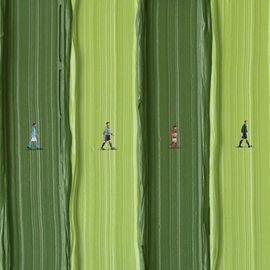
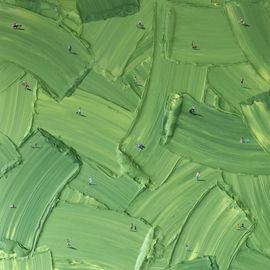
After a detour into charcoal, he came back to thick paint and miniature figures, and set himself one rule for the series: green in every work. He tied the colour to his childhood in Pretoria, where summers were "lush and green", and to the sports and park life he grew up with. 'Good Greens' shows the method at its loosest. Seven shades were spread together on the canvas, and croquet players, cricketers, prams and picnics were painted over the blend.
Prints that pass for paintings
The four large editions, 'Silverstoned', 'Good Greens', 'Players' and 'Gone Clubbing', are giclées on Hahnemühle Daguerre canvas. Each is stretched and framed in Tasmanian oak in the same way as the paintings, so on the wall they read as canvases rather than prints. Bronkhorst was candid about the illusion: "Despite being a flat giclee print on canvas, this edition gives the illusion of being the original." The prints are flat, so the ridges of paint are reproduced, not raised.
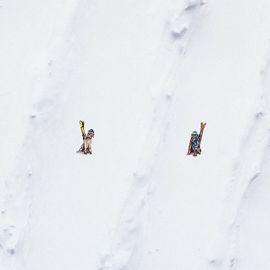
'Gone Clubbing' shows why the editions matter. The painting began as a snow scene, was painted over in green, and gained a bunker and a putting green before Bronkhorst added 27 golfers, among them Tiger Woods and Lewis Hamilton. He kept the original for touring exhibitions, and the print matches it at 100 x 100 cm.
Before and after
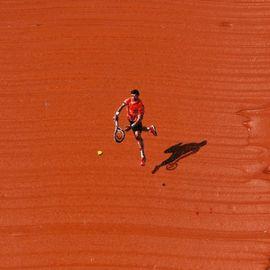
The collection followed 911 WHAT'S YOUR EMERGENCY?, his charcoal car drawings of early 2024. 'Rothcourt', a small green tennis court in the manner of Mark Rothko, was a warm-up for a Wimbledon project that grew into Singles in 2025. Later in 2024 'Gone Clubbing' and 'Good Greens' returned as framed mini prints in 12 Days.