

Artwork Series




Buy & Sell David Shrigley Art



About David Shrigley
From Leicester to Glasgow
Shrigley was born in Macclesfield in 1968 and went to school in Oadby, near Leicester. After a foundation course in art and design at Leicester Polytechnic he studied Environmental Art at Glasgow School of Art, graduating in 1991, and he stayed in Glasgow for the best part of three decades before moving to Brighton and Devon in 2015. Through the 1990s he built his reputation largely on paper, making ink drawings and publishing small books of them himself.
The drawing and the caption
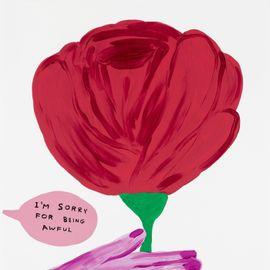
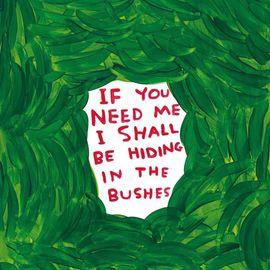
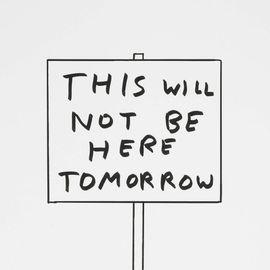
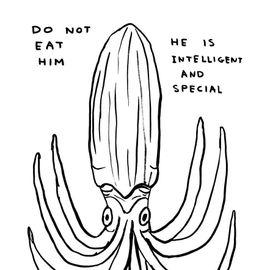
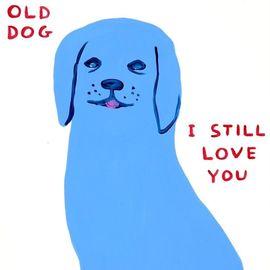
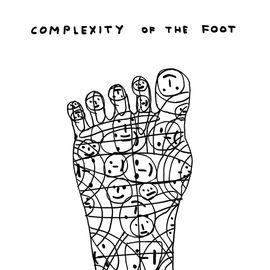
His drawings pair an image made with a quick, unpolished line with a few handwritten words. The results read like overheard remarks, instructions nobody asked for or lists that go slightly wrong, and they often take the viewpoint of an alien, a monster or an anxious narrator talking to himself. His London gallery, Stephen Friedman, described the humour as deadpan, and the texts as chance utterances; the commissioning statement for his Fourth Plinth sculpture placed the work in the British tradition of satire. The crude look is deliberate. Critics have tended to read the tension between that unpolished technique and the anxiety, absurdity and dark comedy the drawings carry as the core of the work, and it explains how the same drawing can be very funny and faintly bleak at once.
Beyond the page
Drawing stays at the centre, but Shrigley has taken its voice into almost every format. His animated short Who I Am and What I Want, co-directed with Chris Shepherd, won a Tiger Award for Short Film at International Film Festival Rotterdam in 2006. Pass the Spoon, an opera with music by David Fennessy and words and costumes by Shrigley, premiered at Tramway in Glasgow in 2011, was staged at the Southbank Centre in London in 2012 and was revived by Opera North in 2025. He has also made sculpture, painting and photography, worked on collaborative music projects, and kept publishing books, deliberately reaching audiences outside the gallery.
The Hayward Gallery's survey Brain Activity in 2012, which travelled to the Yerba Buena Center for the Arts in San Francisco, brought the range of this work together, and he was shortlisted for the Turner Prize the following year.
Really Good
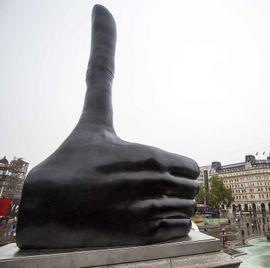
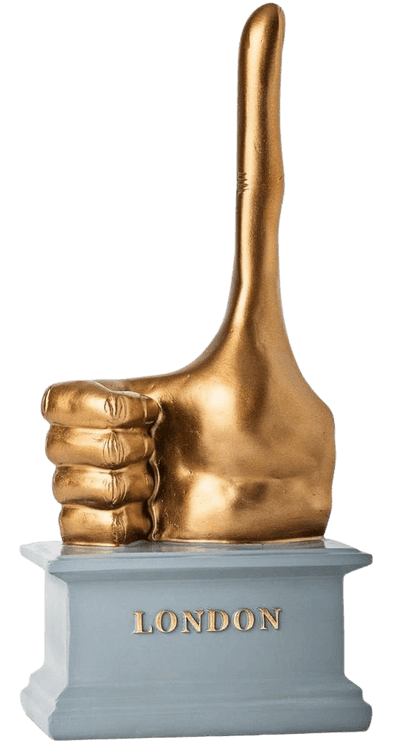
In 2016 Shrigley's Really Good became the eleventh commission for the Fourth Plinth in Trafalgar Square. The bronze hand gives a thumbs-up, cast with the same dark patina as the square's other statues, but the thumb is absurdly long. Shrigley's stated hope was that the gesture might become a self-fulfilling prophecy, nudging things usually agreed to be bad, such as the economy, the weather and society, towards a more positive consensus. The Mayor's office presented it as an open question: what, exactly, is really good, where is it, and who says so? The sculpture divided critics as sharply as it delighted crowds.
Recent projects
Shrigley's public commissions and later projects keep testing how far a joke can travel. Memorial, a five-metre granite slab carved like a war memorial, was installed in Central Park, New York, in 2016 for Public Art Fund. It is engraved instead with a shopping list, which he compiled from lists supplied by American friends, editing out anything too fancy so that only ordinary items remained. For Pulped Fiction in 2023 he pulped thousands of copies of a bestselling thriller and used the paper to print George Orwell's Nineteen Eighty-Four. In 2024 he unveiled The Mantis Muse, a three-metre praying mantis with an animatronic head, at his former school in Oadby, to make the case for art in schools.
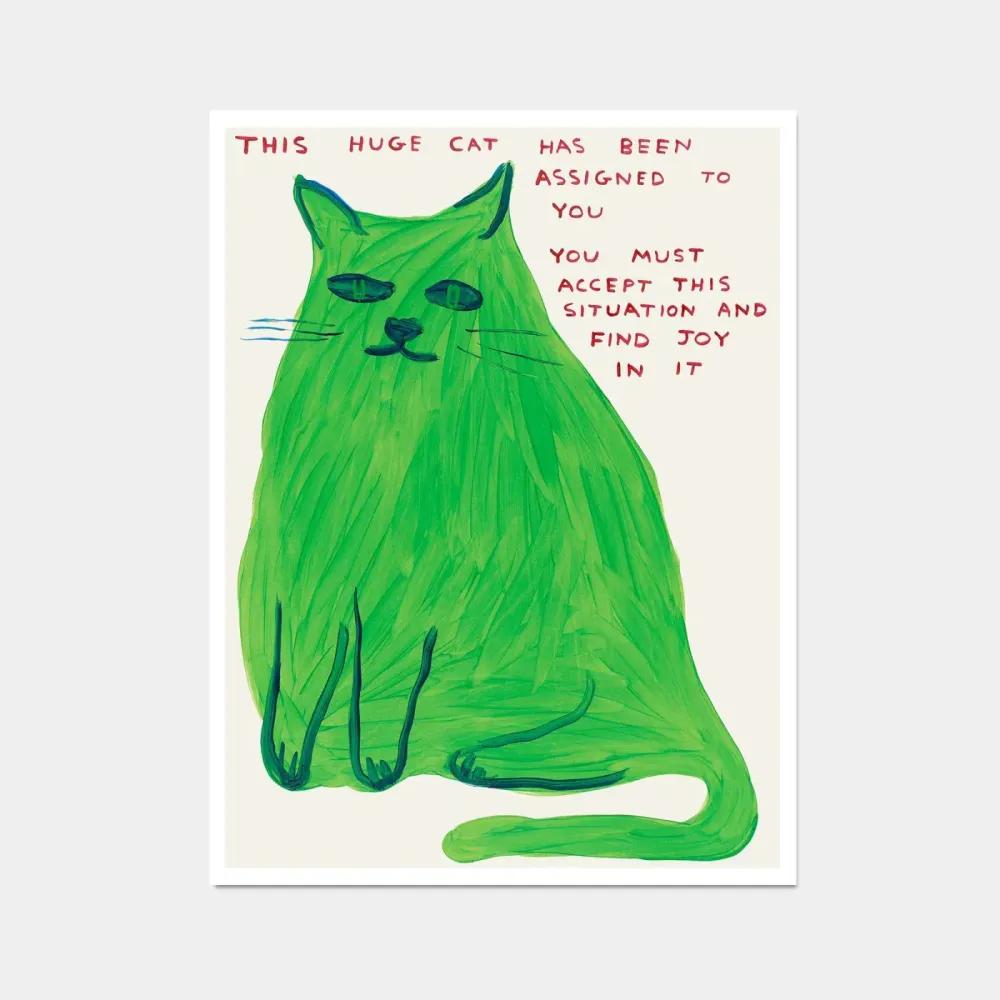
Untitled (This Huge Cat) (2022)
Collector & Guidance
Buying a David Shrigley
Most Shrigley prints are screenprints published by his galleries rather than by a single print publisher, usually in editions of 125 with a handful of artist's proofs. Jealous Gallery in London, Stephen Friedman Gallery in London and Galleri Nicolai Wallner in Copenhagen have all issued editions, as have Counter Editions and Shrig Shop, the Copenhagen shop he founded with Nicolai Wallner. Knowing which gallery published a print lets you check its edition details and dimensions against the original release.
Several recent screenprints, including I Will Retrieve Your Phone (2021), carry a varnish overlay on top of the printed colour. Varnished areas show scuffs and handling marks more readily than a matt surface, so ask for raking-light photographs across the sheet before you buy.
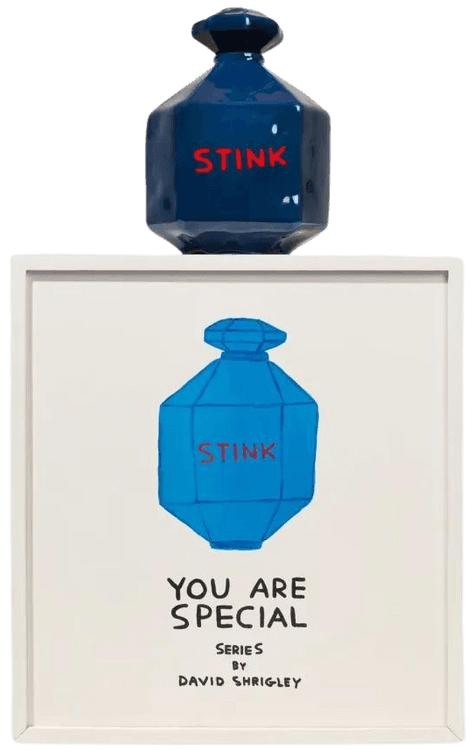
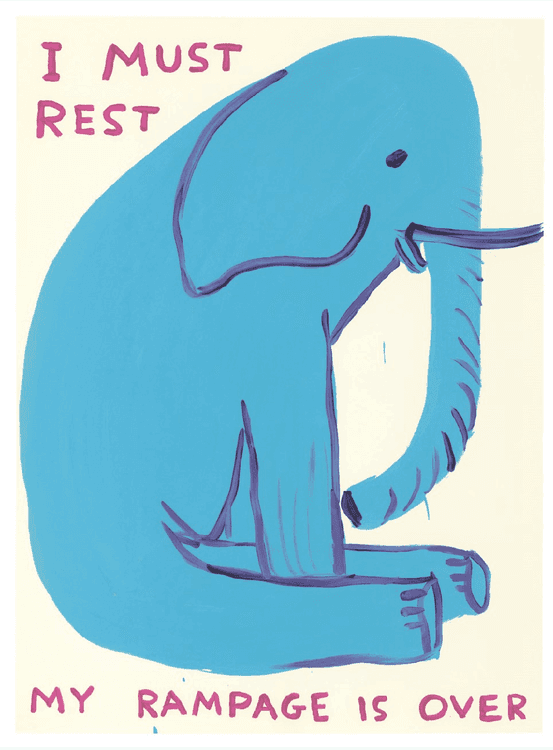
With ceramics, check the certificate as well as the object. I Must Rest My Rampage is Over, a hand-painted piece from You Are Special co-published with AllRightsReserved in Hong Kong, is numbered in ink on the underside, carries its signature on the accompanying certificate and was issued in a foam-lined wooden box. Buy a ceramic with its certificate and, ideally, its box.
Shrig Shop's offset posters are a different category from the screenprints. The Human Behaviour and Animals and Existentialism sets, for example, were printed in editions of 250 but are unsigned and unnumbered, so judge them as posters rather than as signed prints.
For unique drawings, trace provenance back to one of his galleries, such as Stephen Friedman Gallery, Anton Kern Gallery in New York or Galleri Nicolai Wallner, and ask for the invoice that connects the work to that source. Stephen Friedman Gallery entered administration in February 2026, so keep its original paperwork with any work bought there.
Selling a David Shrigley
Photograph the front of the sheet and the reverse, where his screenprints carry his initials, the date and the edition number in pencil. Record the publishing gallery, edition size and any proof designation, with your invoice.
For a ceramic, photograph the number on the underside and include the certificate and the original box.
For drawings, provide the full title as written on the work, the medium and dimensions, and the gallery the work was bought from. Note any light fading, handling marks or, on varnished prints, scuffs to the surface. Say whether the work is framed and whether the frame is original to the purchase.
Recognition
- Work held in collections including Tate, London; the Museum of Modern Art, New York; the Art Institute of Chicago; and the Centre Pompidou, Paris.
- Appointed OBE for services to visual arts in the 2020 New Year Honours.
- Solo exhibition What the Hell Was I Thinking? at Kunsthal Rotterdam, 2025–26.
- British Council touring exhibition Lose Your Mind, shown at six venues from 2015 to 2018, including the Power Station of Art, Shanghai.
- Survey exhibition David Shrigley: Life and Life Drawing at the National Gallery of Victoria, Melbourne, 2014–15.
Market & Collectability
Shrigley's highest reported auction result is Memorial (2016), the granite shopping-list monument, which sold for $165,100 including premium at Sotheby's New York in February 2023. His unique works on paper sit far lower. Untitled (It's OK) (2014), acrylic on paper, was reported sold for $44,100 at Sotheby's New York in March 2022, and recent unique works on paper have ranged from about £2,500 to £6,000: an untitled acrylic on paper from 2017 made £6,096 at Phillips London in July 2025, and an untitled ink drawing from 2021 made £2,451 there in July 2026.
Most of his market sits in gallery-published screenprints, usually in editions of 125 with a small number of artist's proofs. Over the last two years most have sold for between about £800 and £6,000. No One is Happier Than Me (2022) made £2,838 at Phillips London in September 2025, and an artist's proof of To Hell With Zoos (2021) made £6,096 there in January 2025. My Rampage Is Over (2019) is the exception: a numbered copy made £20,640 at Phillips London in September 2026, several times the usual level for one of his screenprints.
I Must Rest My Rampage is Over, a ceramic multiple from an edition of 75, made $1,905 at Phillips New York in September 2024, within the screenprint range. Unsigned offset posters from Shrig Shop are the entry level; a set of four made £254 at Phillips London in June 2023.
Recent unique works on paper and screenprints overlap in price, so a unique sheet is not automatically worth more than a print: compare a screenprint with other copies of the same edition, and assess each unique work on its own.
NOTABLE AUCTION RESULTS
My Rampage Is Over, 2019 (artist's proof) | Phillips London