Gerhard Richter|Cage
All Cage Works By Gerhard Richter (6)
Significance & Analysis
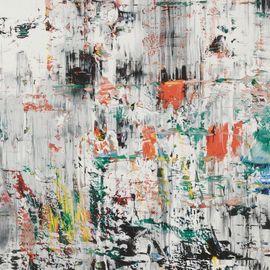
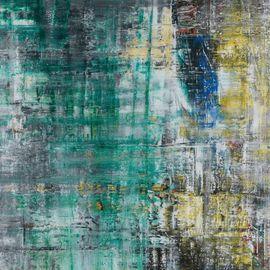
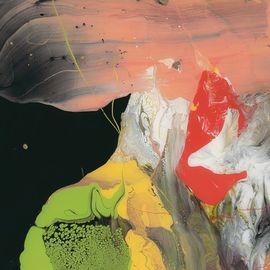
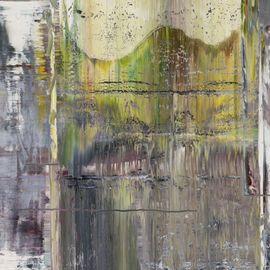
The 'Cage' prints reproduce, at about a third of the paintings' height and width, six canvases that Richter built up and scraped back in layers with a squeegee. HENI published them in London as giclée prints, a high-resolution inkjet process, face-mounted behind acrylic glazing (Diasec) on aluminium composite. Like HENI's earlier reproductions of Richter's paintings, they are what he calls facsimile objects, each a reproduction of a single painting.
How the paintings were made
Richter painted the six canvases in 2006 in rounds of application and removal. He drew wet paint across each surface with a large squeegee, a long blade, scraped parts of it away, and painted over it again, so that earlier layers show through the breaks in later ones. The surfaces keep the marks of that process: lines where the blade paused, scrapings, and ridges of dried paint. Richter has said: "Despite all my technical experience, I cannot always exactly foresee what will happen when I apply or remove large amounts of paint with the scraper."
He listened to John Cage's music while he worked and admired the composer's use of chance, but no painting corresponds to a particular piece of music. Three of the canvases measure 290 x 290 cm (114.2 x 114.2 in) and three 300 x 300 cm (118.1 x 118.1 in). They were first shown together at the 2007 Venice Biennale, in the exhibition directed by the American curator Robert Storr.
Where the series sits in Richter's work
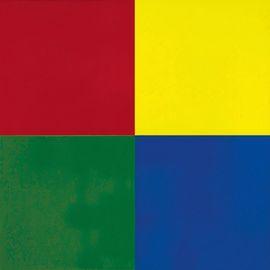
The prints are numbered P19-1 to P19-6 in HENI's numbered run of Richter reproductions, which began in 2014 with the editions in 'HENI P-Series Prints' and 'Flow'. HENI had already reproduced 'Cage (6)' in 2011 as 'Cage Grid', a giclée print in 16 panels. A few weeks after the 'Cage' prints, in January 2021, HENI released 'December 2020', six editions after watercolours Richter had painted that year. Richter signed those editions; the 'Cage' prints are unsigned.
Auction results
In April 2022 a 'Cage (P19 4)' sold for £27,720 with fees at Phillips London. In January 2024 a 'Cage (P19 5)' made €26,400 with fees at Van Ham in Cologne. Complete sets of all six prints sold for £90,000 with fees at Sotheby's London in September 2024 and £90,300 with fees at Phillips London in September 2025.
Prices were higher in 2021, the year after release. A complete set made £176,400 with fees at Phillips London in April 2021, and in June 2021 a 'Cage (P19 6)' sold for HK$403,200 with fees at Phillips Hong Kong.
How Many Cage Prints Were Made, and Are They Signed?
How Were the Cage Prints Sold?
How Can the Six Cage Prints Be Told Apart?
Where Have the Original Cage Paintings Been Shown?
Gerhard Richter Series