Gerhard Richter|Clouds and Seascapes (1969–1973)
All Clouds and Seascapes (1969–1973) Works By Gerhard Richter (5)
Significance & Analysis
'Seascape I' (1969) shows how Richter put these images together. The sea and the sky come from two negatives printed on one sheet and joined at the horizon, and the clouds are printed upside down. Richter printed it by offset lithography.
Richter began painting seascapes in 1968, the year before the first prints in this series. Many of those paintings combine a sky from one photograph with a sea from another, and they have been compared with the seascapes of Caspar David Friedrich, the German Romantic painter.
The cloud prints
'Wolken (Clouds)' of 1969 shows a sky with no land or sea in view. It has been catalogued as a montage of Richter's own photographs taken from an aeroplane, with the upper part of the sky turned through 180 degrees. The Griffelkunst-Vereinigung in Hamburg published it on thin card, with an image of about 45 x 40 cm (17.7 x 15.7 in).
'Wolke' (German for 'cloud') followed in 1971. Kunstring Folkwang in Essen issued it as an annual edition, and Richard Bacht printed it. The image is square, 44 x 44 cm (17.3 x 17.3 in), on a sheet of about 63.8 x 59.8 cm (25.1 x 23.5 in). Each numbered impression is signed on the front and numbered in pencil on the back.
The seascapes and the ship
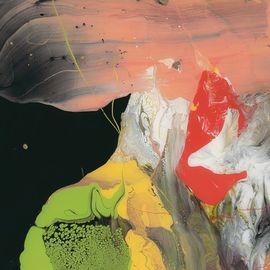
Edition Kirschbaum in Düsseldorf published 'Seascape II (Seestück II)' in 1970, printed in colour on textured card. Its main edition is printed on a black ground and measures about 60 x 45 cm (23.6 x 17.7 in). The print has been catalogued as a montage of photographs Richter took on the Canary Islands in 1969. The islands are also the subject of his 1971 'Canary Landscapes (Kanarische Landschaften)' heliogravures.
'Schiff (Ship)' of 1972 is a landscape offset on white card, built up from black, yellow, red and blue inks. Its image measures 40.3 x 57.7 cm (15.9 x 22.7 in), on a sheet of 49.7 x 64.9 cm (19.6 x 25.6 in). 'Meer' (German for 'sea') of 1973 is a much smaller image, 25 x 25 cm (9.8 x 9.8 in). The Kunstverein in Ghent issued it as its annual edition.
Auction results
In October 2023 a signed impression of 'Wolke' sold for €10,560 with fees at Van Ham in Cologne. 'Meer' made CHF 3,400 without fees at Germann in Zurich in June 2025. In December 2020 four prints from the series sold in a single Phillips London sale, all with fees. A trial proof of 'Seascape II (Seestück II)' made £11,340 and an impression from the black-ground edition £7,560. 'Meer' sold for £6,930 and 'Seascape I' for £5,670.
Are Clouds and Wolken (Clouds) Different Prints?
How Large Are the Editions in Clouds and Seascapes?
Edition sizes run from 100 for the black-ground 'Seascape II (Seestück II)' to 300 for 'Wolken (Clouds)':
- 'Clouds' and 'Wolken (Clouds)', 1969: one edition of 300, with 10 artist's proofs.
- 'Seascape I', 1969: 150, with 10 trial proofs.
- 'Seascape II (Seestück II)', 1970: 100 on a black ground, with a further 30 numbered in Roman numerals.
- 'Wolke', 1971: 150, with 12 artist's proofs numbered in Roman numerals.
- 'Schiff (Ship)', 1972: 250.
- 'Meer', 1973: 250.
What Should a Meer Print Come With?
Gerhard Richter Series