Gerhard Richter|Nine Objects (Neun Objekte)
All Nine Objects (Neun Objekte) Works By Gerhard Richter (4)
Significance & Analysis
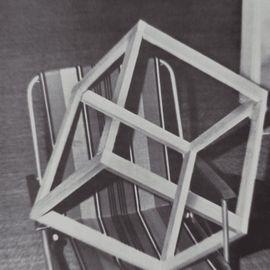
The objects in these prints look solid, but their geometry could not exist in three dimensions. Richter photographed the wooden models as they were and then had the photographs professionally retouched to his instructions. The impossible forms were made in that retouching.
What the prints show
Each sheet shows one of the wooden objects, printed in black by offset lithography from the retouched photograph. The image is about 32 x 32 cm (12.6 x 12.6 in), set on a square sheet of about 45 x 45 cm (17.7 x 17.7 in). Each sheet is catalogued as untitled, and the names used for single sheets describe what each one shows: 'Cube on Lawn Chair', 'Cube with Cups', 'Square with Shadow' and 'Table Legs'.
Reception and museum collections
The series has been read as a reversal of documentary photography. Photographers such as August Sander, and later Bernd and Hilla Becher, used the camera to record and classify real things. Richter used the same plain, catalogue-like pictures to show objects that cannot exist.
Several museums hold the portfolio. A complete set of nine belongs to the Ackland Art Museum in Chapel Hill, North Carolina, and the Museum Ludwig in Cologne acquired an early complete set with the help of its supporters' society. The Serralves Foundation in Porto also holds the work, while the Museum of Fine Arts, Boston, and the National Gallery of Art in Washington hold numbered sheets.
How Many Nine Objects Portfolios Were Made?
Are the Nine Objects Prints Signed?
How Can a Single Sheet Be Identified Without a Title?
Gerhard Richter Series