Gerhard Richter|Flow
All Flow Works By Gerhard Richter (6)
Significance & Analysis
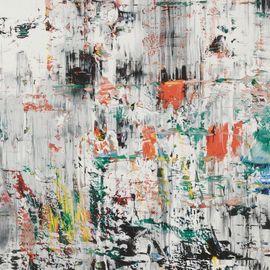
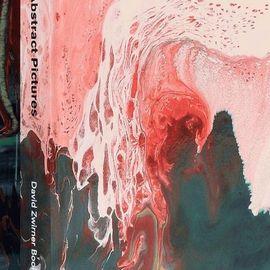
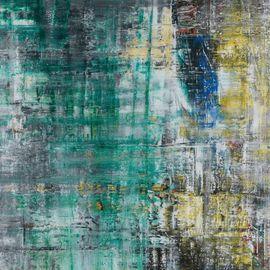
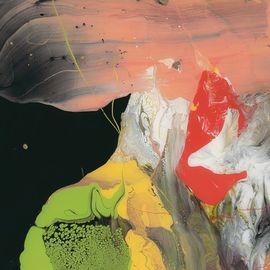
Richter made the 'Flow' paintings behind these prints by pouring paint rather than by using a brush or squeegee, and each one fixes the paint at the moment he chose to stop it. He poured enamel onto a surface laid flat, moved the paint about, and then lowered a sheet of glass onto it while it was still wet. The glass halted the paint where it lay. The finished painting is that sheet of glass, with the paint on its underside, mounted on Alu-Dibond, an aluminium composite board. Seen through the glass, the paint keeps the shapes it had formed when the glass stopped it.
How the prints were made
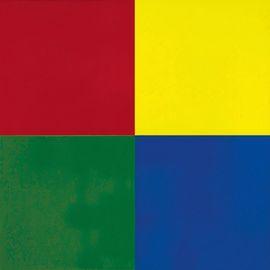
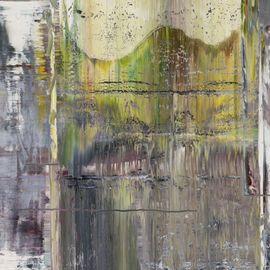
HENI in London made all six as chromogenic prints, a photographic colour process, face-mounted behind a sheet of acrylic (Diasec) on aluminium. 'Flow (P15)' and 'Flow (P16)' are catalogued as reproducing two of the 2013 paintings, numbers 933-2 and 933-3 in Richter's catalogue of his paintings. Both prints match the paintings' full size of 100 x 200 cm (39.4 x 78.7 in). The four earlier prints are squares of 45 x 45 cm (17.7 x 17.7 in), each after another 'Flow' painting.
Exhibitions and HENI's numbering
Two 'Flow' paintings were shown in January 2014 at the Kunstmuseum Winterthur in Switzerland, in 'Streifen & Glas' (Strips and Glass), beside Richter's 'Strip' paintings. Marian Goodman Gallery in London showed a larger group from October to December 2014. HENI gave its Richter reproductions numbers in a single sequence. 'Flow (P4)' to 'Flow (P7)' were numbered alongside the 2014 editions in 'HENI P-Series Prints', and 'Flow (P15)' and 'Flow (P16)' followed two years later. In 2020 HENI numbered the six 'Cage' prints P19-1 to P19-6.
Auction results
In June 2022 a 'Flow (P16)' from the Olbricht Collection sold for €19,800 with fees at Van Ham in Cologne. A 'Flow (P15)' made €15,840 with fees at the same house in November 2023. In October 2021 another 'Flow (P16)' sold for $16,380 with fees at Phillips New York. A set of the four small prints, 'Flow (P4)' to 'Flow (P7)', made $16,250 with fees at Phillips New York in September 2017.
How Large Are the Flow Editions?
Each of the six prints is an edition of 500.
- 'Flow (P4)', 'Flow (P5)', 'Flow (P6)' and 'Flow (P7)': issued in 2014, 500 each.
- 'Flow (P15)' and 'Flow (P16)': issued in 2016, 500 each with two artist's proofs. The Serpentine Galleries in London offered them in June 2016.
Are the Flow Prints Signed?
How Can the Four Small Flow Prints Be Told Apart?
Are Ifrit, Bagdad and Aladin Part of Flow?
Gerhard Richter Series