


David Hockney (1937–2026) was a British painter, printmaker and draughtsman from Bradford, known above all for the swimming pools and double portraits he painted in Los Angeles in the 1960s and 1970s. He worked in acrylic and oil, etching and lithography, photocollage and stage design, and from 2009 drew on the iPhone and later the iPad, returning throughout his life to the people close to him, to water and to landscape. In his last decades he turned the Yorkshire Wolds and the countryside around his Normandy home into long cycles of pictures tracking the arrival of spring.
Artwork Series
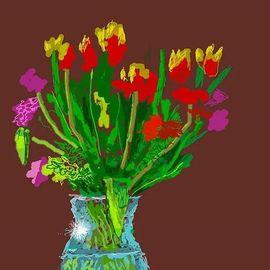
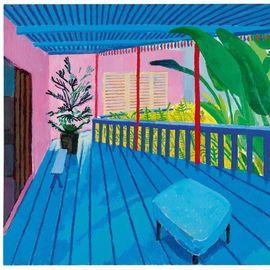





Buy & Sell David Hockney Art





About David Hockney
Art school and the first etchings
Hockney was born in Bradford in 1937, the fourth of five children, and studied at Bradford School of Art. A conscientious objector, he spent his National Service as a hospital orderly before going to the Royal College of Art in London in 1959. There the American painter R. B. Kitaj encouraged him to paint what actually interested him, and canvases such as We Two Boys Together Clinging (1961) dealt openly with love between men at a time when homosexuality was still illegal in Britain. The college threatened to fail him for refusing to write the required essay, and Hockney mocked its officials in a satirical etching. It relented, and he graduated. It relented, and he graduated in 1962 with the college's gold medal.
Etching had come early, partly because the college's printmaking department supplied materials free. A Rake's Progress (1961–63), sixteen etchings that rework Hogarth's moral tale around his first visit to New York, was published by Editions Alecto in 1963, and the money it earned paid for his move to California.
Pools and portraits in Los Angeles
He settled in Los Angeles in 1964 and soon changed from oil to acrylic, whose flat, quick-drying colour suited the hard light and the swimming pools he began painting that year. A Bigger Splash (1967) became one of his best-known paintings. Alongside the pools came large double portraits of friends and couples, among them Christopher Isherwood and Don Bachardy (1968) and Mr and Mrs Clark and Percy (1970–71), which shows the fashion designer Ossie Clark and the textile designer Celia Birtwell with their cat.
California also gave him his longest printmaking partnership. He met the master printer Ken Tyler there in 1964, made the Weather Series lithographs with him at Gemini G.E.L. in 1973, and in 1978 at Tyler Graphics in New York State produced the Paper Pools, images of water formed by pressing dyed paper pulp. Stage design ran alongside, from Stravinsky's The Rake's Progress at Glyndebourne in 1975 to productions for the Metropolitan Opera in New York in 1981.
Joiners and the trouble with the camera
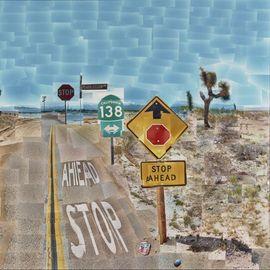
Hockney used photographs as source material for years but distrusted their single, frozen viewpoint, likening it to looking at the world as "a paralysed Cyclops, for a split second". From 1982 he answered that by assembling Polaroids, and then dozens or hundreds of small prints, into composite pictures he called joiners, each fragment taken from a slightly different place and moment. Pearblossom Hwy., 11–18th April 1986, #2, now at the J. Paul Getty Museum in Los Angeles, was built from hundreds of photographs. The same curiosity about how pictures are made led to Secret Knowledge (2001), his contested argument that earlier painters had used optical devices.
Landscapes in Yorkshire and Normandy
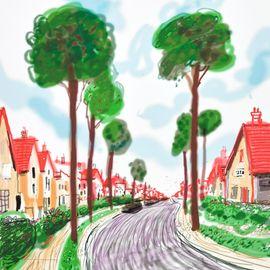
From 2005 he lived in Bridlington and painted the Yorkshire Wolds outdoors. Bigger Trees near Warter (2007), assembled from 50 canvases and more than 12 metres wide, was the largest work he had made when he gave it to Tate in 2008. From 2008 he drew on an iPhone and then an iPad, and the drawings he made at Woldgate through spring 2011 formed the centrepiece of A Bigger Picture at the Royal Academy in 2012, which drew more than 600,000 visitors.
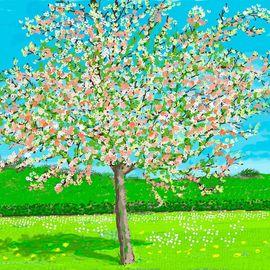
In 2019 he settled in a 17th-century house in Normandy. The first Covid spring there produced the iPad drawings shown as The Arrival of Spring, Normandy, 2020 at the Royal Academy in 2021. He went on to make A Year in Normandie, a frieze around 80 metres long inspired by the Bayeux Tapestry. He moved back to London in 2023 and died at home on 11 June 2026, aged 88.
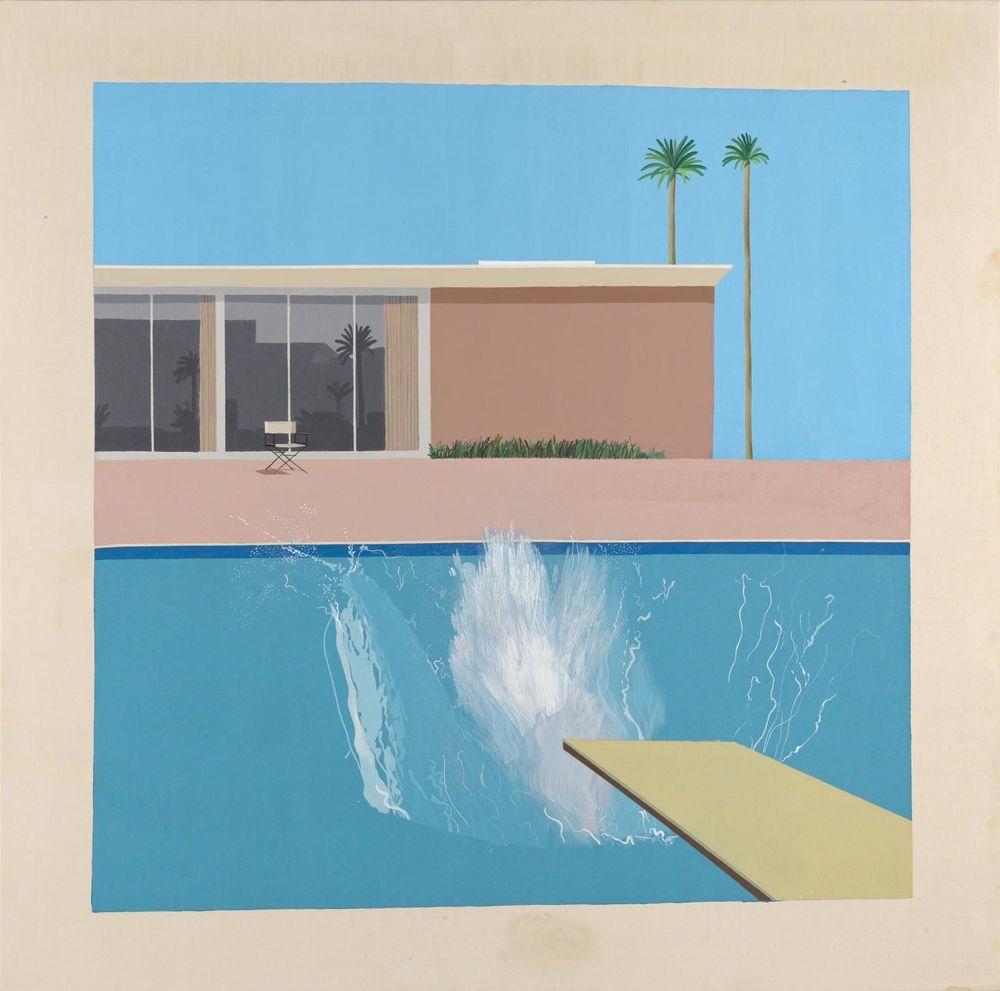
A Bigger Splash (1967)
Collector & Guidance
Buying a David Hockney
Paintings and unique drawings by Hockney trade at a level of their own. Below them, his editioned work falls into four families, each with its own publishers, formats and paperwork: original etchings and lithographs made with master printers, prints of his iPhone and iPad drawings, the art editions Taschen sold with his books, and posters. Settle which family a work belongs to before comparing it with anything else.
Etchings and lithographs
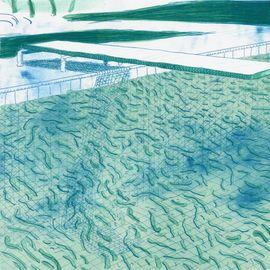
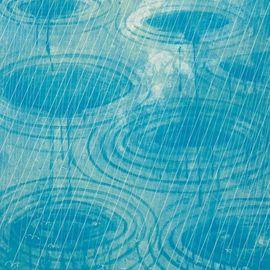
These are original prints, published by a small number of firms over his career: Editions Alecto and Petersburg Press for the etching portfolios of the 1960s and 1970s, Gemini G.E.L. in Los Angeles and Tyler Graphics in New York State for many of the lithographs. Each edition has a fixed size and a known run of proofs. Lithographic Water Made of Lines, Crayon, and a Blue Wash (1978–80), for instance, was printed in 48 impressions with 14 artist's proofs. Check the signature and number against the edition, note the publisher and the catalogue reference, and establish whether you are being offered a single sheet or a complete portfolio, since both circulate.
Prints of iPhone and iPad drawings
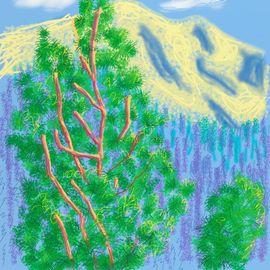
Hockney printed selected iPhone and iPad drawings on paper in numbered editions. The date in the title identifies the drawing, so two prints from the same group are different works if their dates differ. Format matters as much as date: the Woldgate drawings of spring 2011 were issued as single sheets in editions of 25 and, for some dates, as larger versions printed across four sheets and mounted on Dibond in editions of 10, such as The Arrival of Spring in Woldgate East Yorkshire 4th May 2011. Match both before comparing prices.
Taschen art editions
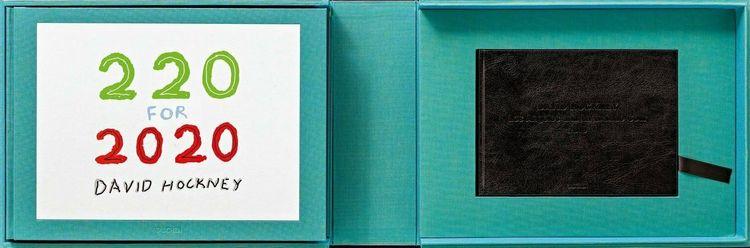
Taschen published A Bigger Book (2016) and My Window (2019) in large editions and in art editions of 250, each with a print of one drawing. The print, the book and, for A Bigger Book, the stand designed by Marc Newson were sold together, so check that every part is present before comparing a work with complete examples.
Posters
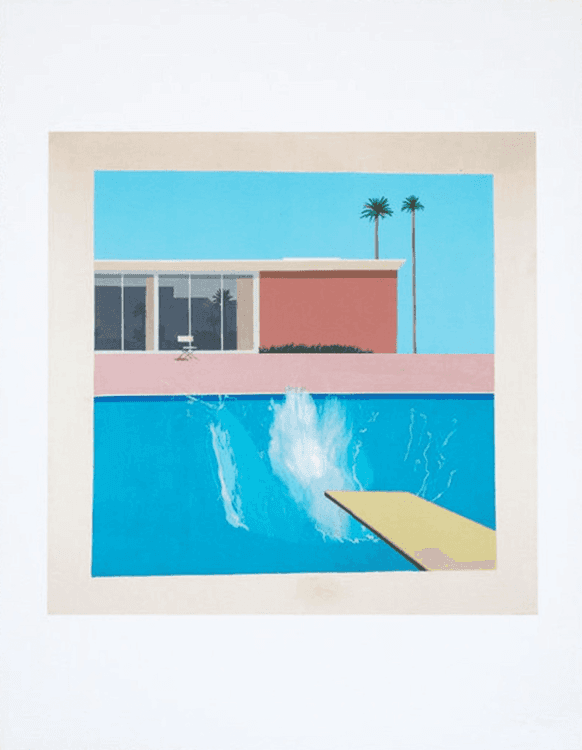
Hockney designed posters for his own exhibitions and for events such as the 1972 Munich and 1984 Los Angeles Olympic Games. They are offset prints, and some carry his signature, which adds to their appeal without making them original prints. Museum posters printed long after the original work, such as A Bigger Splash (Tate 2017), are decorative reproductions rather than editions.
Selling a David Hockney
Most Hockney sales depend on pinning down the exact edition, so give a buyer the details that do it. For an etching or lithograph, that means the title and year, the publisher, any catalogue reference you know, the edition number or proof designation exactly as written, and photographs of the signature and of any stamps or inscriptions in the margins and on the back.
For a print of an iPhone or iPad drawing, give the full title with its date, the format (single sheet or several sheets, and any mount) and the edition number. For a Taschen art edition, say which art edition it is, its number out of 250, and whether the print, the book and any stand are all present.
For a poster, say whether it is signed and in what, which exhibition or event it was printed for and its size, and photograph any folds or tears. A unique drawing or painting needs its history set out from the gallery or sale where it was first bought, with invoices and any exhibition record.
Recognition
- Appointed Officier of the Légion d'honneur, France, 2026.
- Appointed to the Order of Merit by Queen Elizabeth II, 2012.
- Appointed a Member of the Order of the Companions of Honour, United Kingdom, 1997.
- Praemium Imperiale for Painting, awarded by the Japan Art Association, Tokyo, 1989.
- First prize, John Moores Painting Prize, Walker Art Gallery, Liverpool, 1967, for Peter Getting Out of Nick's Pool.
- Exhibition David Hockney 25, Fondation Louis Vuitton, Paris, 2025.
- Retrospective David Hockney, Tate Britain, London, 2017, touring to the Centre Pompidou, Paris, and the Metropolitan Museum of Art, New York.
- Designed the Queen's Window, a stained-glass window in Westminster Abbey, London, dedicated in 2018.
Market & Collectability
Hockney's highest auction result is Portrait of an Artist (Pool with Two Figures) (1972), an acrylic painting that sold for $90,312,500 at Christie's New York on 15 November 2018. Not every painting reaches eight figures: The Only One with Waves (1991) made £2,423,000 at Phillips London in June 2026.
Among editions, prints of his iPad drawings now lead. A sheet of The Arrival of Spring in Woldgate East Yorkshire 19th February 2011, from an edition of 25, made £762,000 at Sotheby's London on 17 October 2025, and other dates from the same spring have sold for six figures. Of the earlier prints, a complete set of the sixteen etchings of A Rake's Progress (1961–63), from an edition of 50, made £254,000 at Phillips London in September 2024, and single Weather Series lithographs of 1973, in editions of 98, have made between £28,380 and £70,950 there since.
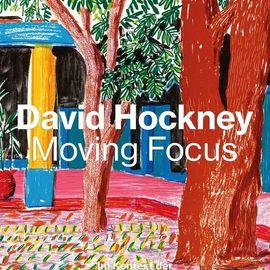
The art editions Taschen issued with his books, each limited to 250 and including a print of one iPhone or iPad drawing, have made £18,060 to £25,800 at Phillips. Single etchings from the larger portfolios start in the low thousands: The Sexton Disguised as a Ghost (1969), from the Grimm fairy-tale portfolio in an edition of 100, made £2,032 in September 2024. Signed posters have made £640 to £1,536 at Bonhams, while an unsigned poster for the 1984 Los Angeles Olympic Games reached £3,302 at Phillips. Prices since his death have been uneven. At Phillips London in September 2026 the Moving Focus lithograph Tyler Dining Room (1984) made £141,900, while an impression of Celia Smoking (1973), from an edition of 70, made £6,450, roughly half what another impression fetched at the same house in 2022.
Every price quoted here includes buyer's premium. The fair comparison for any Hockney edition is another impression of the same title and format, in similar condition.
NOTABLE AUCTION RESULTS
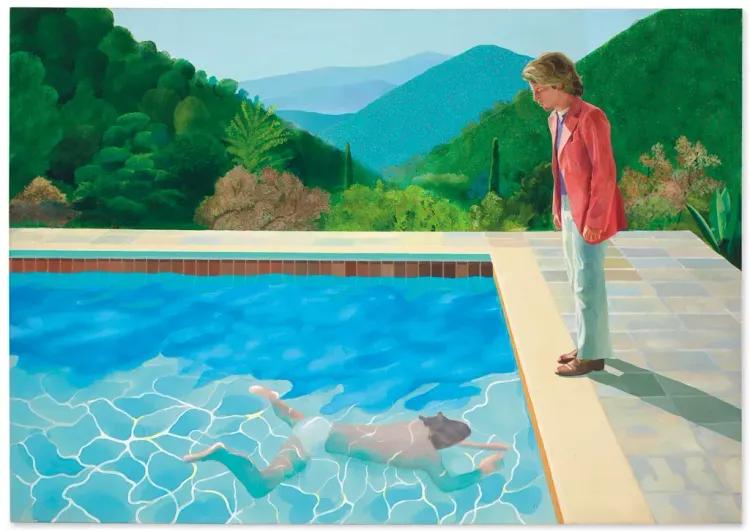
Portrait of an Artist (Pool with Two Figures), 1972 | Christie's, New York