David Hockney|A Simple Heart (Gustave Flaubert)
All A Simple Heart (Gustave Flaubert) Works By David Hockney (3)
Significance & Analysis
These etchings joined two things that mattered to Hockney in the mid-1970s: the colour etching he learned in Paris, and his mother as a sitter. Between 1973 and 1975 he lived in Paris for long periods, where he began making etchings at Atelier Crommelynck, the studio in which Picasso had made prints during the last twenty years of his life. His parents visited him there, and in the Flaubert prints his mother stepped into a role from French literature.
Félicité, Loulou and the geography book
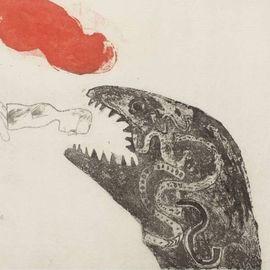
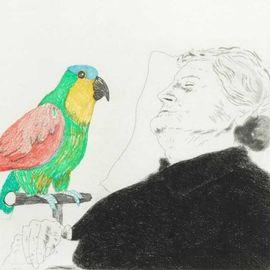
Flaubert published 'Un coeur simple' in 1877 in 'Trois contes'. It follows Félicité, a servant in Pont-l'Évêque who gives her loyalty to a household and loses, one by one, everyone she loves. Her parrot, Loulou, came from America, which reminded her of her nephew Victor, who had died abroad. After the bird's death she had it stuffed, came to see a parrot in the church's image of the Holy Ghost, and at her own death imagined a gigantic parrot hovering above her. 'Félicité Sleeping, With Parrot' gives her the bird as a companion in sleep. 'Geography Book' takes its full title, 'Félicité's Only View from Abroad', from an engraved geography given to the children of the house, with its cannibals, a gorilla and a harpooned whale. In Flaubert's words this was "her only literary education", and Hockney made the book itself the subject of a print.
Hockney's mother as Félicité
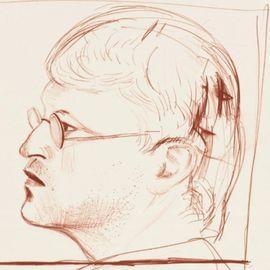
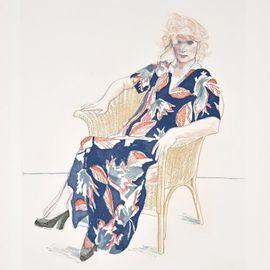
The two studies cast Hockney's mother as the servant at two ages. 'My Mother Today; as a Study for Félicité' draws her as she was in 1974, and 'My Mother at Age Twenty (From a Photograph): as a Study for Félicité' works from a photograph of her as a young woman. 'My Mother And A Parrot' brings her together with the story's bird. The studies are small, portrait-format sheets: an image of 17.8 x 12 cm for 'My Mother Today'.
Before and after
After Picasso's death in April 1973, Hockney made etchings in his honour, among them 'The Student: Homage to Picasso', and learned from Aldo Crommelynck the sugar-lift method, in which the image is brushed directly onto the plate. The Paris training carried into 'The Blue Guitar' of 1976 to 1977, twenty etchings after the poem by Wallace Stevens. Each was printed in a selection of five colours, using the method Crommelynck taught him of printing colour from a single plate. In that series Hockney moved away from illustration: he intended the etchings as interpretations of the verse, not literal pictures of it.
What Are the Edition Sizes of the A Simple Heart Prints?
Why Does My Mother And A Parrot Show Two Images?
Who Printed and Published the Flaubert Etchings?
Are There Proofs Outside the Editions?
David Hockney Series