
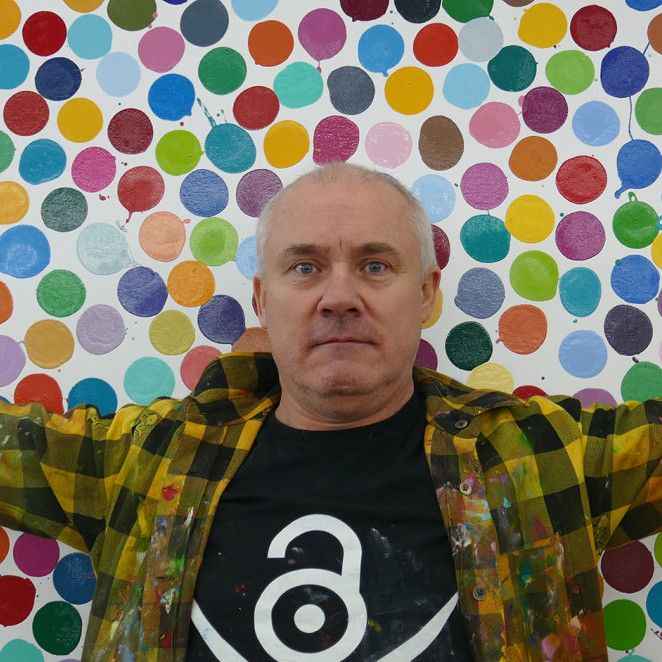


Damien Hirst is a British artist who emerged with the Young British Artists in late-1980s London. He is known for animals preserved in tanks of formaldehyde, glass-fronted medicine cabinets, and the Spot Paintings, spin paintings and butterfly works he has produced in quantity ever since. His imagery borrows the look of science, medicine and religion, and it keeps returning to death and to the systems people use to give life meaning and value.
Artwork Series

Buy & Sell Damien Hirst Art

About Damien Hirst
Leeds, Goldsmiths and Freeze
Hirst was born in Bristol in 1965 and grew up in Leeds. As a teenager he drew in the anatomy department of the city's medical school, experiences he later connected with his preoccupation with death. He moved to London in 1984 and studied fine art at Goldsmiths College from 1986 to 1989. In 1988, during his second year, he conceived and curated Freeze, a show of his own work and that of fellow students in a disused London warehouse. The exhibition came to be seen as the starting point of a generation that also included Tracey Emin, Sarah Lucas and Jake and Dinos Chapman.
Cabinets, spots and tanks
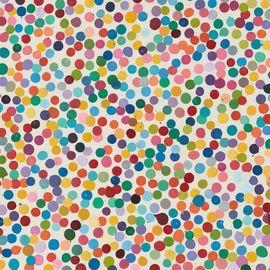
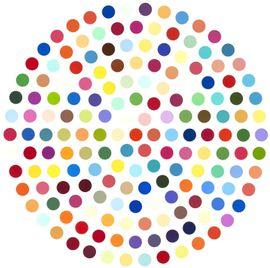
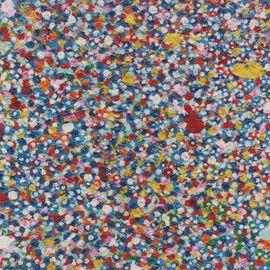
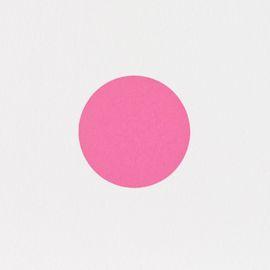
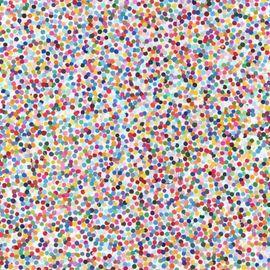
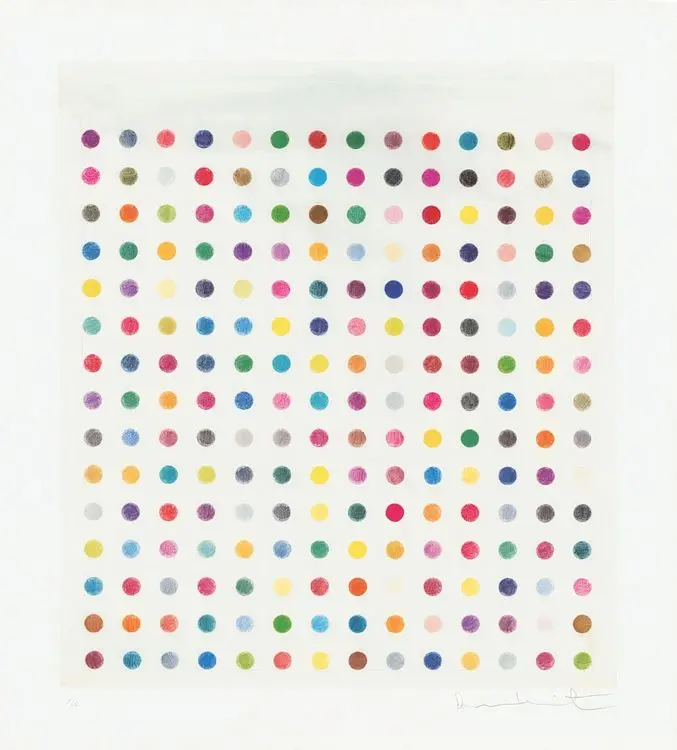
The forms that still define his work arrived within a few years. While at Goldsmiths he assembled his first medicine cabinet, Sinner (1988), and soon afterwards began the Spot Paintings: grids of identical, evenly spaced circles of colour. Hirst has said the grid solved a problem he had always had with colour, giving him a structure in which he controlled it rather than the other way round. By 2012 there were enough to fill all eleven Gagosian galleries at once: The Complete Spot Paintings 1986–2011 showed more than 300 of them simultaneously.
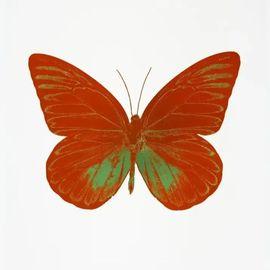
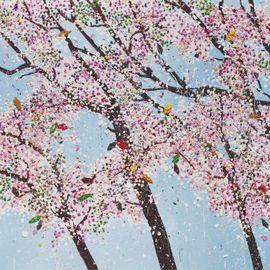
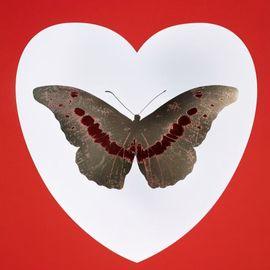
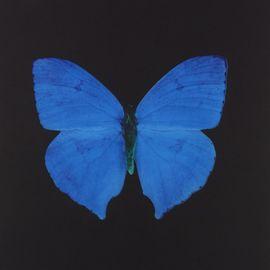
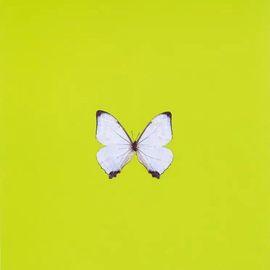
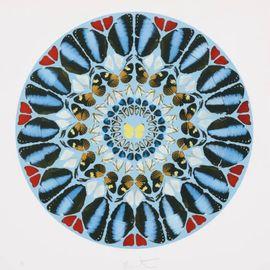
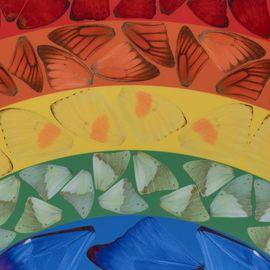
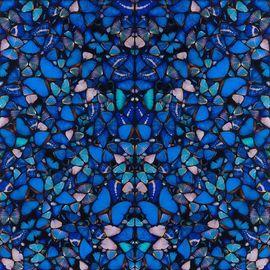
In 1991 he filled a former travel agent's office in London with live butterflies for In and Out of Love. Butterflies became a recurring material, later fixed whole into wet household gloss on canvas. The same year he made The Physical Impossibility of Death in the Mind of Someone Living, a tiger shark suspended in formaldehyde solution. The Natural History sculptures that followed, with sheep, cattle and fish in steel and glass tanks, remain the works most closely tied to his name. Hirst has explained the shark and the butterflies as universal triggers, choosing things almost everyone fears or loves.
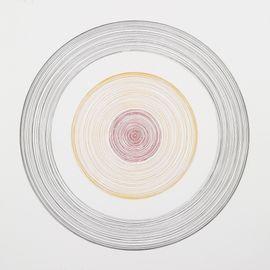
Spin paintings, made by pouring paint onto a rotating surface, brought chance into the same vocabulary. Pharmacy (1992), a room-sized installation laid out as a chemist's shop, took the logic of the medicine cabinet to the scale of architecture. Across all of these, order and decay are set side by side: neat shelves and grids beside dead animals and the drugs that hold death off.
Value as material
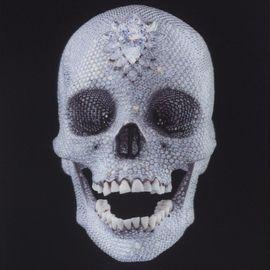
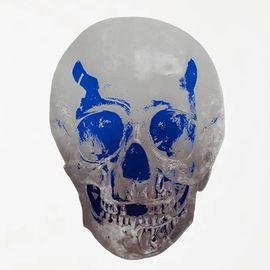
By the mid-2000s Hirst was treating money and ownership as part of the work. For the Love of God (2007) is a platinum cast of an 18th-century human skull, keeping its original teeth and covered in diamonds, first shown at White Cube in London. In September 2008 he consigned more than 200 new works directly to Sotheby's in London for Beautiful Inside My Head Forever, bypassing the galleries that usually sold his work. The two-day sale opened as Lehman Brothers collapsed.
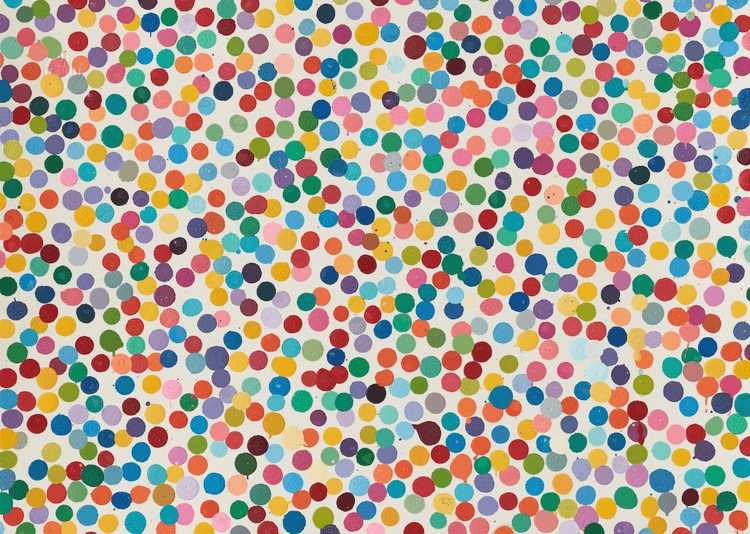
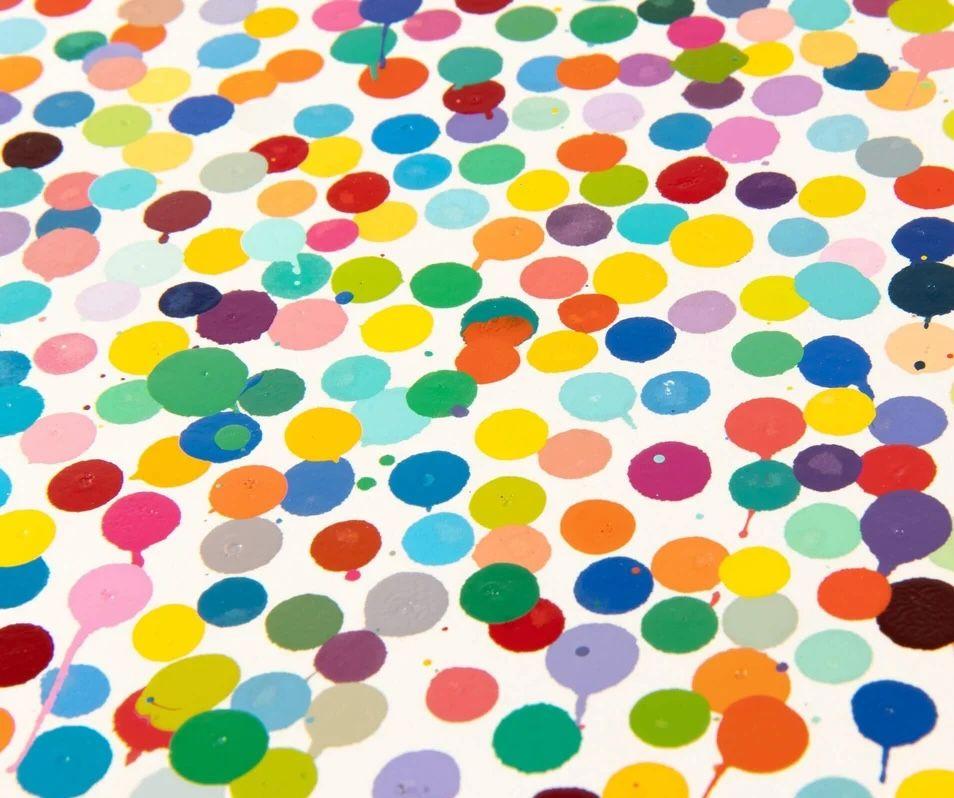
Many of his recent editions are published by HENI and catalogued with H codes. In 2021 he launched The Currency, 10,000 unique spot paintings on paper made by hand in 2016, each first sold as an NFT. Holders were given a year to choose between the token and the physical sheet, and whichever they gave up was destroyed. The unclaimed paintings were burned at Newport Street Gallery in London in 2022. Hirst has described the whole project as a single artwork in which people take part by buying, holding and selling.
Damien Hirst - The Currency (2020)
Collector & Guidance
Buying a Damien Hirst
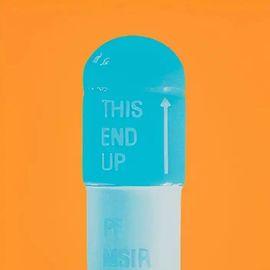
Start by establishing exactly what kind of object you are looking at. Hirst's market runs from unique works (formaldehyde sculptures, medicine cabinets, Spot, spin and butterfly paintings) through editioned multiples such as the pill cabinets of the early 2000s, to screenprints and etchings, HENI's giclée editions on aluminium, and the unique works on paper from The Currency. The same imagery appears across all of these: a butterfly or spot composition can be a unique painting, a signed screenprint or a HENI edition of several thousand. It is the type of object, more than the image, that separates their prices.
Unique works and works on paper
Trace provenance back to the studio, one of his galleries or a documented sale wherever possible, and ask for the invoice or paperwork that makes that connection. This matters most for small spin paintings on paper, which are among the most accessible unique works and have been faked: in 2016 counterfeit examples carrying signatures and studio stamps on the reverse were offered at several UK auction houses. A signature or stamp alone is not enough. Some works carry certificates from the Hirst Authentication Committee; treat any certificate as one part of the documentation, alongside the provenance.
Prints and multiples
For screenprints, etchings and editioned objects, confirm the edition size, the number on your example and how it is signed. Editions range from a few dozen to well over a thousand: the screenprint with collage For the Love of God, Believe (2007) was issued in an edition of 1,700. Signed works on paper sometimes carry a personal dedication, which makes them a different object from an undedicated example and should be part of any comparison.
HENI editions
Note the H code, the title and the edition size, which runs from a few dozen to several thousand for the same kind of object. HENI's largest editions carry a printed signature on the label on the reverse, while smaller editions are signed in pencil on that label, so check which applies before comparing prices. Complete sets of a release circulate alongside single works, and a full set is a different purchase from one print. Ask whether the original HENI box and packaging survive.
The Currency
Each surviving physical work is unique, hand-painted in enamel on handmade paper, and numbered, titled, stamped and signed on the back. The paper also carries a watermark, a microdot and a hologram portrait of the artist. Check all of these on the object itself. A physical work no longer has its NFT, which was destroyed when the holder chose the sheet.
Selling a Damien Hirst
Identify the object type first, because it determines what a buyer needs to see. For every work, provide clear photographs of the front and the reverse, every signature, stamp, label and inscription, the edition number where there is one, and any invoice, certificate or correspondence that shows where the work came from.
For a unique work or a signed work on paper, set out how it was acquired: the gallery or sale, the date, and for gifts or dedicated works the occasion and any accompanying letter. For prints and multiples, give the medium, edition size and number, and say whether it is signed by hand or carries a printed signature.
For a HENI edition, give the H code, title and edition number, say whether you still have the original box and packaging, and say if you own a complete release, since a complete release can be offered as a single lot. For a work from The Currency, give its number and title and photograph the back so the hologram, microdot, stamp and signature are visible.
Recognition
- Winner of the Turner Prize, 1995.
- Work held in the collections of Tate, London, and the Museum of Fine Arts, Boston.
- Mother and Child Divided, first shown at the 1993 Venice Biennale, is in the collection of the Astrup Fearnley Museet, Oslo.
- Survey exhibition Damien Hirst at Tate Modern, London, 2012.
- Retrospective The Agony and the Ecstasy at the Museo Archeologico Nazionale, Naples, 2004.
Market & Collectability
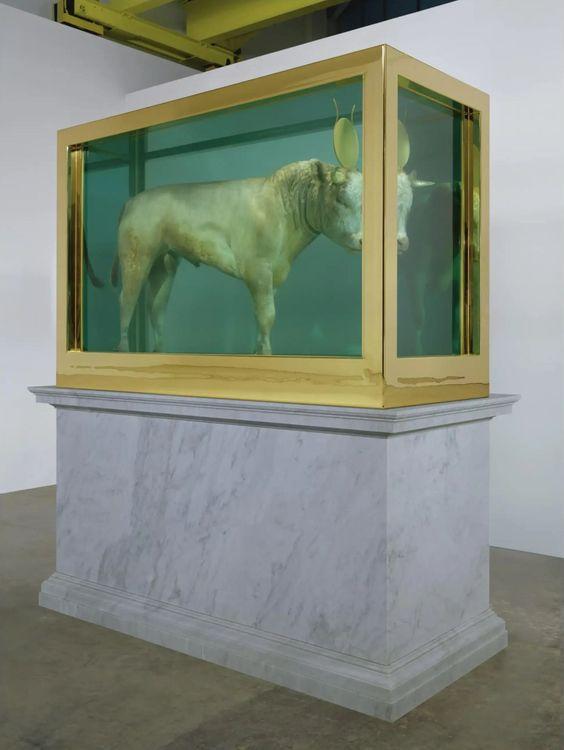
Hirst's top auction prices date from Sotheby's London in 2007 and 2008. The Golden Calf (2008), a calf with 18-carat gold horns and hooves in formaldehyde solution, sold for £10,345,250 on 15 September 2008 during Beautiful Inside My Head Forever. Lullaby Spring (2002), a steel and glass cabinet of individually painted pills, sold for £9,652,000 on 21 June 2007. The calf is the larger figure in sterling; Lullaby Spring was the larger in US dollars at the exchange rates of the day. All prices on this page include buyer's premium.
Recent sales show how far the market extends. At Phillips in London, Day in Day Out (2003), an editioned pill-cabinet multiple, made £177,800 in October 2024, and a complete set of the eight HENI prints The Virtues (H9, 2021) made £82,550 in June 2025. A unique spin painting on paper from 2014, signed and dedicated, sold for £5,080 at the same June 2025 sale. Among single HENI prints, Fire, from The Elements (H6-8, 2020), from an edition of 60, made £8,890 in June 2024, while Butterfly Heart (Large) (H7-3, 2020), from an edition of 1,698, made £1,905 at the same sale. A signed and dedicated screenprint with collage, For the Love of God, Believe (2007), from an edition of 1,700, sold for £1,397.
NOTABLE AUCTION RESULTS
Sotheby's: The Golden Calf, 2008
FAQS
What is the most expensive Damien Hirst ever sold?
What does the H number on a Damien Hirst print mean?
It is the catalogue code for a HENI release. The number after the H identifies the release and the suffix identifies the individual work. One release can contain more than one titled group: H6 includes works from both The Aspects and The Elements. Quoting the full code is the quickest way to make sure a print is being compared with the right release.
Do Damien Hirst's editioned pill cabinets come with pills?
Not always. The Day by Day cabinets of 2003, issued in an edition of 35, were supplied without pills: Hirst intended owners to choose and place the pills themselves. Check what a specific edition included before assuming the contents are original.
How many physical works from The Currency still exist?
5,149. When the exchange period closed on 27 July 2022, that many holders had chosen the physical painting. The other 4,851 kept the NFT, and their paper counterparts were burned.