Damien Hirst|40 Woodcut Spots
All 40 Woodcut Spots Works By Damien Hirst (41)
Significance & Analysis
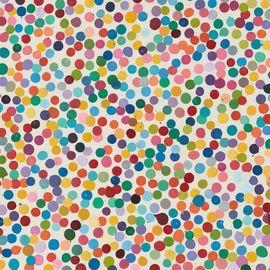
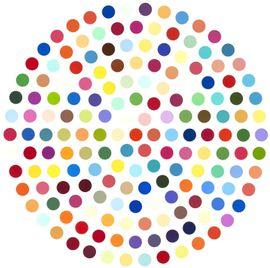
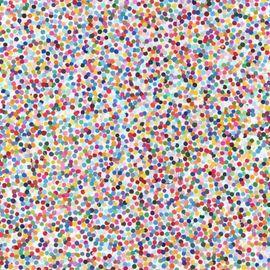
The series sets Hirst's most machine-like motif against one of printmaking's oldest hand processes, and then tests it at forty different scales. The spot paintings were built to look as if no hand had touched them. Here every circle had to be cut into wood, inked and pressed onto paper.
One rule, forty formats
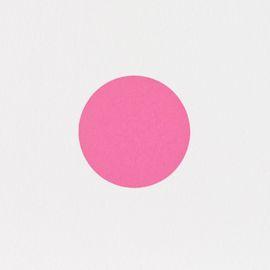
What changes from print to print is size and count, never the system. 'Oleandrigenin' is one orange spot on a sheet barely 16 cm across, and 'Equilin' a single blue one. 'Picolinic Acid' crops the grid so hard that only one and a half circles remain on a long, narrow strip. At the other end, 'Ala-Met' sets twenty spots on a sheet 80.2 x 63.5 cm, and 'Fast Scarlet TR Base' turns the grid on its side at 64.8 x 78.7 cm. Seen together, the forty sheets read like samples cut from one endless spot painting at different points and magnifications.
Cut, not painted
Woodcut is a relief process: the areas meant to print are left standing on the block, everything else is cut away, and the raised surface is inked and pressed onto the sheet. The colour lies flat and dense on the heavy Somerset paper, with none of the faint brush marks that remain on a painted spot. The prints were published by The Paragon Press, the London publisher Charles Booth-Clibborn founded in 1986, which had already editioned Hirst's spot etchings.
At auction
'Ala-Met', the largest sheet, made $29,110 with premium at Phillips in September 2022, more than three times the $8,750 it fetched at Christie's in October 2014. The small sheets trade at a fraction of that: the single orange spot of 'Oleandrigenin' made £2,805 at Bonhams in London in the summer of 2020.
Before and after
The woodcuts followed Paragon's spot etchings of the previous decade, part of Hirst's wider run of Spots prints, which had kept the circles on paper through photography, etching and screenprint. Woodcut then became the medium Hirst kept returning to with the same publisher: single sheets such as 'Lactulose' and 'Isocytosine' in 2017, and a further set, '2018 Woodcut Spots', the following year.
Are All The Titles Names Of Drugs?
Which Are The Largest And Smallest Prints?
Where Are The Prints Signed And Numbered?
Damien Hirst Series