Damien Hirst|Mickey & Minnie
All Mickey & Minnie Works By Damien Hirst (6)
Significance & Analysis
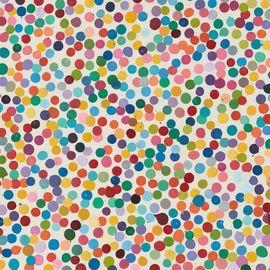
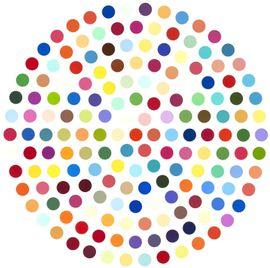
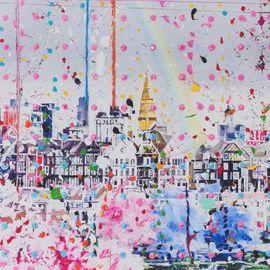
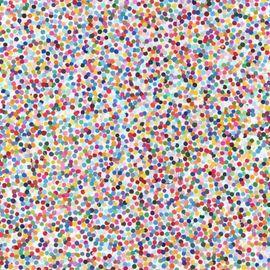
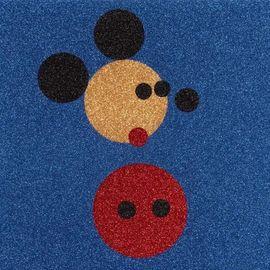
'Mickey & Minnie' is where Hirst's spot paintings met the most recognisable cartoon character in the world, at Disney's own invitation. The prints follow 'Mickey' (2012), a spot painting in household gloss that Hirst gave to Christie's to sell for the children's charity Kids Company. In February 2014 it made £902,500. A mouse made of spots Hirst built the figure from his own visual language: a handful of flat coloured circles, sized and placed so that ears, head, body and big yellow shoes read at once as Mickey. He has said the character "represents happiness and the joy of being a kid" and called him "a universal and powerful icon". With it he joined a line of artists who have taken Mickey as a subject, from Claes Oldenburg and Roy Lichtenstein to Andy Warhol. Spots, spin and glitter The prints came in stages. In 2014 Other Criteria published 'Mickey' as a screenprint in two sizes, large and small. 'Beautiful Mickey' followed in 2015, the first Other Criteria print to show Hirst's spin technique, with the mouse's silhouette set into a whirl of colour. In 2016 Mickey returned in blue glitter and gained a partner, Minnie, in pink glitter. The glitter sits on the surface of the sheet, so those prints catch the light as the viewer moves. At auction Both large glitter prints set their highs in the same sale. In October 2021 a blue-glitter 'Mickey' numbered 7/50 made $81,900, or £59,349 once fees were added, in Sotheby's online Important Prints & Multiples sale in New York. The 'Minnie' with the same number came up in the next lot and reached $69,300 (£50,217), each beating its $30,000 to $50,000 estimate. Before and after The mouse grew out of Spots, Hirst's long-running paintings of evenly spaced coloured circles, here loosened into a figure. 'Beautiful Mickey' brought in the other half of his abstract practice, the spin painting, and the 2016 glitter prints added Minnie, turning a single portrait into a pair.
What Sizes And Editions Do The Mickey & Minnie Prints Come In?
Are The Mickey And Minnie Glitter Prints A Pair?
Where Is A Mickey & Minnie Print Signed?
Damien Hirst Series