Damien Hirst|The Cure
All The Cure Works By Damien Hirst (30)
Significance & Analysis
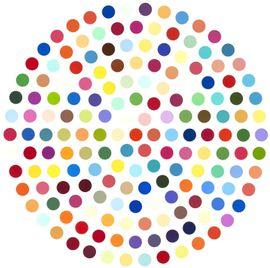
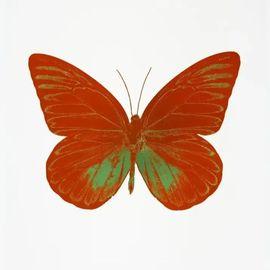
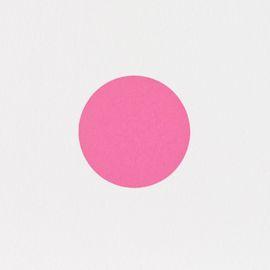
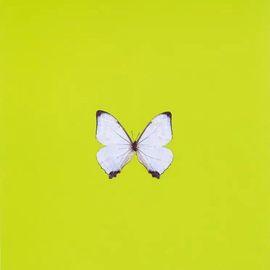
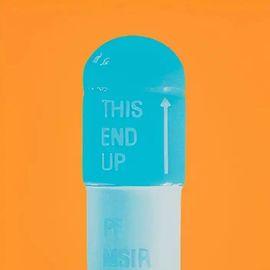
'The Cure' takes the pill out of the cabinet. For years Hirst had shown tablets in their thousands, each cast individually and set in rows behind glass and steel. Here a single capsule fills the sheet, on a ground of sweet, flat colour, and it looks more like an advertisement than a prescription. Hirst has said as much about pills themselves: "Pills are a brilliant little form, better than any minimalist art. They're all designed to make you buy them." A wall of thirty The prints made their debut in October 2014 at Paul Stolper's London gallery, in an exhibition Hirst called 'Schizophrenogenesis'. They hung together as a single wall. Facing them, the gallery was filled with resin sculptures of pharmaceuticals: fourteen pills each 30 cm long, ten smaller ones, and bottles, ampoules, syringes and boxes, the tallest nearly one and a half metres high. Scale was the tool. Blown up on paper or in resin, the tidy, confident design of a medicine becomes impossible to overlook. Why 'The Cure' The title states the promise every pill makes. Hirst's work keeps returning to the near-religious trust people place in science and in medicine, and the definite article makes that promise absolute. Nothing in the image argues back: the candy colours and clean outline sell the idea as smoothly as any packaging. At auction The strongest recent result came for a group of prints rather than a single sheet. In June 2026 eight prints from the series, offered as one lot, made $40,960 (£30,523) including premium at Rago in Lambertville, New Jersey. A single print has made £8,125 with fees: 'The Cure (Fire Red, Sun Yellow, Fire Orange)' at Tate Ward in London in June 2021, above its high estimate of £6,000. Before and after Two years earlier, Utopia (2012) had printed whole shelves of pills inside metal cabinets. 'The Cure' narrows the view to one capsule and drops the cabinet altogether. It also reverses the move made in the Spots, where the pill had been abstracted into a flat coloured circle: here it comes back as a recognisable object, printed markings and all.
What Do The Markings On The Capsule Mean?
How Do The Colour Titles Work?
Can The Cure Be Bought As A Complete Set?
Damien Hirst Series