Damien Hirst|Currency
All Currency Works By Damien Hirst (2)
Significance & Analysis
'The Currency' made the market's verdict part of the artwork. The 10,000 tokens sold for $2,000 each in July 2021, around $18 million in all, and every owner had a year to decide whether the value lay in the token or in the painting it stood for.
Painting or token
When the exchange period closed on 27 July 2022, 5,149 collectors had claimed the physical work and 4,851 had kept the NFT, among them the 1,000 tokens Hirst held himself. All 10,000 paintings then went on show at Newport Street Gallery in London from September 2022. The 4,851 that had lost to their tokens were burned in the gallery over the following weeks, starting with Hirst's own 1,000, an act he called "more like transformation really".
Spots set loose
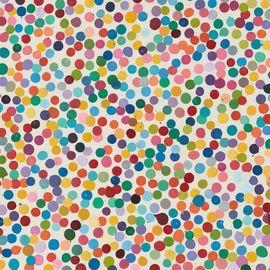
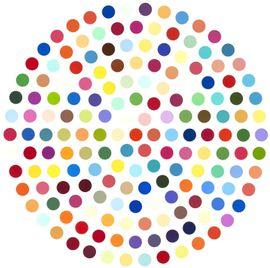
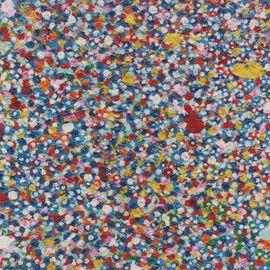
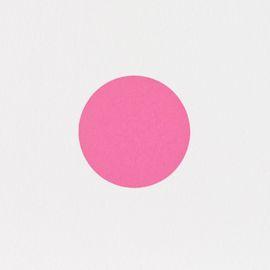
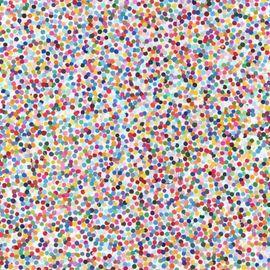
The paintings extend the 'Spot Paintings' Hirst began in 1986, in the freer form he arrived at in 2016, when he dropped the rules of the grid and let the spots drift and overlap like particles. Each is painted in enamel on handmade paper, cut by hand so that every sheet has its own irregular edge. The titles were generated by machine learning from the lyrics of songs Hirst loves.
Every painting is dated 2016. Reporting in 2024 established that at least 1,000 were in fact painted in 2018 and 2019 by teams working for Hirst's company, and his lawyers said it is his usual practice to date works by when they were conceived.
The unique prints
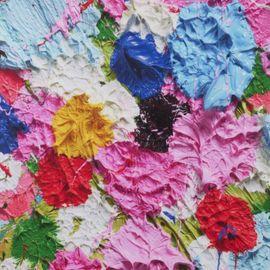
The H11 prints were released during the Newport Street exhibition. Each of the 1,000 enlarges a single detail of one painting as a giclée print, flat but made from very high-resolution images that bring out the drips and overlaps of the enamel. They sold via application, and holders of Currency NFTs could connect their wallets to improve their chances.
At auction
By May 2024 around 100 paintings had been resold at auction, all bearing the 2016 date, at prices between about £5,000 and £28,000. One made $30,642 at Sotheby's in June 2022, more than 15 times its issue price. Among the prints, 'The Currency Unique Print (H11-31)' sold for £8,255 with fees at Phillips London in October 2024.
Before and after
'The Currency' grew out of the 'Colour Space' paintings, which had already reached print as H5 - Colour Space. It opened a run of digital releases rather than a one-off detour. In 2022 H10 - The Empresses again let buyers choose between an NFT and a physical print, and in 2023 H12 - The Beautiful Paintings used generative and machine-learning software to make physical and digital works.
Does A Physical Work From The Currency Come With Its NFT?
How Do You Check A Work From The Currency Is Genuine?
How Do H11 - The Currency Unique Prints Differ From The Paintings?
Why Do Works From The Currency Have Rarity Rankings?
Damien Hirst Series