Damien Hirst|Civilisations (H17)
All Civilisations (H17) Works By Damien Hirst (4)
Significance & Analysis
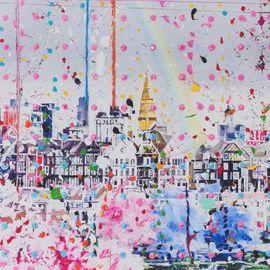
Civilisation' carries Hirst's recent landscape painting into the city, and he has framed it as a statement about the present. He wanted the cities to feel fantastical, chaotic and close to ruin, and still to leave room for optimism.
Cities on the edge
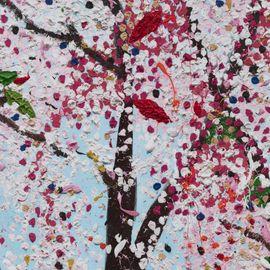
The source works are 32 'Civilisation Paintings' in oil on canvas, shown at Phillips in Berkeley Square through August 2024 in an exhibition curated by Connor Hirst (Damien's son). Each paints the memory or feeling of a city rather than a mapped place. Skylines grow out of thriving vegetation, and realistic passages share the canvas with pointillist dabs and thrown paint. Hirst has said "we must have hope, no matter how dark the world gets", and he kept the palette sweet and light as an answer to the nihilism he saw around him.
Order and accident
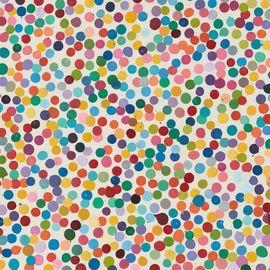
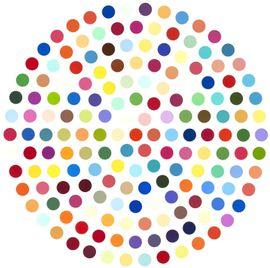
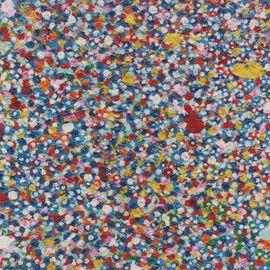
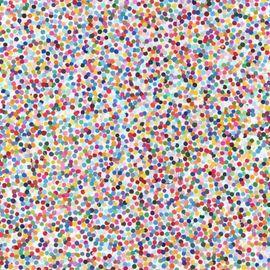
Two techniques carry the idea. Thrown paint stands for chaos: Hirst favours it because he cannot steer where it lands, true to his maxim "You just have to believe". Over it he lays grids of coloured spots, stamped with the tops of his paint tubes. They recall the Spots and stand for the engineered parts of a city, which decay at random and are replaced. In the prints all of this sits on one flat sheet of cotton rag, 132 x 101 cm, behind UV-protective acrylic, so the throw and the stamp are reproduced rather than raised.
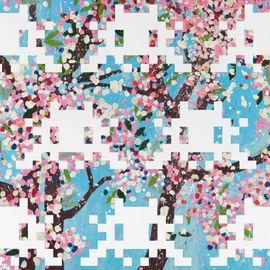
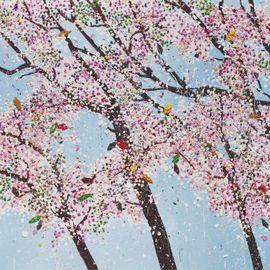
###Coast, garden, city The series extends a run that began with the seascapes of H13 - Where The Land Meets The Sea and moved inland to the gardens of H14 - The Secrets, each a recognisable scene broken up by flung paint. The city paintings openly echo those gardens. In between, H15 - Archangels had gone back to the 'Cherry Blossoms' in fixed editions of 100. 'Civilisation' kept the paper and the front signature, but let demand set the editions again during a sale window of 7 to 19 August 2024. Two months later Hirst left landscape for butterfly wings in H18 - The Kaleidoscopes.
What Do The Four H17 - Civilisation Titles Describe?
Which H17 - Civilisation Print Has The Smallest Edition?
'Civilisation Falling' (H17-2), with 459 prints. 'Civilisation Rising' (H17-1) has 530, 'Civilisation Explained' (H17-3) 531 and 'Civilisation Exploding' (H17-4) 507, a total of 2,027. Each size was fixed by the orders placed during the August 2024 sale, and numbers were allocated at random, so matching-number sets top out at 459.
Does The Frame Matter On An H17 - Civilisation Print?
How Can I Tell An H17 - Civilisation Print Is Genuine?
Damien Hirst Series