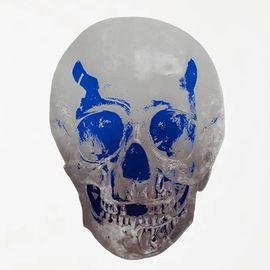
Damien Hirst|Colour Charts (H3)
All Colour Charts (H3) Works By Damien Hirst (2)
Significance & Analysis
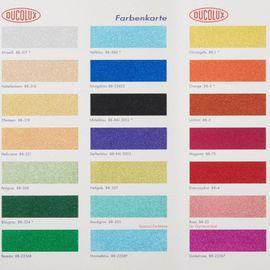
The Colour Charts take Hirst's long study of colour back to its most ordinary source. A paint chart from a DIY store, with its swatch names and stock codes, becomes the entire image.
A readymade in colour
The idea draws on Pop Art and on the readymade: a functional, everyday object lifted out of the shop and presented as art. It also extends the 'Spot Paintings', the grids of separate colours he has made since 1986. The chart keeps that grid and adds the language of commerce, so every colour arrives with a name and a number. Hirst has said works like these question what art is. The prints belong to his 'Colour Charts', a body of paintings dated to 2012, and they turn his pursuit of what he calls "the joy of colour" into something close to a catalogue.
Gloss and glitter
The two prints present the same kind of chart in different finishes. On H2, a giclée print on aluminium, a UV spot varnish gives the colours the sheen of gloss paint. H3 is a screenprint in glitter on a UV-printed, brushed aluminium panel, so its swatches sparkle as the light shifts. Both are flat panels mounted on aluminium strainers, made to hang without a frame.
At auction
The glitter version holds the stronger record. In June 2024 a 'Colour Chart (Glitter)' sold in London for £8,255 including fees, at Phillips. No print from the pair has done better in the last five years. Two years after publication, in October 2019, another glitter chart had sold for $6,250 at Phillips New York.
Before and after
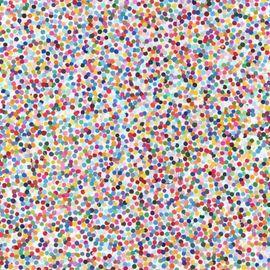
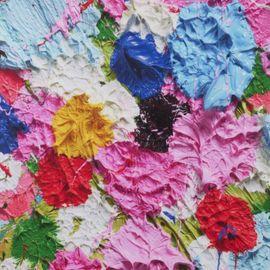
In HENI's numbered sequence the charts follow H1 - Enter The Infinite (2016), tapestries woven by machine from Hirst's spin paintings. Where H1 handed colour over to a machine and to chance, the charts fix each colour in its own labelled box. The releases that came next loosened that order: H4 - Veils spread colour through thick brushwork, and H5 - Colour Space let spots crowd and overlap without a grid.
What Is The Difference Between The H2 And H3 Colour Charts?
Where Are H3 - Colour Charts Prints Signed?
Damien Hirst Series