Damien Hirst|Enter The Infinite (H1)
All Enter The Infinite (H1) Works By Damien Hirst (12)
Significance & Analysis
'Enter The Infinite' opened Hirst's numbered HENI sequence by moving the spin painting from canvas to loom. A spinning machine had already shaped the original painting; here a loom made the finished work.
From spin to weave
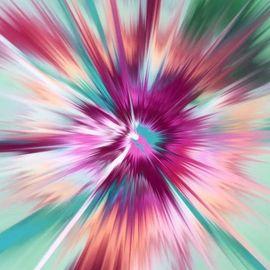
Hirst's spin paintings are made by pouring paint onto a surface as it turns, so speed and chance shape the result as much as the artist does. For the tapestries, that randomness was put through a strict geometric process. The source was a single spin painting of 2008, 'Beautiful Flailing, Falling, Grip on Reality, Pull Yourself Together Painting'. Sections of it were divided and mirrored to produce twelve compositions, each built around a still point at the centre.
The designs were then woven on a jacquard loom, which builds a pattern from coded instructions rather than by hand. Unlike a print, a tapestry has a real surface: the colour sits in interlaced thread. At 2.5 metres square, each work hangs at the scale of a large painting.
Why 'Enter The Infinite'
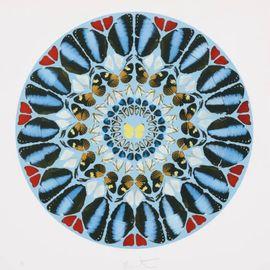
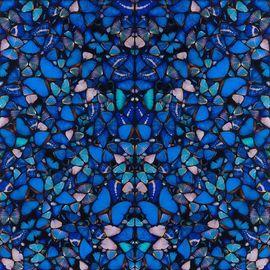
The title describes what the mirroring does to the eye. Repeated reflections suggest planes of symmetry that continue without end, and the patterns seem to pulse inwards and outwards from the centre. Several designs resolve into a cross at their heart: a thin blue cross in 'Ecstasy', a yellow, green and blue one in 'Prophecy'. The strict symmetry has been compared to a Rorschach inkblot, an image that invites viewers to project meaning onto it, which suits a series widely read as being about vision and belief.
At auction
The standout result came at Sotheby's London in October 2021, when 'Ecstasy', numbered 19/20, sold for £151,200 with fees. Later results have been lower: in October 2024 'Supernatural', numbered 20/20, sold online at Phillips London for £44,450 including fees.
Before and after
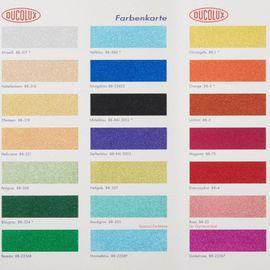
After the tapestries, the numbered releases turned to print, with a colour chart in H2 and a glitter colour chart in H3, both covered on H3 - Colour Charts. The spin returned in 2023 with H12 - The Beautiful Paintings. In H1 the image still came from a painting Hirst had made, and machines only mirrored and wove it. In H12, software generated the image itself, and collectors chose its colours and style.
Is H1 - Enter The Infinite A Print Or A Tapestry?
How Many H1 - Enter The Infinite Tapestries Were Made?
Why Do The H1 - Enter The Infinite Titles Sound Religious?
How Large Is An H1 - Enter The Infinite Tapestry?
Damien Hirst Series