Damien Hirst|Spots
All Spots Works By Damien Hirst (38)
Significance & Analysis
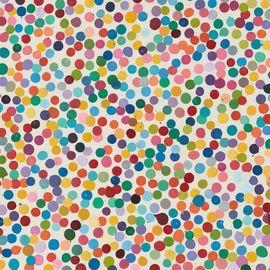
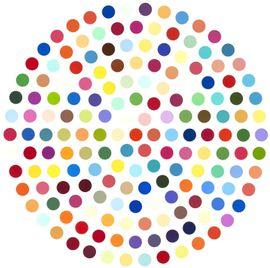
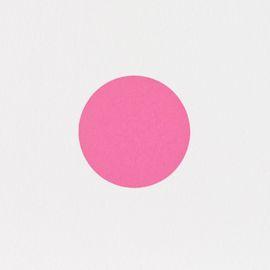
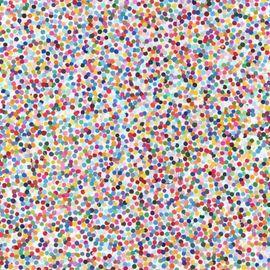
Hirst has returned to the spot in print for more than two decades, and the prints show how far one simple structure can be pushed by changing the process around it. The circles stay evenly sized and spaced; the medium, the scale, the surface and the edition size change from one work to the next.
Why spots, and why drugs
The spot began in painting. The first spot on board dates from 1986, and by 2012 the paintings filled all eleven Gagosian galleries at once in 'The Complete Spot Paintings 1986–2011', a single exhibition of more than 300 works. Hirst has called the format "a way of pinning down the joy of colour", but he also built it as a system: in his words, "a scientific approach to painting in a similar way to the drug companies' scientific approach to life".
That is where the repetition and the drug names meet. Identical circles in strict rows are often likened to pills and to the order of a laboratory, and the titles complete the analogy: the largest group of the paintings is 'The Pharmaceutical Paintings', each named after a compound. Hirst has said that art, like medicine, "can heal", and that he was struck by how many people trust one and not the other. The cheerful surface and the clinical name are usually read together, as a comment on that faith and on the mortality that medicine can only postpone.
One motif, many processes
The earliest editions are photographic. In 2000, the online gallery Eyestorm issued 'Valium', 'Lysergic Acid Diethylamide (LSD)' and 'Opium' as lambda prints on Fujicolor paper; 'Valium' sets its spots in a disc 122 cm across.
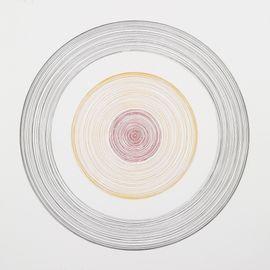
Etching followed. 'Cinchonidine' belongs to a set of three round spot etchings published by Paragon Press in 2004, and 'Diacetoxyscirpenol' of 2005 stretches the format to about two metres wide.
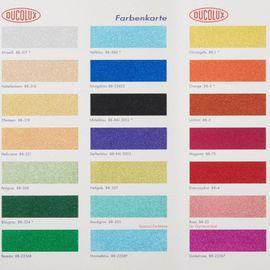
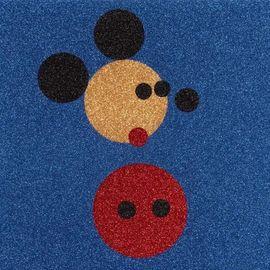
From 2007 Other Criteria issued the spots as screenprints, often with a reflective ground: bronze glitter for 'Proctolin', metallic silver for 'Histidyl' and gold glitter for 'Untitled Gold Gift Spot'. In 2011 'Controlled Substances' added glaze and debossing and set letters and numbers between the circles, turning the grid into a key, as if to a cabinet of restricted drugs. Woodcut came later still.
At auction
Of the three Eyestorm prints, 'Lysergic Acid Diethylamide (LSD)' has the smallest edition, 300 against 500 for 'Valium' and 'Opium', and it has drawn the strongest recent results. An impression made $27,940 with buyer's premium at Sotheby's New York in October 2025.
Before and after
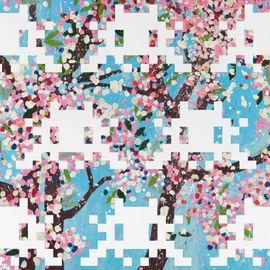
For more than a decade the prints on paper kept the circles evenly sized and spaced. Hirst's next step was to let that rule go. In H5 - Colour Space, issued in 2018, the circles vary and can touch or overlap, printed as giclées on aluminium rather than on paper. With Currency in 2021 the spots returned to paper as 10,000 unique paintings, each tied to a token. Woodcut had meanwhile become a body of work of its own in 40 Woodcut Spots.
Why Are Hirst's Spot Prints Named After Drugs?
Why Does Hirst Repeat The Same Spots?
Are All Of Hirst's Spot Prints Screenprints?
What Does Gift Mean In Untitled Gold Gift Spot?
Which Spot Prints Have The Smallest Editions?
Damien Hirst Series