Damien Hirst|Veils (H4)
All Veils (H4) Works By Damien Hirst (8)
Significance & Analysis
'H4 - Veils' carried Hirst's return to the brush into print. After the sculptural spectacle of 'Treasures from the Wreck of the Unbelievable' in Venice in 2017, he went back to painting in the studio, and the 'Veil Paintings' were the result.
The paintings behind the prints
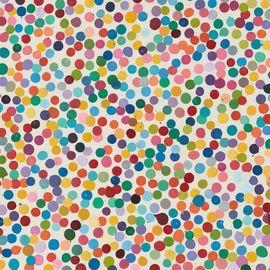
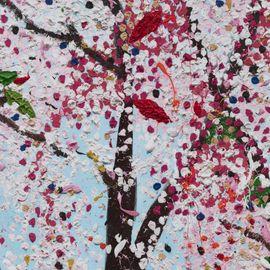
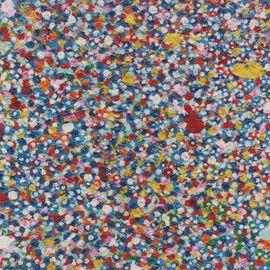
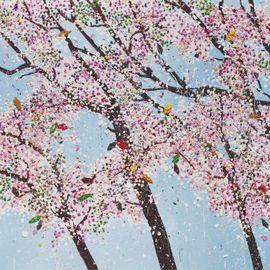
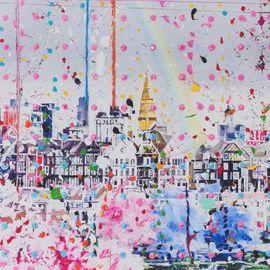
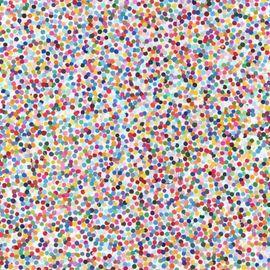
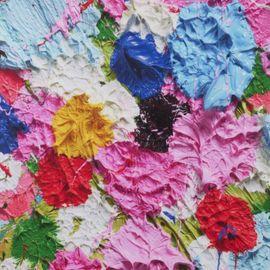
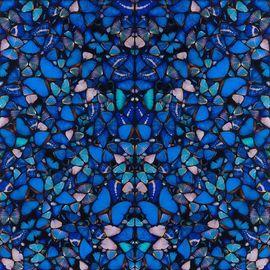
The canvases, dated 2017, were first shown at Gagosian in Beverly Hills from March to April 2018. They grew out of the 'Visual Candy' paintings Hirst made in the mid-1990s, layering short brushstrokes and heavy dabs of paint across the whole surface, with clear debts to Seurat's Pointillism and to Bonnard. Hirst called the palette "sweet shop colours and the colours of fruit and flowers". He described a veil as a barrier you can look at and pass through, solid yet invisible.
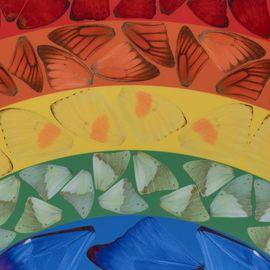
Each print is a close-up of a painting rather than the whole canvas. High-resolution photography records the ridges and splashes of the impasto, and the Diasec face-mount keeps that detail sharp, though the panel itself is flat.
Two releases
The first four prints, 'Sans Souci', 'Andromeda', 'Garden of Dreams' and 'Cannizaro', came out in 2018. HENI added 'Nong Nooch', 'Kew', 'Ryoanji' and 'Keukenhof' in November 2020, sold by application through HENI Leviathan. From that second release, $100,000 went to the Fondation Beyeler in Basel and another $100,000 to the Serpentine in London.
Results
The two halves trade well as groups of four. At a Phillips London online sale of Hirst's work in October 2024, H4-1 to H4-4 made £27,940 with fees and H4-5 to H4-8 made £22,860. In the same sale 'Sans Souci' sold on its own for £7,620.
Before and after
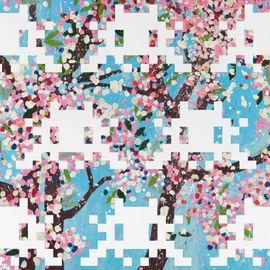
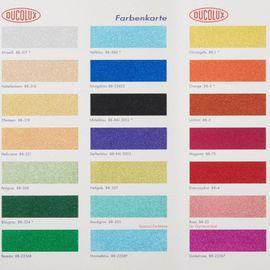
In HENI's numbered sequence the Veils sit between H3 - Colour Charts and H5 - Colour Space. All three come from Hirst's paintings about colour, and the Veils are the loosest of them: elsewhere his colours stay in charts or discrete spots, while here they dissolve into brushwork. Hirst did not leave that heavy paint behind. It returned in the 'Cherry Blossoms' of 2018 to 2020, the paintings first issued as prints in H8 - Fruitful And Forever.
Why Are Some H4 - Veils Prints Dated 2018 And Others 2020?
Where Is The Signature On An H4 - Veils Print?
Can You Buy H4 - Veils As A Set?
What Are The H4 - Veils Titles Named After?
Damien Hirst Series