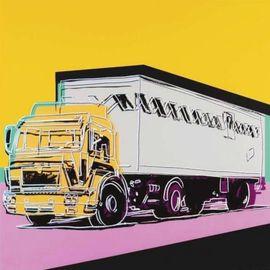
Andy Warhol|Ads (1985)
All Ads (1985) Works By Andy Warhol (6)
Significance & Analysis
'Ads' is Warhol's late return to the material he started with. He began his career as a commercial illustrator, and in 1985, two years before his death, he took ten existing advertisements, logos and publicity images and remade them as prints.
What Warhol chose
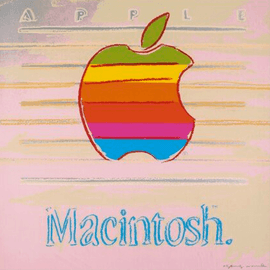
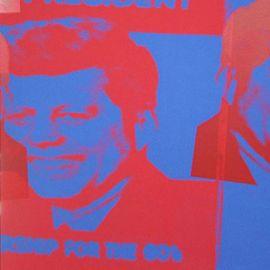
The title is literal: every image was already selling something before Warhol touched it. Corporate marks for Mobilgas, Paramount, Life Savers, Chanel, Volkswagen and Apple sit beside three actors. James Dean comes from the poster for 'Rebel Without a Cause', Judy Garland from a Blackglama mink campaign, and Ronald Reagan from a Van Heusen shirt advertisement of his Hollywood years. By 1985 Reagan was president, so the print presents a sitting head of state as a collar model.
The set spans half a century of branding. At one end is a Mobilgas sign from the 1930s; at the other, the Apple logo, barely a year after the Macintosh went on sale. Warhol flattened them all into the same saturated colour, with no hierarchy between a perfume, a cartoon duck and a film star.
At auction
Complete sets now trade at close to $3 million. Sotheby's New York achieved $2,978,000 including premium for an artist's proof set in November 2025, and $2,926,000 for a numbered set from the main edition in May 2026. Among single prints the trial proofs lead: there are 30 for each image, every one a unique colour variant, and a 'Mobilgas' trial proof realised £120,650 in London at Phillips in September 2024.
Before and after
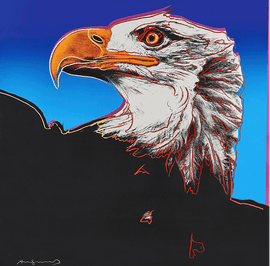
'Ads' followed Endangered Species (1983), issued by the same New York gallery in the same square format on the same board. Its cartoon character looks back to Myths (1981), where Mickey Mouse had appeared among America's invented heroes. The next portfolio, Cowboys and Indians (1986), moved from the language of selling to the legends of the American West.
Where Is Each Ads Print Signed?
How Are The Ads Prints Numbered In The Catalogue Raisonné?
Why Did Warhol Include Donald Duck In Ads?
Is The Van Heusen Print Really Ronald Reagan?
Andy Warhol Series