Andy Warhol|Shadows I and II
All Shadows I and II Works By Andy Warhol (2)
Significance & Analysis
Both portfolios bring one of Warhol's rare abstract subjects, the shadow paintings of 1978–79, onto paper.
What the prints show
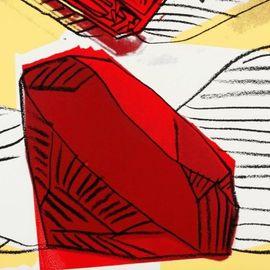
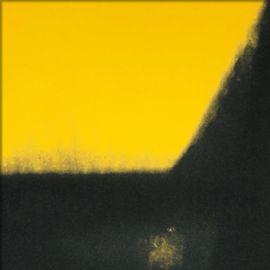
Each sheet shows an enlarged shadow with no recognisable object behind it. Ronnie Cutrone, who assisted Warhol at the time, recalled that the shadows were cast from cardboard maquettes at the Factory, though the source of the images has been debated. When the paintings were first shown in 1979, one critic guessed at a water faucet or a golf cart, and another saw a pilot light and bunny rabbits. Warhol himself called the series "disco décor".
How the prints were made
Rupert Jasen Smith printed both portfolios in New York. Diamond dust, a glittering powder of crushed glass, lies over the screenprinted ink, so matt areas of colour sit beside areas that catch the light.
The paintings behind the prints
The paintings came first: 102 canvases of equal size, hung edge to edge. Heiner Friedrich, a co-founder of the Dia Art Foundation, showed them at his New York gallery from January to March 1979. On each canvas the shadow was screenprinted over colour applied with a sponge mop or brush. Dia commissioned the paintings and acquired them in 1979. Diamond dust appears on at least one painting of the subject, 'Shadow (Diamond Dust)' in the Baltimore Museum of Art.
Where the series sits in Warhol's work
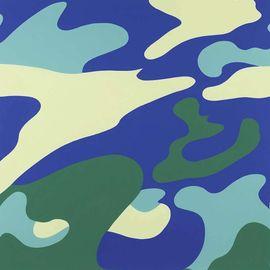
'Shadows' belongs with the abstract series Warhol made between 1977 and 1986, among them 'Oxidation', 'Rorschach' and 'Camouflage'. In 1979 he also issued three further portfolios, 'Shadows III', 'Shadows IV' and 'Shadows V'. Diamond dust reappeared in 1980, on 'Diamond Dust Shoes' and on two of his 'Joseph Beuys' portraits.
What Are The Edition Sizes Of Shadows I And Shadows II?
How Are The Shadows Prints Signed And Marked?
Do The Sheets In A Complete Set Match In Colour?
Andy Warhol Series