Andy Warhol|Alexander the Great (1982)
All Alexander the Great (1982) Works By Andy Warhol (2)
Significance & Analysis
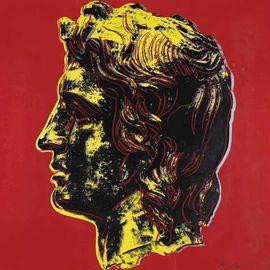
'Alexander The Great' turns the most recognisable face of the ancient world into a Warhol celebrity portrait, and it is an early step in his 1980s turn from modern fame to art history. Alexander made sure his likeness was copied across his empire, so the heavy brow and lion's mane of hair were familiar for more than two thousand years. For Warhol, that made him a celebrity like any other.
The exhibition
The prints were issued in cooperation with the Hellenic Heritage Foundation to coincide with 'The Search for Alexander' at the Metropolitan Museum of Art, from October 1982 to January 1983. The exhibition had toured America since 1980, built around recent finds from the royal Macedonian tombs at Vergina. Its portraits of Alexander in marble and bronze gave Warhol a subject that was already public property.
How the image works
Warhol reduced the bronze to flat planes of colour held together by drawn outlines, so the face reads as both sculpture and graphic. The two prints in the edition use the same head against different grounds, one purple and one red. Printing was by Rupert Jasen Smith, on the large square board used for many of Warhol's commissions of the early 1980s.
At auction
Proofs have set the highest prices. An artist's proof reached €189,000 with premium in Paris in March 2022, in a Sotheby's sale devoted to Iolas and his artists, and a unique trial proof brought £139,700 in a Phillips editions sale in London in September 2024.
Before and after
Iolas had given Warhol his first gallery show in 1952 and would stage his last. After 'Alexander The Great' Warhol went further into the old masters, cropping Botticelli and Leonardo in Details of Renaissance Paintings (1984). Iolas then commissioned the Last Supper series after Leonardo, shown in Milan in January 1987, a month before Warhol's death.
Why Did Alexander Iolas Commission Alexander The Great?
How Many Alexander The Great Prints Were Made?
Are There Trial Proofs Of Alexander The Great?
Andy Warhol Series