Andy Warhol|Cow Wallpaper
All Cow Wallpaper Works By Andy Warhol (4)
Significance & Analysis
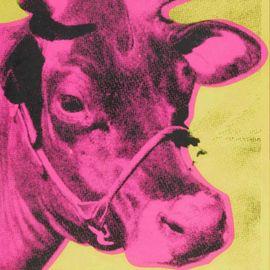
'Cow' is the work that turned Warhol's gallery walls into the exhibit. In 1966, while he was publicly announcing his retirement from painting, he papered one room of his Leo Castelli Gallery show in New York with the cow's head and filled the other with floating helium balloons, the 'Silver Clouds'.
Why a cow
The idea came from Ivan Karp, the dealer at Leo Castelli Gallery who had taken an early interest in Warhol's work. He urged Warhol to paint cows because they were "so wonderfully pastoral and such a durable image in the history of the arts", as Warhol later recalled. Warhol answered with a bright pink head on a bright yellow ground, made to be printed by the roll. Karp's verdict, in Warhol's telling, was that it was "super-pastoral" and "ridiculous".
The wallpaper is often read as a joke about how art is collected and displayed. Cows are a staple of the rural genre painting people hang at home; here the subject became the decoration itself, repeated wall to wall.
Four colourways
The pink-on-yellow paper of 1966 (II.11) was published by Warhol himself for the Castelli exhibition. In 1971 he reissued the cow in new colours, an orange-brown cow on lilac (II.11A) and a yellow cow on blue (II.12), for his retrospective at the Whitney Museum of American Art, where at his request the walls were papered with cows behind the paintings. A fourth version, a pink cow on purple (II.12A), followed in 1976. The three later colourways were published by Factory Additions, the print company Warhol had set up in 1967.
At auction
Because each colourway was printed without limit, signed impressions are the scarcer ones and set the prices. Signed sheets of the 1976 colourway have done best recently: one reached $69,850 with fees at Phillips in New York in April 2023, the top single-sheet result of the past five years. Hand-signed sets of all four colourways are rarer still; one fetched $94,500 with fees at the same house two years earlier.
The wallpaper's original purpose produced the series' most striking result. In April 2016 six lengths of the 1966 paper mounted on canvas, from the collection of Bill Leonard, director of the Contemporary Arts Center in Cincinnati when it staged Warhol's 'Holy Cow! Silver Clouds! Holy Cow!' that year, sold for $100,000 at Phillips New York.
Are Warhol's Cow Prints Signed?
Where Did The Cow Image Come From?
What Is A Complete Set Of Cow?
Was Cow Made As Wallpaper Or As Prints?
Andy Warhol Series