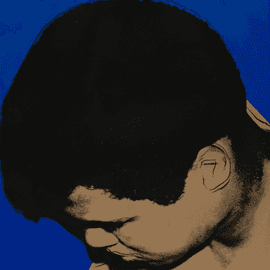
Andy Warhol|Muhammad Ali (1978)
All Muhammad Ali (1978) Works By Andy Warhol (3)
Significance & Analysis
The series grew out of a commission for paintings: Ali was one of ten athletes Warhol was hired to portray in 1977.
The visit to Fighter's Heaven
The investment banker Richard Weisman had commissioned the portraits earlier that year, choosing athletes who included Pelé, O.J. Simpson and Kareem Abdul-Jabbar. Between March and November Warhol travelled to photograph each of them. In August he reached Ali's camp at Deer Lake with Weisman, Warhol's business manager Fred Hughes and the writer Victor Bockris, shortly before Ali's fight against Earnie Shavers. Ali talked through the first rolls of film, and when he heard what the portraits would sell for he spoke at length about race and his own rise. Warhol, still without a usable picture, asked: "Could we do some where you're not…er, talking?" Ali apologised, smiled and went through a run of classic boxing poses, which gave Warhol the photographs he needed. Warhol later said of the commission: "I really got to love the athletes because they are the really big stars."
How the prints were made
Rupert Jasen Smith printed the series in New York on portrait sheets of Strathmore Bristol paper, 101.6 x 76.2 cm. The Polaroid poses, with their clenched fists and fixed stare, are printed in strong, bright colour.
Where the series sits in Warhol's work
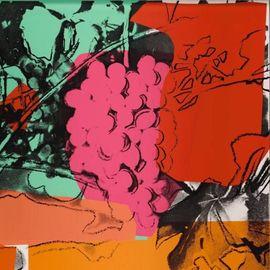
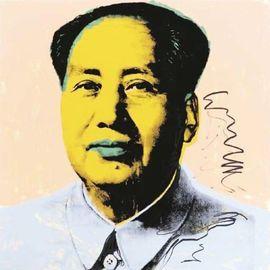
Like 'Mick Jagger' (1975), the series takes each sheet from a different photograph Warhol had shot himself, where 'Mao' (1972) repeats one official portrait across ten sheets. It is also one of several late-1970s series Warhol published through his own company and had printed by Smith on Strathmore Bristol, from 'Hammer and Sickle' (1977) to 'Grapes' (1979).
Auction results
In September 2025 the set numbered 41/150 sold for £154,800 with fees at Phillips in London. In October 2021 a single II.182 sold for $113,400 with fees at Phillips in New York, and in October 2023 an impression of II.179 made $165,100 with fees there. Much earlier, in July 2001, a set from Warhol's estate had sold for £29,000 at Bonhams & Brooks in London.
What Are The Edition Details For Muhammad Ali?
How Are The Muhammad Ali Prints Signed?
Did Muhammad Ali Sign Any Of The Prints?
Andy Warhol Series