Andy Warhol|Moonwalk (1987)
All Moonwalk (1987) Works By Andy Warhol (2)
Significance & Analysis
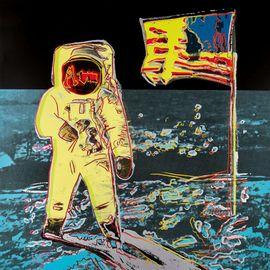
'Moonwalk' is the only image Warhol completed for 'TV', a portfolio he planned around moments that Americans had watched on television. When he died in February 1987, the moon landing of July 1969 was the only subject of the portfolio that had been printed.
The TV portfolio
The subjects planned for 'TV' ran from Martin Luther King Jr.'s "I Have a Dream" speech of August 1963 to Ed Sullivan introducing the Beatles in February 1964, with episodes of 'I Love Lucy' and 'The Honeymooners' among them. Warhol had appeared on television himself, as a guest star on 'The Love Boat' in October 1985.
What the prints show
Warhol recoloured the scene of Aldrin and the flag in neon tones and traced it with fluorescent outlines. 'Moonwalk (F. & S. II.404)' is the yellow version and 'Moonwalk (F. & S. II.405)' the pink. His initials, AW, appear across Aldrin's visor. Rupert Jasen Smith screenprinted both images on Lenox Museum Board, printing the image to the edges of each square sheet.
Where the series sits in Warhol's work
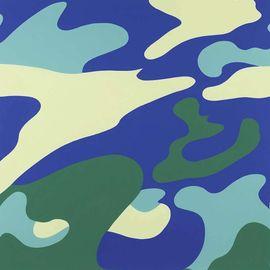
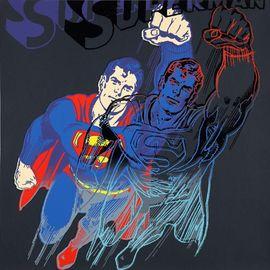
Ronald Feldman Fine Arts had published earlier portfolios of American popular imagery by Warhol, printed by Smith on the same square board. 'Myths' (1981) gathered characters from film, television and comics, among them Superman and Howdy Doody. 'Ads' (1985) turned to advertisements and logos. In the same final months Warhol moved the other way in 'Camouflage' (1987), whose pattern removes the recognisable subject altogether.
Auction results
In October 2024 a complete set of the two prints made $762,000 with fees at Phillips in New York, a record for the pair when it sold. Six months earlier, in April 2024, 'Moonwalk (F. & S. II.405)' numbered 156/160 sold there for $463,550 with fees. In October 2025 two trial proofs, each in colours of its own, made $516,000 and $412,800 with fees at Phillips New York. A decade earlier, in April 2015, Phillips New York had sold another trial proof for $185,000.
What Does The Moonwalk Suite Include?
Why Do Moonwalk Prints Carry Three Signatures On The Back?
How Do The Moonwalk Trial Proofs Differ From The Edition?
Is Moonwalk Taken From The Television Broadcast?
Andy Warhol Series