Damien Hirst|The Empresses (H10)
All The Empresses (H10) Works By Damien Hirst (6)
Significance & Analysis
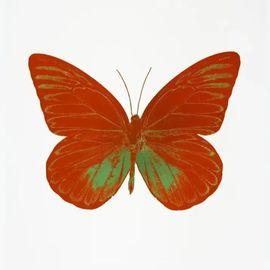
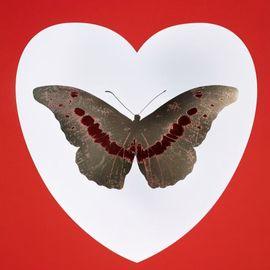
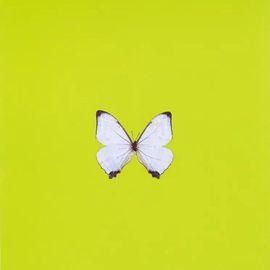
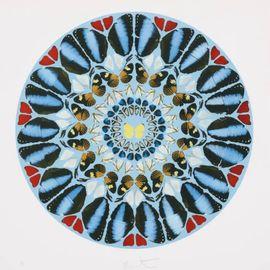
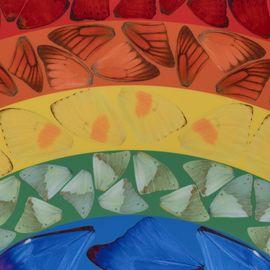
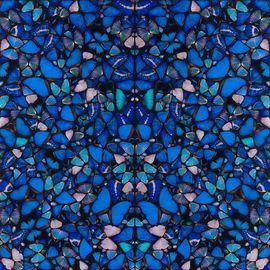
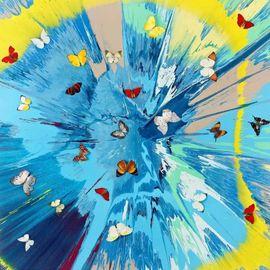
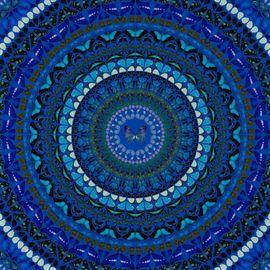
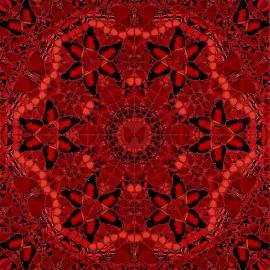
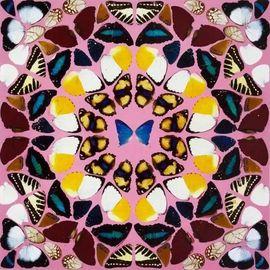
'The Empresses' brought Hirst's butterflies back into HENI's numbered prints and changed how a print could be owned. It was the first release sold with the option of an NFT Deed, a token that stood in for the physical print until the owner claimed it. Why 'Empresses' The title works two ways. It names five women who held power in very different empires, and it puns on the empress butterfly. Hirst has long used the butterfly to stand for freedom, religion, life and death. Here he connects it to glory, to female power and to the founding of nations. Red dominates all five prints, with black wingtips breaking the pattern. From Kaleidoscope to tea tray The compositions grow out of the 'Kaleidoscope' paintings Hirst began in 2001, which set real wings into geometric patterns. A chance encounter in the studio and the intricate designs of Victorian tea trays led him to new arrangements: some symmetrical, some asymmetrical, some spiralling, as in 'Taytu Betul'. No actual butterflies are used. The wings are printed in fine detail on aluminium, and glitter screenprinted on top traces the patterns, catching the light as the viewer moves while the panel itself stays flat. Print or token HENI sold the series for one week, from 28 January to 4 February 2022, and demand set each edition. Buyers chose between the print and the NFT Deed, which could be traded and redeemed for the print from August 2022 until 5 February 2025. Deeds outnumbered prints in four of the five editions; only 'Suiko' sold slightly more physical copies. At auction The highest result for a complete set came in September 2022, when one sold at Tate Ward Auctions in London for £37,500, fees included. Sets have since sold for less: £10,160 with fees at Phillips London in November 2023, and £8,890 at Phillips London in June 2024. Before and after Butterflies had already reached the HENI prints in 'H6 - The Aspects' (2019) and H6 - The Elements (2020). Cherry blossoms followed, ending with H9 - The Virtues in 2021. 'The Empresses' then returned to wings in H9's laminated aluminium format and added glitter. The next step pushed collector choice further: in H12 - The Beautiful Paintings (2023), buyers chose the image itself as well as whether to own it as an object, a token or both.
Who Were The Five Rulers Behind H10 - The Empresses?
How Large Are The H10 - The Empresses Editions?
Do H10 - The Empresses Sets Carry Matching Numbers?
Can An H10 - The Empresses NFT Deed Still Be Redeemed?
Damien Hirst Series