Damien Hirst|Utopia
All Utopia Works By Damien Hirst (9)
Significance & Analysis
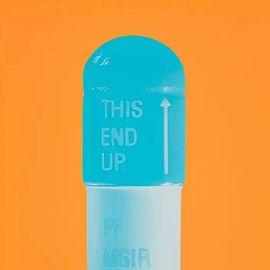
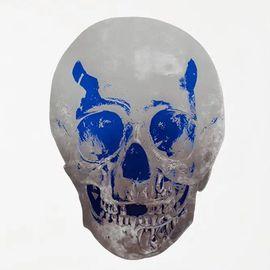
'Utopia' brings Hirst's cabinets into print and lets their contents argue with one another. The glass-fronted cabinet is one of his longest-running sculptural forms. Here its shelves are printed flat, and what sits on them changes from sheet to sheet: hope in one, doubt or decay in the next. Pills, diamonds and cigarettes The title print lines silver shelves with pills in every colour. In 'Gold Tears' and 'Silver Tears' the shelves hold rows of cut diamonds on gold and silver foil instead. 'Hell' replaces both with stubbed-out cigarette ends and a single Cuban cigar. Medicine sits in Hirst's work beside love, art and religion as one of the belief systems people use to hold off death, and these prints display its products the way a jeweller displays stock, as luxuries on gleaming shelves. Inkjet meets foil The series joins two processes. Each cabinet is printed in inkjet on heavy Hahnemühle photo rag paper and glazed for depth. The shelves are then foil blocked, so the metal of the cabinet is rendered in reflective foil that catches the light, while the pills and stones stay printed images on the flat sheet. At auction 'Black Utopia' holds the strongest result of recent years: in December 2022 it sold for £5,985 with fees at Koller in Zurich. Two months earlier the title print, 'Utopia', made the equivalent of £5,000 with fees at Sotheby's New York. Before and after Foil block had stood on its own in The Dead (2009), the skulls Hirst printed entirely in foil, and in the butterflies that followed. 'Utopia' lays the same technique over a printed image and turns from emblems of death to the remedies set against it. Two years later, The Cure (2014) left the cabinet behind and printed a single capsule, many times its real size, on each sheet.
Why Are The Pills Black In Black Utopia?
Which Utopia Prints Have Diamond Dust?
How Large Are The Utopia Prints?
Is Day By Day A Print?
Damien Hirst Series